
New vs old tax regime in brief: Since the new tax regime became the default in 2023, most salaried Indians never actively choose.
Since the new tax regime became the default in 2023, most salaried Indians never actively choose. They just get opted in automatically unless they file for the old regime instead. Here’s what changes between the two, and how to tell in under a minute which one actually saves you more.
Since its introduction in Budget 2020 and revamped in Budget 2023, the new tax regime has become the default for salaried employees in India. But “default” doesn’t mean “better for everyone.” Whether you should stick with the new regime or opt back into the old one depends entirely on how much you invest and claim in deductions. Here’s how to decide.
New Tax Regime: Lower Rates, No Deductions
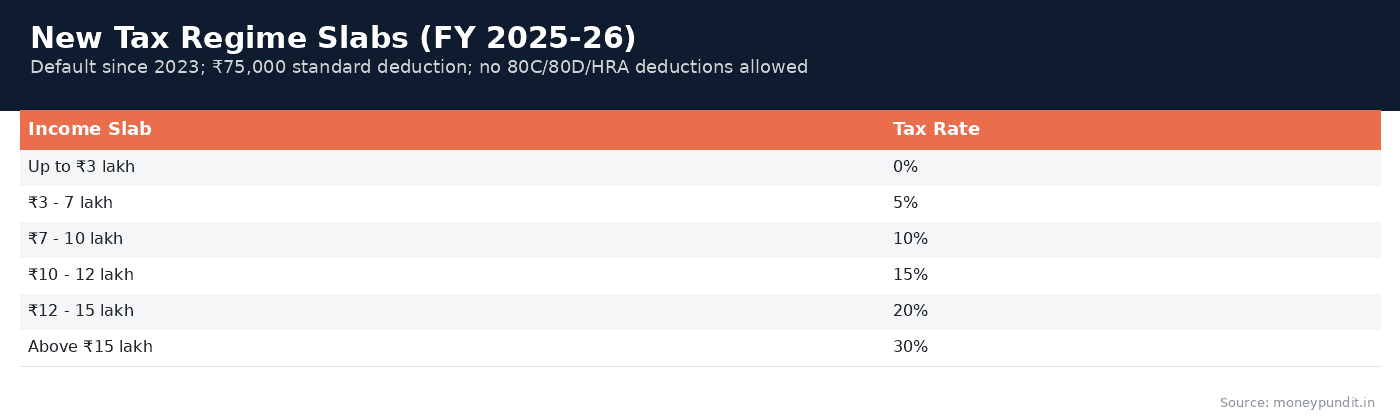
The new regime (FY 2025-26) offers lower tax rates across all slabs: 0% up to ₹3 lakh, 5% from ₹3–7 lakh, 10% from ₹7–10 lakh, 15% from ₹10–12 lakh, 20% from ₹12–15 lakh, and 30% above ₹15 lakh. It also includes a standard deduction of ₹75,000 for salaried employees and the basic exemption limit effectively becomes ₹7 lakh (with rebate u/s 87A).
The trade-off: you cannot claim deductions under 80C, 80D, HRA, LTA, home loan interest (Section 24), or most other exemptions.
Old Tax Regime: Higher Rates, Generous Deductions
The old regime has higher rates but allows you to reduce your taxable income significantly through deductions: ₹1.5 lakh under 80C, ₹50,000 under 80CCD(1B) for NPS, ₹25,000–₹50,000 under 80D for health insurance premiums, HRA exemption (for those paying rent), home loan interest deduction up to ₹2 lakh under Section 24, and ₹50,000 standard deduction.
The Break-Even Calculation
The regime that saves you more tax depends on your total deductions. As a rough guideline: if your total deductions (80C + 80D + HRA + home loan interest + NPS + others) exceed ₹3.75 lakh for someone earning ₹15 lakh, the old regime likely saves more tax. Below that threshold, the new regime is generally better.
For income of ₹10 lakh: if you can claim more than ~₹2.5 lakh in deductions, the old regime wins. For ₹20 lakh income: if you can claim more than ~₹4.5 lakh in deductions, old regime wins.
Who Should Pick Which
New Regime is better for: Young earners with few deductions, those without home loans or HRA claims, people in lower income brackets, and those who simply want simplicity and less paperwork.
Old Regime is better for: Those maximizing 80C + NPS, people paying significant rent with HRA claims, home loan borrowers claiming the ₹2 lakh interest deduction, and those paying health insurance for parents (80D).
Do the Math Every Year
You can switch between regimes every year (as a salaried employee). Use one of the many online tax calculators to compute your tax liability under both regimes with your actual projected deductions, and pick the one that saves more. Don’t default blindly.
Key Differences Between New and Old Tax Regime
The fundamental difference is straightforward: the old tax regime offers higher tax rates but allows you to claim over 70 deductions and exemptions, while the new regime offers significantly lower tax rates but removes most deductions. Under the new regime (effective FY 2025-26), the tax slabs start at 0% up to ₹4 lakh, 5% from ₹4-8 lakh, 10% from ₹8-12 lakh, 15% from ₹12-16 lakh, 20% from ₹16-20 lakh, 25% from ₹20-24 lakh, and 30% above ₹24 lakh. The standard deduction of ₹75,000 is available in both regimes.
The old regime retains deductions under Section 80C (₹1.5 lakh for PPF, ELSS, life insurance), Section 80D (health insurance premiums up to ₹1 lakh for senior citizens), HRA exemption (significant for those paying high rent in metros), home loan interest under Section 24(b) (up to ₹2 lakh), and NPS employer contribution under Section 80CCD(1B) (additional ₹50,000). Use our Tax Calculator to compare your exact liability under both regimes.
When the Old Regime Makes More Sense
The old tax regime is typically better if your total deductions and exemptions exceed ₹3.75 lakh to ₹4.5 lakh (depending on your income slab). This commonly happens when you’re claiming HRA exemption (₹1-₹3 lakh for metro tenants), Section 80C investments (₹1.5 lakh), health insurance premiums (₹25,000-₹1 lakh), home loan interest (up to ₹2 lakh), and NPS contribution (₹50,000).
Salaried employees living in rented accommodation in Mumbai, Delhi, or Bangalore, where rents are high, often find the old regime more beneficial because HRA alone can exempt ₹2-₹4 lakh of income. Similarly, homeowners with an active home loan in the early years (when interest component is highest) benefit from the ₹2 lakh Section 24(b) deduction that’s unavailable in the new regime.
When to Choose the New Regime
The new regime works better for those with fewer deductions: typically young professionals living with parents (no HRA claim), those without home loans, or individuals who don’t invest the full ₹1.5 lakh under 80C. The substantially lower tax rates in the new regime mean that even without any deductions, your tax outgo can be lower.
For income up to ₹12 lakh, the new regime effectively results in zero tax after the ₹75,000 standard deduction and rebate under Section 87A, making it the clear winner for most people in this income bracket. The new regime is also the default option; you don’t need to do anything special to opt for it. If you want the old regime, you must specifically opt in while filing your return. Salaried employees can switch between regimes every year, giving you flexibility to choose the better option annually based on your actual investments and expenses. Use our Take Home Salary Calculator to see the impact on your monthly pay.
Frequently Asked Questions
Which tax regime is better, old or new?
If you claim large deductions such as HRA, home loan interest and Section 80C, the old regime may save more. Otherwise the new regime, with its lower slab rates, is usually simpler and cheaper. Compare both for your numbers.
Can I switch between regimes every year?
Salaried individuals can choose each year when filing. Business income earners have restrictions on switching back, so check the rules before moving.
Is the new regime the default?
Yes, the new regime applies by default unless you opt for the old regime, so tell your employer or choose it while filing your return.
New vs old tax regime: Key Takeaways
Key points on new vs old tax regime:
- The trade-off: you cannot claim deductions under 80C, 80D, HRA, LTA, home loan interest (Section 24), or most other exemptions.
- The regime that saves you more tax depends on your total deductions.
- New Regime is better for: Young earners with few deductions, those without home loans or HRA claims, people in lower income brackets, and those who simply want simplicity and less paperwork.
Verify the latest new vs old tax regime figures with Income Tax Department before you act.