
Section 80D of the Income Tax Act allows taxpayers to claim deductions for health insurance premiums paid for themselves, their family, and parents. This deduction is available over and above the ₹1.5 lakh limit under Section 80C, making it one of the most valuable additional tax-saving provisions. For the financial year 2026-27, the maximum deduction under Section 80D can go up to ₹1 lakh in specific cases.
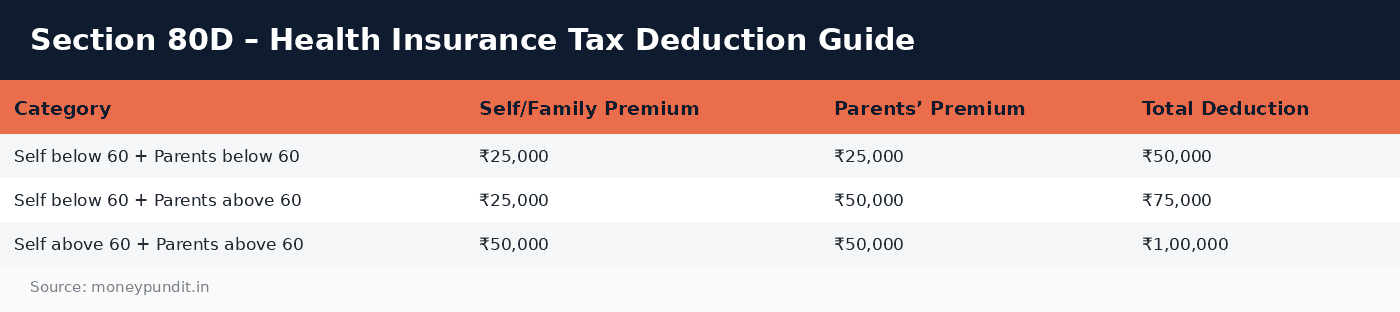
Section 80D Deduction Limits
| Category | Self/Family Premium | Parents’ Premium | Total Deduction |
|---|---|---|---|
| Self below 60 + Parents below 60 | ₹25,000 | ₹25,000 | ₹50,000 |
| Self below 60 + Parents above 60 | ₹25,000 | ₹50,000 | ₹75,000 |
| Self above 60 + Parents above 60 | ₹50,000 | ₹50,000 | ₹1,00,000 |
The “self and family” component covers health insurance premiums for yourself, your spouse, and dependent children. The “parents” component covers premiums paid for your parents, whether they are dependent on you or not.
What Qualifies Under Section 80D?
Health Insurance Premiums
Premiums paid for mediclaim or health insurance policies from any IRDA-registered insurance company qualify for deduction. This includes individual health plans, family floater plans, and top-up or super top-up health plans. The premium must be paid through non-cash modes, cheque, bank transfer, UPI, or card payment. Cash payments for insurance premiums are not eligible for 80D deduction.
Preventive Health Check-up
An additional deduction of ₹5,000 is available for preventive health check-up expenses. However, this ₹5,000 is not over and above the ₹25,000 or ₹50,000 limit. It is included within the overall limit. The benefit is that preventive health check-up expenses can be paid in cash and still qualify for the deduction, unlike insurance premiums.
Medical Expenses for Senior Citizens Without Insurance
If your parents are senior citizens (aged 60 or above) and do not have health insurance, you can still claim a deduction up to ₹50,000 for medical expenses incurred on their behalf. This is particularly useful since many senior citizens find it difficult to get comprehensive health insurance at affordable premiums due to age-related loading and pre-existing condition clauses.
80D Under Old vs New Tax Regime
Section 80D deduction is available only under the old tax regime. Taxpayers who opt for the new tax regime cannot claim this deduction. This is an important consideration when choosing between the two regimes. If you pay significant health insurance premiums (especially for senior citizen parents), the 80D deduction combined with 80C and other deductions could make the old regime more beneficial despite higher tax rates.
How to Maximise Your 80D Benefits
Buy a Separate Policy for Parents
Many taxpayers add parents to their family floater plan, but this has two disadvantages. First, the combined premium is higher because parent’s age increases the risk pool. Second, you can only claim up to ₹25,000 for the entire family floater. By buying a separate policy for parents, you unlock an additional ₹25,000 or ₹50,000 deduction slot, potentially saving ₹7,500 to ₹15,000 in taxes annually.
Include Preventive Health Check-ups
If your insurance premium is slightly below the ₹25,000 limit, use the remaining amount for preventive health check-ups. Annual health screenings cost ₹2,000-₹5,000 at most hospitals and diagnostic centres. This utilises the full 80D limit while keeping you informed about your health status.
Pay Multi-Year Premiums Strategically
Some insurers offer discounts for paying premiums for 2-3 years upfront. While this saves on premium costs, you can only claim the deduction proportionately for each year. A premium of ₹60,000 paid for 3 years allows ₹20,000 deduction each year, not ₹60,000 in the first year. Plan accordingly to ensure you maximise the annual deduction limit.
Practical Examples
Example 1: Young Professional, Age 28
Rahul (28) pays ₹15,000 for his family floater covering himself and wife, and ₹18,000 for his parents’ health plan (parents aged 55 and 52). He also spends ₹3,000 on an annual health check-up. His total 80D deduction: ₹15,000 + ₹3,000 (self/family, within ₹25,000 limit) + ₹18,000 (parents, within ₹25,000 limit) = ₹36,000. Tax savings in the 30% bracket: ₹10,800.
Example 2: Middle-Aged Professional, Age 45
Priya (45) pays ₹22,000 for her family floater and ₹42,000 for her parents’ policy (parents aged 72 and 68). Her total 80D deduction: ₹22,000 (self/family, within ₹25,000 limit) + ₹42,000 (parents, within ₹50,000 senior citizen limit) = ₹64,000. Tax savings in the 30% bracket: ₹19,200.
Section 80D for Self-Employed Individuals
Self-employed individuals and professionals can also claim Section 80D deductions. They need to purchase health insurance in their individual capacity (not through a company policy). The deduction limits remain the same. If a self-employed person is also a senior citizen, their personal limit increases to ₹50,000.
Frequently Asked Questions
Can I claim 80D for health insurance paid for my married daughter?
You can claim 80D deduction for insurance premiums paid for your dependent children, including daughters. However, once your daughter is married and financially independent, she would claim her own 80D deduction. The key factor is dependency, not marital status.
Is critical illness cover eligible for 80D?
Yes, premiums paid for critical illness insurance policies are eligible for Section 80D deduction, subject to the overall limits. This includes standalone critical illness plans and riders attached to health insurance policies.
Can both husband and wife claim 80D for the same family floater?
If both spouses are earning and one pays the family floater premium, only the person who paid can claim the deduction. They cannot split the deduction between them. However, if each spouse buys a separate policy, both can individually claim up to ₹25,000 each for their own premiums.
Does employer-provided group health insurance count under 80D?
If your employer provides group health insurance as a perquisite and does not deduct any premium from your salary, you cannot claim 80D deduction for it. However, if you pay a portion of the group insurance premium (employee contribution), that amount is eligible for 80D deduction.