
Save maximum tax in brief: Section 80C is the most powerful tax-saving tool available to individual taxpayers in India.
Section 80C’s ₹1.5 lakh limit can be filled with EPF contributions alone for many salaried employees, meaning the ‘investment’ decision most people agonize over is actually just deciding how to spend a deduction they’re already getting automatically. Here’s what actually counts and the best options to fill the rest.
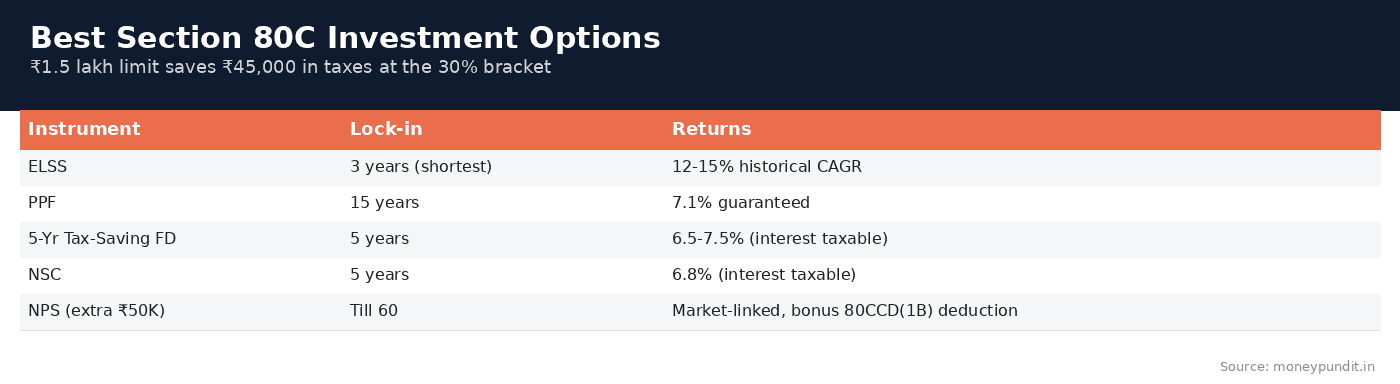
Section 80C is the most powerful tax-saving tool available to individual taxpayers in India. It allows you to deduct up to ₹1.5 lakh from your taxable income every financial year, saving ₹45,000 in taxes if you’re in the 30% bracket, or ₹22,500 if you’re in the 20% bracket. But many people fill it up with the wrong instruments. Here’s how to optimize it.
What Counts Under 80C
The ₹1.5 lakh limit is a combined ceiling for all investments and expenditures across all eligible instruments. Many salaried employees already have a portion filled automatically: EPF contributions (both employee’s share), children’s tuition fees, and housing loan principal repayment all count under 80C.
Check your Form 16 to see how much of 80C is already consumed by EPF before you invest anything extra.
Important: the Section 80C deduction is available only under the old tax regime. If you choose the new regime, which is the default, you cannot claim 80C, so compare both regimes before you invest purely to save tax. Our tax planning guide shows how to choose.
Best Investment Options Under 80C (Ranked)
1. ELSS (Equity Linked Savings Scheme): The only 80C option that invests in equities. 3-year lock-in (shortest among all 80C instruments). Returns are market-linked and not guaranteed. Gains up to ₹1.25 lakh a year are tax-free, and gains above that are taxed at 12.5%. Best suited for investors with a 5+ year horizon who want to grow wealth while saving tax.
2. PPF: As discussed earlier: EEE tax status, 7.1% guaranteed returns, 15-year lock-in. Zero risk. Ideal for conservative investors or as a complement to ELSS.
3. 5-Year Tax Saving FD: Available at all major banks. Returns 6.5–7.5%. Interest is taxable, so effective post-tax return in the 30% bracket is ~4.7–5.25%. Lowest complexity, good for short-horizon savers.
4. NSC (National Savings Certificate): Government-backed, 6.8% interest (revised quarterly), 5-year maturity. Interest is taxable but accrued interest qualifies for 80C deduction in subsequent years. Slightly more complex but very safe.
5. NPS: Additional ₹50,000 deduction under 80CCD(1B): over and above the 80C limit. Very powerful if you’re in the 30% bracket, saving an extra ₹15,000 in taxes annually.
Complete List of Section 80C Investments
The Section 80C deduction of ₹1,50,000 can be claimed through multiple instruments: ELSS mutual funds (3-year lock-in, market-linked returns), PPF (15-year lock-in, 7.1% guaranteed), NPS (retirement lock-in, market-linked), Sukanya Samriddhi Yojana (21-year for girl child, 8.2%), 5-year tax-saving FD (bank/post office, 6.5-7.5%), NSC (5-year, 7.7%), life insurance premiums, home loan principal repayment, tuition fees for children, and stamp duty/registration charges on property purchase. The limit is shared across all, so ₹1,50,000 total, not ₹1,50,000 each.
The Optimal 80C Allocation Strategy
For maximum returns within the 80C limit: Step 1: Account for mandatory 80C items first. EPF contribution (deducted from salary) counts toward 80C; if your employer deducts ₹21,600/year for EPF, you have ₹1,28,400 remaining. Life insurance premiums (if any) and children’s tuition fees also count. Step 2: Fill the remaining limit with the highest-return instruments: ELSS SIP for equity growth (12-16% CAGR), PPF for guaranteed safety (7.1%), and SSY if you have a daughter (8.2%).
A sample allocation for someone with ₹21,600 EPF: ₹1,00,000 in ELSS SIP (₹8,333/month: best returns with shortest lock-in), ₹28,400 in PPF (safe, tax-free compounding). This fills the entire ₹1,50,000 limit with a growth-plus-safety combination. Add ₹50,000 in NPS under 80CCD(1B) for an additional deduction above the 80C limit.
Common 80C Mistakes That Cost You Money
Last-minute March investing: Rushing to invest ₹1.5 lakh in March leads to poor choices (often pushed by banks into insurance products or FDs). Start an ELSS SIP in April instead. Over-investing in insurance: Endowment and money-back policies give poor returns (4-5%): use term insurance + ELSS for far better outcomes. Ignoring EPF: Many employees forget that their EPF contribution already counts toward 80C, leading to over-investment. Use our tax calculator to plan your exact 80C allocation for maximum tax savings with best returns.
Getting Started: The most important step is to begin: even small amounts invested consistently create significant wealth over time. Open a demat account, start one SIP in an index fund, and gradually expand your portfolio as your knowledge and income grow. Use our SIP Calculator to visualize how your investments can compound over 10, 20, and 30 years.
Remember, every successful investor started exactly where you are today. The key is taking that first step.
References: Amfiindia.com
Source: amfiindia.com
Frequently Asked Questions
Can I claim 80C in the new tax regime?
No. Section 80C and most other deductions are available only under the old regime. The new regime offers lower slab rates instead.
What is the lock-in period for ELSS?
ELSS has a 3-year lock-in from the date of each investment, the shortest among 80C options. Each SIP installment has its own 3-year lock-in.
Is the 80C limit Rs 1.5 lakh per instrument or in total?
It is Rs 1.5 lakh in total across all eligible investments and expenses, including EPF, tuition fees and home loan principal.
Save maximum tax: Key Takeaways
Key points on save maximum tax:
- The ₹1.5 lakh limit is a combined ceiling for all investments and expenditures across all eligible instruments.
- ELSS (Equity Linked Savings Scheme): The only 80C option that invests in equities.
- The limit is shared across all, so ₹1,50,000 total, not ₹1,50,000 each.
Verify the latest save maximum tax figures with Income Tax Department before you act.