
Health insurance in brief: Two health insurance policies with the same ₹5 lakh sum insured can have wildly different real-world value once you check sub-limits, room rent caps, and disease-wise waiting periods buried in the fine print.
Two health insurance policies with the same ₹5 lakh sum insured can have wildly different real-world value once you check sub-limits, room rent caps, and disease-wise waiting periods buried in the fine print. Here’s how to actually calculate the coverage you need and compare policies properly.
Health insurance is your financial shield against medical emergencies. With healthcare costs in India rising at 15% annually, even a few days of hospitalization can cost ₹5-20 lakh. A comprehensive health insurance policy protects your savings and ensures access to quality healthcare when you need it most.
Types of Health Insurance Plans
Individual health insurance covers a single person with a dedicated sum insured. Family floater plans cover the entire family under a single sum insured, making them cost-effective for young families. Super top-up plans provide high coverage above a threshold (deductible) at very low premiums, ideal for supplementing employer insurance. Critical illness plans pay a lump sum on diagnosis of specified diseases regardless of actual medical costs. Group health insurance from your employer provides basic coverage but should never be your only policy.
How to Calculate Ideal Coverage
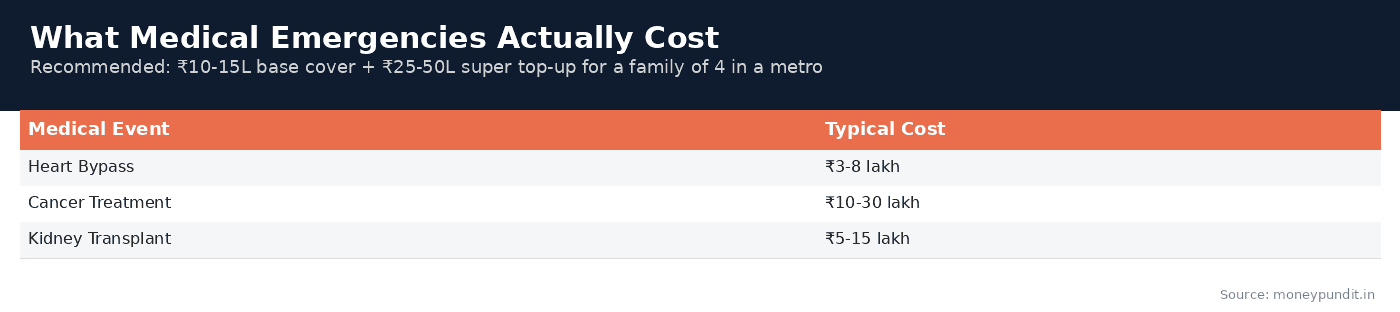
Base cover should handle a major medical event: consider that a heart bypass costs ₹3-8 lakh, cancer treatment runs ₹10-30 lakh, and a kidney transplant costs ₹5-15 lakh. For a family of four in a metro city, a minimum base cover of ₹10-15 lakh is recommended, supplemented by a ₹25-50 lakh super top-up. The super top-up is remarkably affordable, a ₹50 lakh super top-up with ₹5 lakh deductible costs just ₹3,000-5,000 annually for a 30-year-old.
Key Features to Compare
Room rent limits can cap your reimbursement: choose plans without room rent restrictions. Co-payment means you pay a percentage of each claim. Avoid plans with co-pay for ages below 60. Network hospital list determines cashless availability, ensure your preferred hospitals are included. Restoration benefit refills your sum insured if it is exhausted during the year. No-claim bonus increases your cover by 10-50% for every claim-free year. Pre and post hospitalization coverage should be at least 30 and 60 days respectively.
Top Health Insurance Plans in 2026
Niva Bupa Reassure 2.0 offers unlimited restoration, no room rent limits, and wide network coverage. HDFC ERGO Optima Secure provides up to 3X automatic sum insured restoration and covers modern treatments. ICICI Lombard Elevate combines base cover with built-in super top-up functionality. Star Health Comprehensive offers extensive coverage for families including maternity benefits after waiting period. Care Supreme provides unlimited room rent with single private AC room guarantee.
Common Mistakes to Avoid
Relying solely on employer insurance leaves you unprotected if you change jobs or during retirement. Buying the cheapest plan often means poor claim experience and extensive exclusions. Not disclosing pre-existing conditions leads to claim rejection, always declare everything honestly. Waiting until you are older means higher premiums, waiting periods for pre-existing conditions, and potential rejection for serious conditions. Buy health insurance in your 20s when you are healthy and premiums are lowest.
What is the waiting period for pre-existing diseases?
Most policies have a 2-4 year waiting period for pre-existing conditions. Some insurers offer reduced waiting periods of 1-2 years at higher premiums. Conditions declared at the time of purchase are covered after the waiting period; undeclared conditions may lead to permanent claim rejection.
Can I buy health insurance for my parents?
Yes, several insurers offer senior citizen health insurance for ages up to 65-80 years. Premiums are higher and co-payments of 10-20% are common. Star Health, Niva Bupa, and Care Health have dedicated senior citizen plans. Buy early. Most insurers have an entry age limit of 65 years.
Understanding Policy Fine Print: Sub-Limits and Exclusions
The biggest surprises in health insurance come from sub-limits buried in the policy document. Room rent capping is the most common: if your plan covers “single AC room” but caps at ₹5,000/day, and you’re admitted to a room costing ₹8,000/day, the insurer proportionally reduces ALL payable amounts (doctor fees, medicines, surgery charges), not just the room rent excess. This can reduce your claim by 30-40%. Always choose plans with no room rent sub-limits or unlimited room rent.
Other critical exclusions to check: waiting period for pre-existing diseases (1-4 years), initial waiting period (30 days for non-accident claims), specific disease waiting periods (2 years for conditions like hernia, cataract, joint replacement), and permanent exclusions (cosmetic surgery, self-inflicted injuries, substance abuse treatment). Day-care procedures coverage is essential, over 500 procedures now don’t require 24-hour hospitalization, including cataract surgery, chemotherapy, dialysis, and angiography. Ensure your plan covers these without sub-limits.
Building the Right Health Insurance Portfolio for Your Family
A family floater plan covers the entire family (self, spouse, children) under a single sum insured, more economical than individual plans. Recommended minimum: ₹10 lakh family floater for a young couple, increasing to ₹15-20 lakh after children. Add a super top-up plan with ₹50 lakh-₹1 crore cover using your base plan’s sum insured as the deductible, this costs just ₹5,000-12,000/year extra and protects against catastrophic medical expenses.
For parents above 60, a separate senior citizen health plan is usually better than adding them to your floater (it would significantly increase premiums). Compare Niva Bupa, Star Health, and HDFC Ergo for senior citizen plans, look for minimal co-payment, wide hospital network, and domiciliary treatment cover. Tax benefits: premiums up to ₹25,000 for self/family and ₹50,000 for senior citizen parents are deductible under Section 80D. Preventive health check-up costs (up to ₹5,000) are included within the 80D limit. Use our Tax Calculator to optimize your Section 80D deductions alongside other tax-saving investments.
References: Sebi.gov.in
Source: sebi.gov.in
Health insurance: Key Takeaways
Key points on health insurance:
- Individual health insurance covers a single person with a dedicated sum insured.
- Base cover should handle a major medical event: consider that a heart bypass costs ₹3-8 lakh, cancer treatment runs ₹10-30 lakh, and a kidney transplant costs ₹5-15 lakh.
- Room rent limits can cap your reimbursement: choose plans without room rent restrictions.
Verify the latest health insurance figures with IRDAI before you act.
Related reading: Learn how the claim settlement ratio is explained before choosing an insurer.