
Gst explained in brief: The Goods and Services Tax (GST) replaced multiple indirect taxes in India on July 1, 2017.
Every time you buy groceries, eat at a restaurant, or book a cab in India, GST is quietly built into the price, yet most people can’t explain why a restaurant bill and a grocery bill are taxed so differently. Here’s how India’s GST rate structure actually works and where it shows up in your everyday spending.
The Goods and Services Tax (GST) replaced multiple indirect taxes in India on July 1, 2017. While businesses deal with GST compliance daily, understanding how GST works helps every consumer and professional make informed financial decisions and spot overcharging.
GST Rate Structure
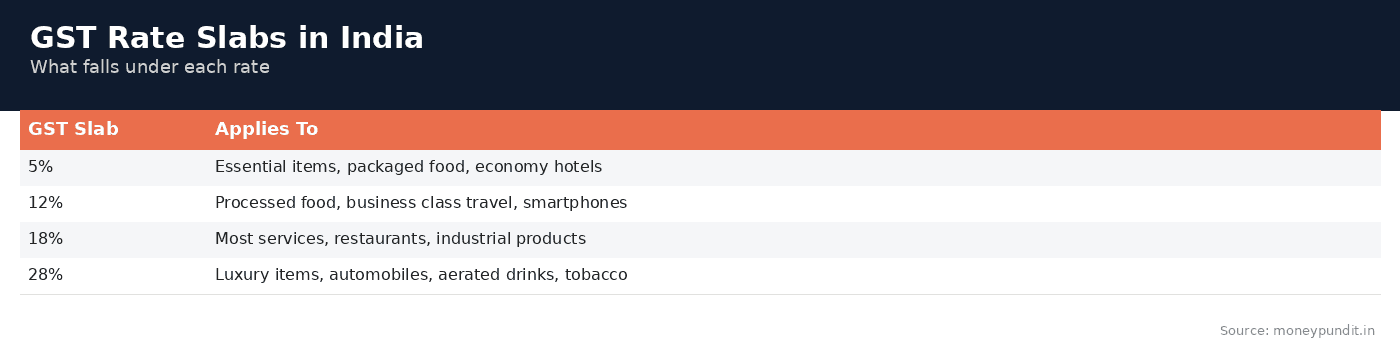
GST has four main slabs: 5% on essential items like packaged food, economy hotels, and transport services. 12% on processed food, business class air travel, and smartphones. 18% on most services, restaurants, and industrial products, this is the most common rate. 28% on luxury items, automobiles, aerated drinks, and tobacco. Some items like fresh food, milk, and essential services are exempt (0% GST). Understanding which slab your regular purchases fall under helps you verify billing accuracy.
Types of GST
CGST (Central GST) and SGST (State GST) apply to transactions within a state, each is half the total rate. For an 18% GST item, 9% goes to the central government and 9% to the state. IGST (Integrated GST) applies to inter-state transactions and equals the full rate. For consumers, the total tax paid is the same regardless of whether it is CGST+SGST or IGST. The split only matters for government revenue distribution.
How GST Affects Your Daily Life
Dining at restaurants attracts 5% GST (without input tax credit) or 18% for restaurants in starred hotels. Online food delivery charges 5% GST. Your monthly mobile bill includes 18% GST. Insurance premiums carry 18% GST, on a ₹25,000 health insurance premium, ₹3,813 is GST. Movie tickets are taxed at 12% (tickets up to ₹100) or 28% (above ₹100). Understanding these rates helps you budget accurately and verify that businesses are not overcharging.
GST Impact on Investments
Mutual fund management fees include 18% GST, which is already factored into the expense ratio. Insurance premiums include 18% GST. Brokerage charges on stock trading attract 18% GST. These embedded taxes reduce your effective investment returns. For instance, on a mutual fund with a 1% expense ratio, approximately 0.15% of that is GST on the management fee.
GST Registration for Freelancers
If you provide services and your annual turnover exceeds ₹20 lakh (₹10 lakh for special category states), GST registration is mandatory. Freelancers and consultants must charge 18% GST on their invoices, file monthly or quarterly returns, and can claim input tax credit on business expenses. The composition scheme for service providers allows simplified compliance with a flat 6% rate for turnover up to ₹50 lakh.
Can I get GST refund as a consumer?
Generally, consumers cannot claim GST refund on personal purchases. However, international tourists can claim refund on goods purchased in India (above a threshold) when leaving the country. For business expenses, GST input tax credit is available if you are GST registered.
The GST Rate Structure and What It Means for You
India’s GST operates on a four-tier rate structure: 5% (essential items like packaged food, economy travel), 12% (processed food, business class travel, smartphones under ₹30,000), 18% (most services, electronics, restaurants with AC), and 28% (luxury items, cars, aerated drinks, cement). Some essentials like fresh fruits, vegetables, milk, and unbranded cereals carry 0% GST. Understanding which slab your regular purchases fall under helps you estimate the real tax impact on your budget.
GST replaced a complex web of 17 indirect taxes: central excise, service tax, VAT, entertainment tax, luxury tax, and others, with a single unified tax. The “One Nation One Tax” structure means a product costs the same whether you buy it in Mumbai, Delhi, or Chennai (excluding logistics differences). For consumers, this simplification eliminated the cascading “tax on tax” effect where multiple taxes were levied at each supply chain stage, ultimately reducing prices on many goods. Use our GST Calculator to quickly compute GST-inclusive or exclusive prices for any transaction.
How GST Affects Your Daily Expenses
Your monthly expenses are impacted differently across categories. Groceries (0-5% GST on essentials) have minimal impact. Dining out at non-AC restaurants attracts 5% GST without input tax credit, while AC restaurants charge 5% as well (reduced from 18% in earlier years). Mobile and internet bills carry 18% GST, as do streaming subscriptions, insurance premiums, and most services. Major purchases like smartphones (18%), cars (28% + cess), and electronics (18%) have GST built into the MRP or quoted price.
For home buyers, GST on under-construction property is 5% (without input tax credit) for regular housing and 1% for affordable housing (up to ₹45 lakh in metros). Ready-to-move-in properties with completion certificate attract no GST, only stamp duty. This makes the timing of your property purchase financially significant. Calculate the total cost including GST, stamp duty, and registration charges alongside your home loan EMI to understand the true cost of homeownership.
GST and Your Investments
GST impacts investment costs too. Mutual fund management fees attract 18% GST, though this is already included in the expense ratio you see. Insurance premiums (term, health, motor) carry 18% GST, adding ₹1,800 on a ₹10,000 premium. Stock broking commissions attract 18% GST, affecting your trading costs. Bank locker rent, demat account charges, and financial advisory fees all carry 18% GST.
Self-employed professionals and business owners should register for GST if their annual turnover exceeds ₹20 lakh (₹10 lakh for special category states). Registration enables you to claim input tax credit, GST paid on business purchases can be offset against GST collected on sales, reducing your net tax outflow. Understanding GST implications helps in accurate tax planning alongside income tax obligations. Refer to our Tax Calculator for comprehensive tax planning and ensure you’re accounting for both direct and indirect tax impacts on your finances.
References: Amfiindia.com
Source: amfiindia.com
GST explained: Key Takeaways
Key points on gst explained:
- GST has four main slabs: 5% on essential items like packaged food, economy hotels, and transport services.
- CGST (Central GST) and SGST (State GST) apply to transactions within a state, each is half the total rate.
- Dining at restaurants attracts 5% GST (without input tax credit) or 18% for restaurants in starred hotels.
Verify the latest gst explained figures with GST Portal before you act.