
Albert Einstein reportedly called compound interest the “eighth wonder of the world,” adding that “he who understands it, earns it; he who doesn’t, pays it.” Whether or not Einstein actually said this, the math behind the power of compounding is one of the most powerful forces in wealth creation: and understanding it can transform your financial future.
In this comprehensive guide on the power of compounding, we break down how compounding works, why starting early matters more than investing large amounts, and exactly how a modest monthly investment can grow into a multi-crore corpus over time.
Want to see the numbers for your own situation? Use our compound interest calculator to instantly calculate how a lump sum, a monthly SIP, or both together will grow at your own rate and time horizon.
What Is the Power of Compounding?
Compounding is the process where your investment earns returns, and then those returns themselves start earning returns. It’s essentially “interest on interest”: a snowball effect where your money grows exponentially rather than linearly. The longer your money compounds, the faster it grows, creating a hockey-stick curve that accelerates dramatically in later years.
Here’s a simple example: If you invest ₹1,00,000 at 12% annual return, after year 1 you have ₹1,12,000. In year 2, you earn 12% on ₹1,12,000 (not just the original ₹1,00,000), giving you ₹1,25,440. The extra ₹1,440 is the compounding effect. Interest earned on previous interest. This may seem small, but over decades, this effect becomes extraordinary.
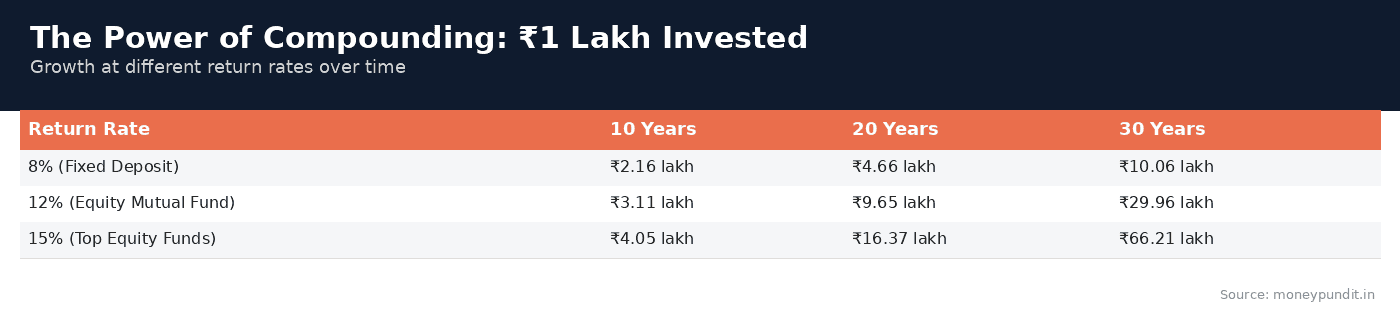
The Compounding Growth Table: ₹1 Lakh Over Time
To truly appreciate compounding, look at how ₹1,00,000 grows at different rates over different time periods:
At 8% return (typical for fixed deposits): ₹1 lakh becomes ₹2.16 lakh in 10 years, ₹4.66 lakh in 20 years, and ₹10.06 lakh in 30 years.
At 12% return (typical for equity mutual funds): ₹1 lakh becomes ₹3.11 lakh in 10 years, ₹9.65 lakh in 20 years, and ₹29.96 lakh in 30 years.
At 15% return (top-performing equity funds): ₹1 lakh becomes ₹4.05 lakh in 10 years, ₹16.37 lakh in 20 years, and ₹66.21 lakh in 30 years.
Notice the massive difference the extra years make. At 12%, your money grows 3x in the first 10 years, but nearly 10x in the first 20 years, and almost 30x in 30 years. The last decade alone adds more wealth than the first two decades combined, this is the magic of compounding at work. You can verify these numbers yourself with our lumpsum calculator.
How ₹5,000/Month Can Build ₹5 Crore
Now let’s apply compounding to a realistic monthly investment through a Systematic Investment Plan (SIP). If a 25-year-old starts investing ₹5,000 per month in equity mutual funds earning 12% CAGR:
After 10 years (age 35): Total invested: ₹6,00,000. Portfolio value: ₹11,61,695. Returns earned: ₹5,61,695.
After 20 years (age 45): Total invested: ₹12,00,000. Portfolio value: ₹49,95,740. Returns earned: ₹37,95,740.
After 30 years (age 55): Total invested: ₹18,00,000. Portfolio value: ₹1,76,49,569. Returns earned: ₹1,58,49,569.
After 35 years (age 60): Total invested: ₹21,00,000. Portfolio value: ₹3,24,83,695. Returns earned: ₹3,03,83,695.
But here’s where it gets even more exciting. If you use a step-up SIP: increasing your monthly investment by just 10% each year (from ₹5,000 to ₹5,500 in year 2, ₹6,050 in year 3, and so on), the same 35-year journey yields approximately ₹8.7 crore. That’s the combined power of compounding and incremental saving.
The Cost of Waiting: Why Starting Early Is Everything
The single biggest enemy of compounding is delay. Every year you postpone investing costs you disproportionately more than you’d expect. Consider three friends, Priya, Rahul, and Anita, who each want ₹2 crore by age 60:
Priya starts at age 25 (35 years to invest): She needs approximately ₹3,000/month at 12% CAGR. Total investment: ₹12,60,000.
Rahul starts at age 30 (30 years): He needs approximately ₹5,700/month. Total investment: ₹20,52,000.
Anita starts at age 35 (25 years): She needs approximately ₹11,000/month. Total investment: ₹33,00,000.
Priya invests the least money (₹12.6 lakh vs Anita’s ₹33 lakh) yet reaches the same goal. The difference, ₹20.4 lakh, is the “cost of delay.” Every year of delay essentially means you need to invest approximately 15-20% more per month to achieve the same outcome.
The Rule of 72: A Quick Compounding Calculator
The Rule of 72 is a mental shortcut to estimate how long it takes for your money to double. Simply divide 72 by your annual return rate:
At 6% return (savings account): Money doubles in 72 ÷ 6 = 12 years.
At 8% return (fixed deposits): Money doubles in 72 ÷ 8 = 9 years.
At 12% return (equity mutual funds): Money doubles in 72 ÷ 12 = 6 years.
At 15% return (top equity funds): Money doubles in 72 ÷ 15 = 4.8 years.
This means at 12% returns, ₹1 lakh becomes ₹2 lakh in 6 years, ₹4 lakh in 12 years, ₹8 lakh in 18 years, ₹16 lakh in 24 years, and ₹32 lakh in 30 years. Each doubling adds more absolute value than all previous doublings combined. Verify with our CAGR calculator.
Power of Compounding Works Against You Too: The Debt Trap
While compounding builds wealth when you invest, it destroys wealth when you borrow. Credit card debt at 36-42% annual interest compounds monthly, meaning ₹1 lakh of unpaid credit card debt becomes ₹1.42 lakh in just one year. In 5 years without payment, it balloons to ₹5.2 lakh.
Personal loans at 12-18% and home loans at 8.5% compound against borrowers. On a ₹50 lakh home loan at 8.5% for 20 years, you end up repaying ₹1.04 crore, more than double the borrowed amount. Using our loan prepayment calculator, you can see how even small additional payments dramatically reduce total interest.
Real Returns vs Nominal Returns: Accounting for Inflation
Compounding works for inflation too. If inflation averages 6% per year, something costing ₹10 lakh today will cost ₹32 lakh in 20 years. This means your investments need to beat inflation just to maintain purchasing power. A fixed deposit earning 7% gives you only 1% real return after 6% inflation.
This is the fundamental argument for equity investing through SIPs in mutual funds. At 12-14% equity returns minus 6% inflation, your real return is 6-8%, genuinely growing your purchasing power. Over 20 years, the compounding gap between equity and fixed income becomes enormous.
How to Maximise the Power of Compounding
1. Start now, not later. Even ₹1,000/month is better than waiting until you can afford ₹10,000/month. Time is the most important ingredient in the compounding formula.
2. Increase your investment annually. Set up a step-up SIP that automatically increases by 10-15% each year as your salary grows.
3. Don’t interrupt compounding. The biggest mistake investors make is stopping SIPs during market corrections. Stay invested through market cycles.
4. Choose growth over dividends. In mutual funds, always select the growth option: dividends break the compounding chain.
5. Minimise costs and taxes. Choose low-cost index funds or direct plans. Hold equity over a year for lower 12.5% LTCG tax. Use Section 80C deductions through ELSS funds.
Resources to Understand the Power of Compounding
To see the power of compounding in action, use the Value Research fund performance tracker to compare long-term returns. The RBI compound interest guidelines explain how banks calculate compound interest on deposits. For understanding how the power of compounding applies to mutual fund SIPs, check AMFI (Association of Mutual Funds in India). The Nifty 50 historical returns on NSE demonstrate the power of compounding over 20+ year periods.
Your Power of Compounding Action Plan
Ready to put compounding to work? Use our retirement calculator to determine your target corpus. Then use the SIP calculator to find the monthly investment needed. Start a step-up SIP in a flexi cap fund or Nifty 50 index fund today. Maximise your Section 80C limit with ELSS and PPF. Set annual reminders to increase your SIP by 10%. And most importantly, be patient. Compounding rewards those who give it time.
The difference between a comfortable retirement and a financially stressful one often isn’t about earning more money, it’s about starting to invest earlier and letting compounding do its work. As the saying goes: “The best time to plant a tree was 20 years ago. The second best time is now.”