
Financial independence roadmap in brief: Retiring at 45 with a ₹5 crore corpus sounds like a distant fantasy on a typical Indian salary, until you break it down into a savings rate and a timeline, at which point it becomes a math problem, not a dream.
Retiring at 45 with a ₹5 crore corpus sounds like a distant fantasy on a typical Indian salary, until you break it down into a savings rate and a timeline, at which point it becomes a math problem, not a dream. Here’s a step-by-step roadmap to financial independence, whether your target is 40, 50, or later.
Financial independence (FI) means having enough passive income or invested wealth to cover your living expenses without needing to work for money. It doesn’t necessarily mean retiring early, it means working becomes a choice, not a compulsion. In India, where living costs are relatively lower and investment returns are higher than many developed countries, achieving financial independence is more attainable than most people think. This roadmap gives you a practical, step-by-step plan to reach FI.
What Does Financial Independence Look Like in India?
You are financially independent when your investment corpus generates enough returns to cover your annual expenses indefinitely. The widely used “25x Rule” states that you need a corpus equal to 25 times your annual expenses. If your annual expenses are ₹6 lakh (₹50,000/month), you need ₹1.5 crore. If your expenses are ₹12 lakh (₹1 lakh/month), you need ₹3 crore. At ₹24 lakh/year (₹2 lakh/month), you need ₹6 crore. This corpus, invested in a mix of equity and debt, can sustain you indefinitely using the 4% safe withdrawal rate.
The 4% Rule – How It Works in India
The 4% rule says you can withdraw 4% of your corpus in the first year, then adjust for inflation each subsequent year, and your money should last 30+ years. In India, with equity returns of 12-14% and inflation of 5-6%, a 4% withdrawal rate is actually quite conservative. Many Indian FI practitioners use a 3-3.5% withdrawal rate for extra safety, or a higher 5% rate if they have other income sources (rental income, part-time work, or pension).
Step 1: Calculate Your FI Number
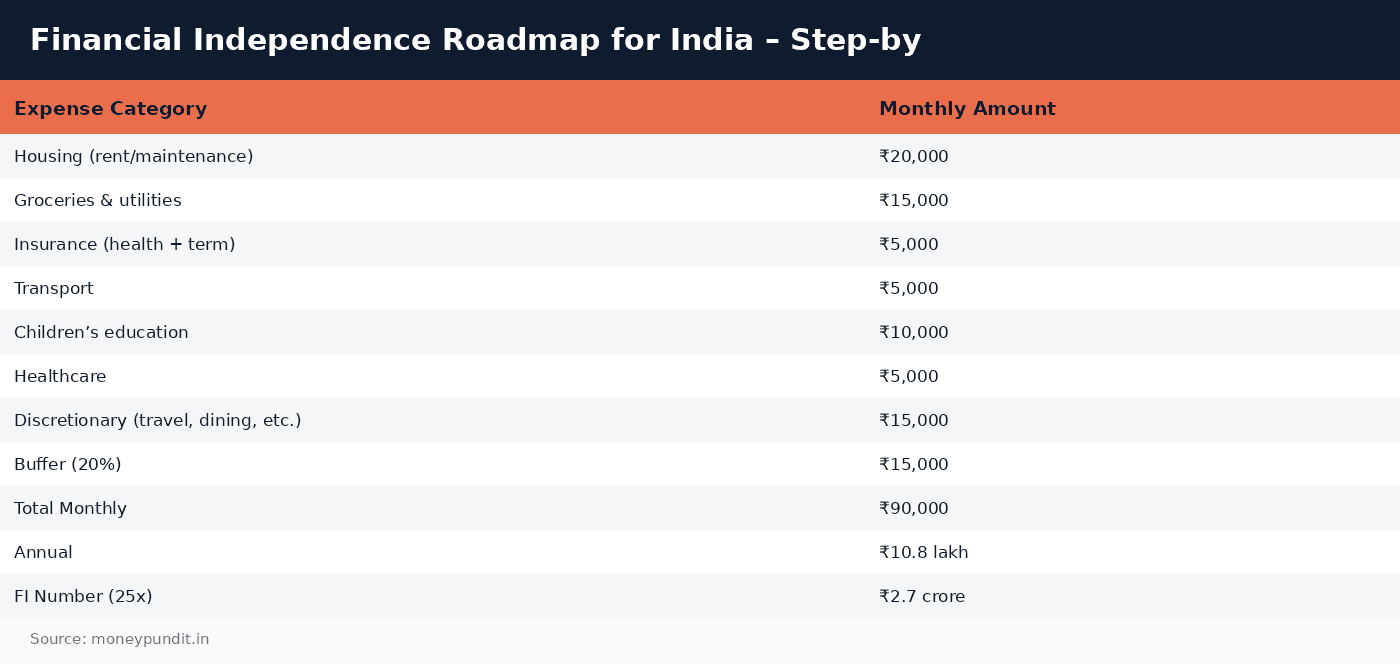
Start by tracking your current monthly expenses for 3-6 months. Separate essential expenses (housing, food, utilities, insurance, healthcare) from discretionary ones (travel, dining out, subscriptions). Your FI expenses should include essentials plus a reasonable discretionary budget. Add 20% buffer for unexpected costs. Then multiply your annual FI expenses by 25 (or 30 for extra safety). That’s your FI number, the corpus you need to achieve financial independence.
Example FI Number Calculation
| Expense Category | Monthly Amount |
|---|---|
| Housing (rent/maintenance) | ₹20,000 |
| Groceries & utilities | ₹15,000 |
| Insurance (health + term) | ₹5,000 |
| Transport | ₹5,000 |
| Children’s education | ₹10,000 |
| Healthcare | ₹5,000 |
| Discretionary (travel, dining, etc.) | ₹15,000 |
| Buffer (20%) | ₹15,000 |
| Total Monthly | ₹90,000 |
| Annual | ₹10.8 lakh |
| FI Number (25x) | ₹2.7 crore |
Step 2: Maximise Your Savings Rate
Your savings rate is the single most important variable in reaching FI. Someone earning ₹1 lakh/month and saving 50% (₹50,000) will reach FI decades before someone earning ₹2 lakh but saving only 20% (₹40,000). Here’s how savings rate affects your FI timeline at 12% investment returns:
| Savings Rate | Years to FI (from zero) |
|---|---|
| 20% | 28 years |
| 30% | 22 years |
| 40% | 18 years |
| 50% | 14 years |
| 60% | 11 years |
| 70% | 8 years |
To increase your savings rate, focus on the big three expenses: housing (keep rent under 25% of income), transport (avoid expensive car loans), and lifestyle inflation (resist upgrading with every salary hike).
Step 3: Build Your FI Portfolio
Accumulation Phase (Working Years)
During your earning years, invest aggressively in growth assets. A recommended allocation: 60-70% in equity mutual funds (index funds + flexi-cap for growth), 10-15% in EPF/PPF/NPS (automatic for salaried, tax-efficient), 10-15% in debt funds or SGBs (stability + diversification), and 5-10% in REITs or international funds (diversification). Use SIPs for equity investing and increase amounts with every salary hike.
Transition Phase (2-3 Years Before FI)
Gradually shift from growth to income-generating assets. Move 2-3 years of expenses into liquid/short-term debt funds as a buffer. Build a “bucket system”, Bucket 1 (1-2 years expenses in FDs/liquid funds), Bucket 2 (3-5 years in balanced/hybrid funds), and Bucket 3 (remaining in equity for long-term growth).
Step 4: Generate Passive Income Streams
While your corpus is the primary FI engine, multiple income streams add security. Options include SWP from mutual funds (systematic withdrawal of 3-4% annually), dividend income from quality stocks (₹2-5 lakh/year from a ₹25-50 lakh dividend portfolio), rental income from real estate (if you own property), interest from FDs, SGBs, and debt instruments, and freelance or consulting income (optional, for extra cushion). Having 2-3 income streams means no single failure can derail your FI plan.
Step 5: Handle Inflation
Inflation is the silent enemy of financial independence. At 6% inflation, expenses double every 12 years. Your ₹90,000/month expenses today become ₹1.8 lakh in 12 years and ₹3.6 lakh in 24 years. This is why your FI portfolio must maintain significant equity allocation (at least 40-50%) even after reaching FI, equity returns historically beat inflation by 6-8% in India. The 4% rule already accounts for inflation adjustment, but many Indian FI practitioners keep 50% in equity even post-FI for this reason.
FI Milestones to Track
Break your journey into milestones to stay motivated. “Coast FI” means you’ve invested enough that compounding alone will reach your FI number by traditional retirement age (58-60). You can stop investing aggressively and just cover current expenses. “Lean FI” means your corpus covers basic essential expenses only. “Full FI” means your corpus covers your complete desired lifestyle. “Fat FI” means corpus covers a comfortable lifestyle with significant buffer. Track your progress using a simple spreadsheet updated quarterly. Watching your net worth grow is powerful motivation.
Indian-Specific FI Advantages
India offers unique advantages for FI seekers. Lower cost of living compared to the West means a smaller corpus is needed. Higher equity returns (12-14% historical CAGR vs 8-10% in the US) accelerate wealth building. Tax-free instruments like PPF, EPF, and SGBs boost after-tax returns. Geographic arbitrage is possible, earn in metros but live in tier-2/3 cities post-FI. And the growing gig economy allows flexible part-time income to supplement withdrawals.
Frequently Asked Questions
Can I achieve FI on a ₹10 LPA salary?
Yes. At ₹10 LPA with a 40% savings rate, you invest ₹4 lakh/year. At 13% CAGR, this grows to approximately ₹2.5 crore in 20 years, enough for FI if your annual expenses stay around ₹8-10 lakh. The key is maintaining a high savings rate and investing consistently through salary growth.
What about healthcare costs after FI?
Health insurance is critical for FI in India. Buy a comprehensive health insurance policy of ₹25-50 lakh (super top-up plans are cost-effective) while you’re still young and healthy. Budget ₹50,000-1,00,000/year for premiums in your FI expenses. Also maintain a separate medical emergency fund of ₹5-10 lakh outside your main FI corpus.
Should I pay off my home loan before pursuing FI?
Not necessarily. If your home loan rate is 8-9% and your investments earn 12-14%, the mathematical answer is to invest rather than prepay. However, being debt-free reduces your monthly FI expenses significantly, which lowers your FI number. A balanced approach: make regular EMI payments but don’t aggressively prepay. Invest the surplus for potentially higher returns.
Financial independence roadmap: Key Takeaways
Key points on financial independence roadmap:
- You are financially independent when your investment corpus generates enough returns to cover your annual expenses indefinitely.
- The 4% rule says you can withdraw 4% of your corpus in the first year, then adjust for inflation each subsequent year, and your money should last 30+ years.
- Start by tracking your current monthly expenses for 3-6 months.
Verify the latest financial independence roadmap figures with RBI before you act.