
Financial planning salaried employees in brief: Step 1: Understand Your Salary Structure Before planning anything, understand your CTC (Cost to Company) breakdown.
A salary slip has more moving parts than most employees ever look at closely, basic pay, HRA, special allowance, PF contributions, and misunderstanding any one of them can mean overpaying tax or under-saving for years. Here’s a step-by-step financial plan built specifically around how a salaried income actually works.
As a salaried employee in India, you have a predictable income stream, which is both an advantage and a limitation. The advantage is that you can plan your finances with certainty. The limitation is that your income has a ceiling unless you actively invest and grow your wealth. A solid financial plan ensures you maximise every rupee of your salary through smart tax planning, strategic investments, adequate insurance, and disciplined spending. This guide provides a step-by-step financial planning framework for Indian salaried professionals at every stage of their career.
Step 1: Understand Your Salary Structure
Before planning anything, understand your CTC (Cost to Company) breakdown. Your salary typically includes basic salary (40-50% of CTC, used for EPF and gratuity calculations), HRA (House Rent Allowance, partially tax-exempt), special allowance (fully taxable), EPF contribution (12% of basic, deducted automatically), gratuity (4.81% of basic, paid after 5 years), and other components like LTA, food coupons, and medical allowance. Your in-hand salary (take-home) is CTC minus EPF, tax deductions, professional tax, and other deductions. Understanding this structure helps you identify tax-saving opportunities.
Step 2: Build an Emergency Fund First
Before investing in anything, keep 3-6 months of expenses in a liquid, easily accessible account. This protects you from unexpected events, job loss, medical emergencies, or sudden expenses. Keep your emergency fund in a high-yield savings account (5-7% interest) or a liquid mutual fund (6-7% returns with instant redemption up to ₹50,000). For a monthly expense of ₹50,000, your emergency fund should be ₹1.5 lakh to ₹3 lakh.
Step 3: Get Adequate Insurance
Term Life Insurance
If anyone depends on your income, buy a term insurance policy covering 10-15 times your annual income. A 30-year-old can get ₹1 crore term cover for just ₹700-1,000/month. Buy early. Premiums increase significantly with age. Avoid investment-linked insurance plans (ULIPs, endowment policies), they give poor returns compared to mutual funds.
Health Insurance
Your company’s group health insurance is not enough: it stops when you leave the job. Buy a personal health insurance policy of ₹10-20 lakh (₹25-50 lakh for family floater in metro cities). Check for features like no room rent capping, restoration benefit, and coverage for pre-existing diseases after waiting period.
Step 4: Maximise Tax Savings
Salaried employees have several options to reduce their tax burden legally. Under the old tax regime, you can claim deductions under Section 80C (₹1.5 lakh, EPF, PPF, ELSS, life insurance premium), Section 80D (₹25,000-75,000, health insurance premium), HRA exemption (based on rent paid, basic salary, and city), Section 80CCD(1B) (₹50,000 additional for NPS), and home loan interest under Section 24 (₹2 lakh). Under the new tax regime (default from FY 2024-25), there are lower tax rates but limited deductions, only standard deduction of ₹75,000 and employer NPS contribution under 80CCD(2). Compare both regimes using an online calculator to see which saves you more tax based on your specific deductions.
Step 5: Start Investing Based on Your Goals
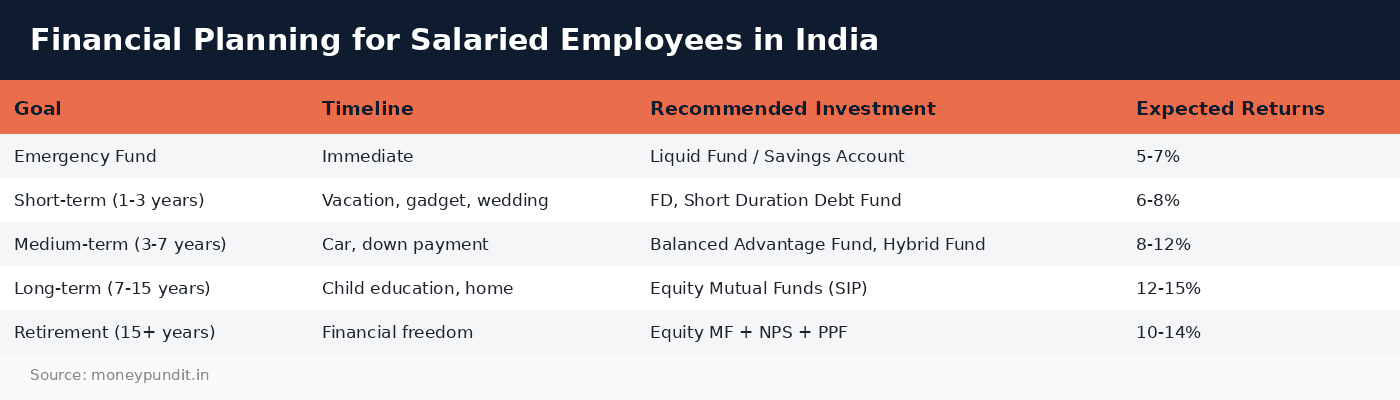
| Goal | Timeline | Recommended Investment | Expected Returns |
|---|---|---|---|
| Emergency Fund | Immediate | Liquid Fund / Savings Account | 5-7% |
| Short-term (1-3 years) | Vacation, gadget, wedding | FD, Short Duration Debt Fund | 6-8% |
| Medium-term (3-7 years) | Car, down payment | Balanced Advantage Fund, Hybrid Fund | 8-12% |
| Long-term (7-15 years) | Child education, home | Equity Mutual Funds (SIP) | 12-15% |
| Retirement (15+ years) | Financial freedom | Equity MF + NPS + PPF | 10-14% |
Step 6: The Ideal Investment Allocation by Age
Age 22-30: Growth Phase
Allocate 70-80% to equity (index funds, flexi-cap mutual funds via SIP), 10-15% to EPF/PPF (already auto-deducted for EPF), and 10-15% to debt instruments. At this stage, time is your biggest asset. A ₹5,000/month SIP started at 25 can grow to ₹3.5 crore by age 55 at 14% CAGR. Focus on increasing your investment amount with every salary hike, follow the “50% hike rule” where you invest at least 50% of every salary increment.
Age 30-40: Accumulation Phase
Allocate 60-70% to equity, 20-25% to debt (PPF, NPS, debt funds), and 10-15% to real estate (if buying a home). This is when most people start families and take on EMIs. Ensure your EMIs (home loan + car loan) don’t exceed 40% of your take-home salary. Continue increasing SIPs and start goal-specific investments for child education.
Age 40-50: Consolidation Phase
Gradually shift to 50-60% equity and 40-50% debt. Review your portfolio annually, increase term insurance if needed, and focus on maximising NPS and PPF contributions. Start planning your retirement corpus target, aim for 25-30 times your annual expenses at retirement.
Age 50-60: Pre-Retirement Phase
Reduce equity to 30-40% and increase debt and fixed-income allocation. Avoid taking new loans. Ensure your retirement corpus is on track. Consider SWP (Systematic Withdrawal Plan) from mutual funds as a post-retirement income strategy.
Step 7: Track and Review Annually
Financial planning is not a one-time exercise. Review your portfolio at least once a year, check if your asset allocation has drifted (rebalance if needed), increase SIP amounts after salary hikes, review insurance coverage as your lifestyle and dependents change, reassess your tax regime choice each year, and update your financial goals as life circumstances change.
Common Mistakes Salaried Employees Make
The biggest mistake is lifestyle inflation: increasing spending in proportion to salary hikes instead of investing the difference. Other common errors include buying insurance for investment (ULIPs, endowment plans), not investing beyond EPF and tax-saving FDs, keeping too much money in savings accounts earning 2.5-4%, taking personal loans for lifestyle purchases, and not having health insurance beyond the employer’s group policy.
Frequently Asked Questions
How much of my salary should I invest?
Follow the 50-30-20 rule as a starting point: 50% for needs (rent, EMIs, groceries), 30% for wants (dining, entertainment, shopping), and 20% for investments and savings. As your income grows, try to increase the investment portion to 30-40% by keeping lifestyle expenses in check.
Should I invest in NPS or mutual funds?
Both have a role. NPS offers an additional ₹50,000 tax deduction under 80CCD(1B) that mutual funds don’t, so invest at least enough in NPS to claim this benefit. Beyond that, equity mutual funds offer more flexibility, no lock-in (for non-ELSS funds), and potentially similar or better returns. A combination of both is ideal.
Is a home loan a good investment?
A home loan for a house you’ll live in is a lifestyle decision, not an investment. The tax benefits (Section 24 and 80C) make it tax-efficient, and you build an asset. But don’t stretch beyond 40% of take-home salary for EMI. Buying property purely as an investment has underperformed equity mutual funds in most Indian cities over the past decade.
References: Amfiindia.com
Financial planning salaried employees: Key Takeaways
Key points on financial planning salaried employees:
- Before planning anything, understand your CTC (Cost to Company) breakdown.
- Before investing in anything, keep 3-6 months of expenses in a liquid, easily accessible account.
- If anyone depends on your income, buy a term insurance policy covering 10-15 times your annual income.
Verify the latest financial planning salaried employees figures with RBI before you act.