
Inflation impact savings in brief: A fixed deposit paying 6.5% interest can still leave you poorer in real terms if inflation is running at 6%, the return looks positive on paper, but your purchasing power barely moves.
A fixed deposit paying 6.5% interest can still leave you poorer in real terms if inflation is running at 6%, the return looks positive on paper, but your purchasing power barely moves. Here’s exactly how inflation erodes Indian savers’ wealth category by category, and what actually protects against it.
Inflation is often called the “silent tax” on your money, it doesn’t show up on any bill, but it steadily erodes the purchasing power of every rupee you save. While India’s consumer inflation has averaged 5-6% over the past decade, many everyday expenses like education, healthcare, and housing have inflated at 8-12% annually. If your investments aren’t beating inflation, you’re actually getting poorer every year, even if your bank balance is growing. Here’s exactly how inflation impacts your savings and what you can do to protect your wealth.
What Inflation Really Means for Your Money
Inflation means prices of goods and services increase over time, so each rupee buys less. If inflation is 6%, something that costs ₹100 today will cost ₹106 next year and ₹179 in 10 years. Your ₹100 note doesn’t shrink physically, but its purchasing power drops from ₹100 to ₹56 in real terms over a decade at 6% inflation. This is why keeping money in a savings account earning 3-4% when inflation is 6% means you’re losing 2-3% of purchasing power every year.
The Real Cost of Inflation – Category-Wise
| Category | Avg Annual Inflation | ₹1 Lakh Today = After 20 Years |
|---|---|---|
| General CPI Inflation | 5-6% | ₹2.65 lakh needed |
| Education | 10-12% | ₹6.73 lakh needed |
| Healthcare | 8-10% | ₹4.66 lakh needed |
| Housing (Metro cities) | 7-9% | ₹3.87 lakh needed |
| Food & Groceries | 5-7% | ₹2.65 lakh needed |
| Fuel & Transport | 6-8% | ₹3.21 lakh needed |
The most alarming figure is education inflation at 10-12%. If your child’s college education costs ₹10 lakh today, it could cost ₹67 lakh by the time they’re ready in 20 years. Planning for these specific inflation rates, not just the headline 5-6%, is critical for goal-based investing.
How Inflation Eats Different Investments
Savings Account: The Biggest Loser
Most savings accounts pay 2.5-4% interest. With 6% inflation, your real return is negative 2% to negative 3.5%. Every ₹1 lakh sitting in a savings account loses approximately ₹2,000-3,500 in purchasing power every year. Over 10 years, ₹1 lakh in a savings account earning 3.5% grows to ₹1.41 lakh nominally, but in real terms (adjusted for 6% inflation) it’s worth only ₹79,000. You’ve lost ₹21,000 in real value despite “earning” interest.
Fixed Deposits: Barely Breaking Even
FDs currently offer 6.5-8.5% pre-tax returns. After paying 20-30% tax on interest income (depending on your slab), the post-tax return drops to 4.5-6.8%. Against 6% inflation, FDs offer near-zero to slightly positive real returns. They preserve your purchasing power at best, they don’t grow it. FDs are suitable for short-term parking of money, but terrible for long-term wealth building.
PPF and EPF: Modest Real Returns
PPF at 7.1% and EPF at 8.25% offer positive real returns of 1-2% after inflation, and their tax-free status makes them better than FDs. But 1-2% real growth means your money only grows modestly in purchasing power. Doubling in real terms takes 35-70 years. These are safety instruments, not wealth builders.
Equity Mutual Funds: The Inflation Beater
Equity mutual funds have historically delivered 12-15% CAGR in India, providing 6-9% real returns after inflation. This means your purchasing power genuinely doubles every 8-12 years. A ₹1 lakh investment growing at 13% nominal (7% real) becomes ₹3.87 lakh in real purchasing power over 20 years, actually making you wealthier, not just maintaining value.
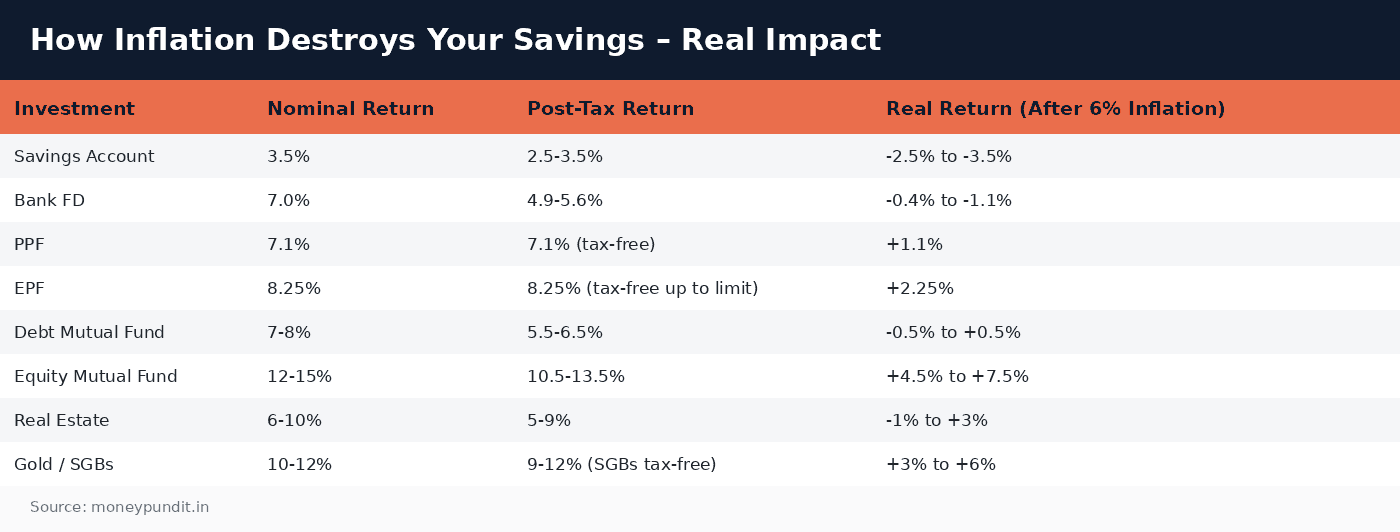
Real Returns: What Your Investments Actually Earn
| Investment | Nominal Return | Post-Tax Return | Real Return (After 6% Inflation) |
|---|---|---|---|
| Savings Account | 3.5% | 2.5-3.5% | -2.5% to -3.5% |
| Bank FD | 7.0% | 4.9-5.6% | -0.4% to -1.1% |
| PPF | 7.1% | 7.1% (tax-free) | +1.1% |
| EPF | 8.25% | 8.25% (tax-free up to limit) | +2.25% |
| Debt Mutual Fund | 7-8% | 5.5-6.5% | -0.5% to +0.5% |
| Equity Mutual Fund | 12-15% | 10.5-13.5% | +4.5% to +7.5% |
| Real Estate | 6-10% | 5-9% | -1% to +3% |
| Gold / SGBs | 10-12% | 9-12% (SGBs tax-free) | +3% to +6% |
How to Protect Your Wealth from Inflation
1. Keep Minimal Cash in Savings Accounts
Only keep 1-2 months of expenses in your savings account for day-to-day needs. Move everything else to at least a liquid mutual fund (5-6% returns with instant redemption) or a high-yield savings account (5-7% from small finance banks).
2. Invest in Equity for Long-Term Goals
For any goal more than 5 years away, equity mutual funds are the best inflation hedge. The Nifty 50 has beaten inflation in every rolling 10-year period since inception. Use SIPs to invest systematically and ride out short-term volatility.
3. Use Inflation-Adjusted Goal Planning
When planning for future goals, always factor in inflation. A ₹50 lakh home today will cost ₹1.3 crore in 15 years at 7% housing inflation. Your child’s ₹20 lakh education today will cost ₹80 lakh in 15 years at 10% education inflation. Plan for the inflated cost, not today’s cost.
4. Add Gold to Your Portfolio
Gold has historically kept pace with or exceeded inflation in India. Allocating 10-15% of your portfolio to gold (preferably through SGBs for the extra 2.5% interest and tax-free maturity) provides an inflation hedge and portfolio diversification.
5. Invest in Yourself
The best inflation hedge is increasing your earning power. Skills, certifications, and career growth that boost your salary by 15-20% annually far outpace any investment return. Your human capital is your biggest asset. Keep investing in it.
Frequently Asked Questions
Is 6% inflation rate accurate for India?
The official CPI inflation averages 5-6%, but your personal inflation rate depends on your spending pattern. If a large portion of your expenses goes to education, healthcare, or rent in metro cities, your effective inflation could be 8-10%. Track your own expenses year-over-year to know your true personal inflation rate.
Are FDs completely useless?
No. FDs serve a purpose for short-term goals (1-3 years) and as part of your emergency fund. For money you’ll need within 1-2 years, FDs protect against market volatility even if they don’t beat inflation. The problem is using FDs as your primary long-term investment. That’s where purchasing power gets destroyed.
How much should I inflate my financial goals by?
Use 6% for general expenses, 7-8% for housing-related goals, and 10-12% for education goals. Online SIP calculators with inflation adjustment can help you calculate the exact monthly investment needed. Always overestimate inflation slightly, it’s better to have more than needed than less.
Inflation impact savings: Key Takeaways
Key points on inflation impact savings:
- Inflation means prices of goods and services increase over time, so each rupee buys less.
- If your child’s college education costs ₹10 lakh today, it could cost ₹67 lakh by the time they’re ready in 20 years.
- With 6% inflation, your real return is negative 2% to negative 3.5%.
Verify the latest inflation impact savings figures with RBI before you act.