
Emergency fund in brief: An emergency fund is the foundation of every solid financial plan, yet most Indians don’t have one .
Nearly 70% of Indian households can’t cover a sudden ₹1 lakh medical or job-loss emergency without borrowing or dipping into long-term investments, which is exactly the situation an emergency fund exists to prevent. Here’s how to size yours correctly and where to actually keep it.
An emergency fund is the foundation of every solid financial plan, yet most Indians don’t have one. According to a 2024 survey by Paisabazaar, nearly 60% of salaried Indians would struggle to cover even 3 months of expenses if they lost their income tomorrow.
If you’re reading this, you’re already ahead. This guide will show you exactly how much to save, where to park your emergency fund, and how to build it even if you’re living paycheck to paycheck.
What Is an Emergency Fund?
An emergency fund is money set aside specifically for unexpected financial shocks, job loss, medical emergencies, urgent home repairs, or any situation where you need cash fast without going into debt.
It is not your savings goal for a vacation, a new phone, or investments. It’s your financial safety net, boring, liquid, and always accessible.
How Much Emergency Fund Do You Need?
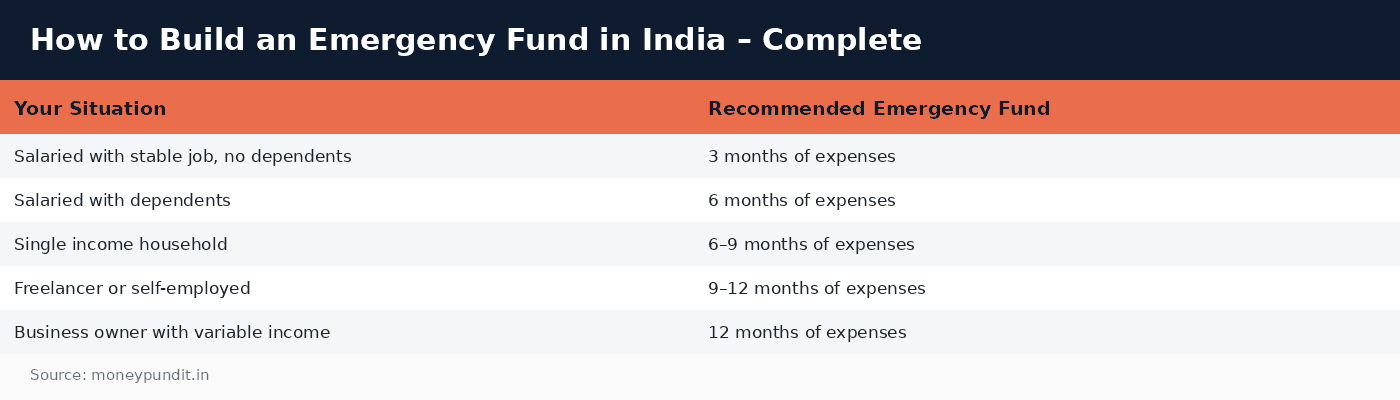
The right size depends on your situation. Here’s a framework based on your employment type and obligations:
| Your Situation | Recommended Emergency Fund |
|---|---|
| Salaried with stable job, no dependents | 3 months of expenses |
| Salaried with dependents | 6 months of expenses |
| Single income household | 6–9 months of expenses |
| Freelancer or self-employed | 9–12 months of expenses |
| Business owner with variable income | 12 months of expenses |
How to Calculate Your Monthly Expenses
Add up your essential monthly costs. Focus only on needs, not wants:
- Rent or home loan EMI
- Groceries and household essentials
- Utility bills (electricity, water, internet, phone)
- Insurance premiums (health, term life)
- Children’s school fees (if applicable)
- Loan EMIs (car loan, personal loan)
- Transportation (fuel, metro pass)
- Medical expenses (regular medications)
For example, if your monthly essentials total ₹40,000 and you’re a salaried professional with a family, your target emergency fund is ₹40,000 × 6 = ₹2,40,000.
Where to Keep Your Emergency Fund
Your emergency fund must be safe, liquid, and easily accessible. Returns are secondary: the primary goal is availability. Here are the best options ranked by liquidity:
1. High-Interest Savings Account (Best for 30–40% of your fund)
Keep 1–2 months’ worth in a savings account you can access via UPI or debit card instantly. Choose banks offering 6–7% interest like AU Small Finance Bank, Ujjivan Small Finance Bank, or Unity Small Finance Bank.
2. Liquid Mutual Funds (Best for 40–50% of your fund)
Liquid funds invest in short-term debt instruments and typically provide 6–7% returns. Redemptions up to ₹50,000 are processed instantly. Top options include Parag Parikh Liquid Fund, HDFC Liquid Fund, and ICICI Prudential Liquid Fund.
3. Fixed Deposits with Premature Withdrawal (Best for 20–30% of your fund)
Short-term FDs (3–6 months) earn 6.5–7.5% in most banks. While there’s a premature withdrawal penalty (usually 0.5–1%), the higher interest rate often compensates. Consider FDs from SBI, HDFC Bank, or ICICI Bank.
Where NOT to Keep Your Emergency Fund
- Equity mutual funds or stocks: too volatile, can be down 30% when you need it most
- PPF or NPS: lock-in periods make them useless for emergencies
- Gold or real estate: not liquid enough
- Crypto: extreme volatility, potential for massive loss
- Under your mattress: earns 0%, loses to inflation
How to Build Your Emergency Fund Step by Step
Step 1: Set Your Target
Calculate your monthly essential expenses and multiply by the recommended number of months from the table above. Write this number down, it’s your goal.
Step 2: Start Small: Even ₹500/Month Counts
Don’t wait until you can save big. If your target is ₹2,40,000 and you can save ₹5,000/month, you’ll reach your goal in 48 months. If you can save ₹10,000/month, you’ll hit it in 24 months. The key is to start now.
Step 3: Automate Your Savings
Set up an automatic transfer on salary day. Money you don’t see is money you don’t spend. Most banks allow recurring transfers, set one up from your salary account to your emergency fund account.
Step 4: Use Windfalls to Accelerate
Got a bonus? Tax refund? Cash gift? Put at least 50% directly into your emergency fund. These lumps sums can cut months off your timeline.
Step 5: Replenish After Using It
If you dip into your emergency fund (that’s what it’s for!), make refilling it your top financial priority. Pause SIPs temporarily if needed, the emergency fund comes first.
Emergency Fund vs. Insurance: Know the Difference
An emergency fund and insurance serve different purposes. You need both:
| Scenario | Emergency Fund | Insurance |
|---|---|---|
| Job loss | ✅ Covers expenses while job hunting | ❌ No coverage |
| Major surgery | ✅ Covers deductible/co-pay | ✅ Covers hospital bills |
| Car breakdown | ✅ Covers repair costs | ✅ If comprehensive policy |
| Death of breadwinner | ✅ Immediate expenses | ✅ Long-term family support |
| Appliance replacement | ✅ Covers cost | ❌ No coverage |
The emergency fund handles the small-to-medium shocks. Insurance handles the catastrophic ones. Together, they make you financially resilient.
Common Mistakes to Avoid
- Investing your emergency fund in stocks: A market crash and a job loss often happen together. Your emergency fund would be worth less exactly when you need it most.
- Keeping everything in a savings account: While safe, a savings account at 3–4% loses to inflation. Split your fund across savings, liquid funds, and short FDs.
- Using it for non-emergencies: A sale on electronics is not an emergency. A new iPhone is not an emergency. Be disciplined.
- Not adjusting for life changes: Got married? Had a child? Took a home loan? Recalculate your emergency fund every year.
- Waiting for the “right time”: There’s no perfect time to start. The best time was yesterday. The second best time is today.
Emergency Fund FAQ
Should I build an emergency fund before investing?
Yes, absolutely. Your emergency fund should be Priority #1. Without it, you might be forced to redeem investments at a loss during a crisis. Build at least 3 months of expenses before starting SIPs.
Can I use a credit card as my emergency fund?
No. Credit cards charge 36–42% annual interest. Using a credit card in an emergency and then paying minimum dues turns a temporary crisis into a long-term debt trap. Your emergency fund should be actual cash savings.
Should married couples have separate emergency funds?
If both partners earn, a joint emergency fund covering 6 months of household expenses is sufficient. However, each partner should also have a small personal emergency reserve (1 month of personal expenses) for independence.
How often should I review my emergency fund?
Review annually or whenever there’s a major life change, new job, marriage, child, home purchase, salary change. Adjust the target amount based on your current monthly expenses.
The Bottom Line
An emergency fund isn’t glamorous. It won’t make you rich. But it will keep you from going into debt, making panic decisions, or liquidating investments at a loss when life throws a curveball.
Start today. Automate ₹5,000 (or whatever you can afford) into a separate savings account. Then gradually move portions into liquid funds and short FDs. In 12–24 months, you’ll have a fully-funded safety net, and the peace of mind that comes with it.
Frequently Asked Questions
How big should my emergency fund be?
Keep 6 months of essential expenses, and up to 12 months if your income is irregular or you have dependants.
Where should I keep my emergency fund?
Use liquid, low-risk options such as a savings account, a sweep-in FD or a liquid mutual fund, so you can withdraw quickly without loss of capital.
Should I invest my emergency fund in equities?
No. The purpose is availability and safety, not returns, so avoid volatile assets for this money.
Emergency fund: Key Takeaways
Key points on emergency fund:
- An emergency fund is money set aside specifically for unexpected financial shocks, job loss, medical emergencies, urgent home repairs, or any situation where you need cash fast without going into debt.
- For example, if your monthly essentials total ₹40,000 and you’re a salaried professional with a family, your target emergency fund is ₹40,000 × 6 = ₹2,40,000 .
- Your emergency fund must be safe, liquid, and easily accessible .
Verify the latest emergency fund figures with AMFI before you act.