

How to save money low salary in brief: Saving money on a limited income feels impossible, but even earning ₹15,000-₹30,000 per month, you can build a financial cushion and start investing for your future.
Most saving advice assumes you have discretionary spending to cut, but on a genuinely tight salary, the real savings usually come from renegotiating the big three fixed costs, not skipping coffee. Here’s a practical approach built for that situation specifically.
Saving money on a limited income feels impossible, but even earning ₹15,000-₹30,000 per month, you can build a financial cushion and start investing for your future. The key is not how much you earn but how intentionally you manage what you have. Small, consistent savings compound into meaningful wealth over time.
Track Every Rupee for One Month
Before saving, understand where your money goes. Use a simple notebook or free apps like Walnut, Money Manager, or even a Google Sheet. Categorize every expense: rent, food, transport, phone, entertainment, and miscellaneous. Most people discover they spend 15-25% of their income on things they do not even remember. This awareness alone triggers better spending decisions without feeling deprived.
Cut the Big Three: Housing, Food, Transport
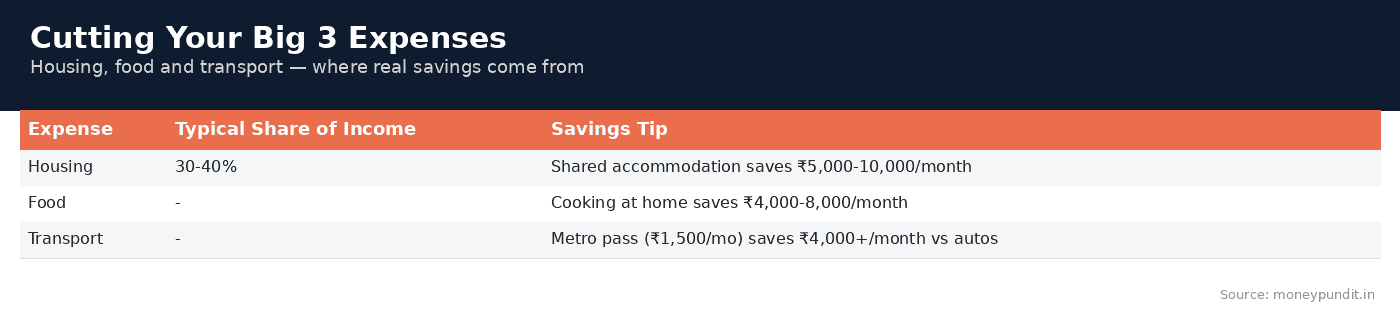
Housing typically consumes 30-40% of income. Consider shared accommodation, splitting rent with a roommate can save ₹5,000-₹10,000 monthly. Negotiate rent renewal instead of accepting increases. Food savings: cook at home for 80% of meals (saves ₹4,000-8,000 versus eating out/delivery). Meal prep on weekends to avoid expensive impulse meals. Transport: use public transport or bike instead of auto-rickshaws and cabs. A metro pass at ₹1,500/month versus ₹200/day on autos saves ₹4,000+ monthly.
Start with ₹500 Per Month
If you can only save ₹500, do it. Start a ₹500 SIP in a liquid fund for your emergency fund. Once you reach ₹10,000, open a recurring deposit alongside the SIP. When emergency fund reaches 3 months of expenses, redirect the SIP to an equity mutual fund for long-term growth. ₹500/month at 12% for 30 years grows to ₹17.6 lakh. It is not about the amount. It is about building the habit.
Increase Income Alongside Cutting Expenses
Freelancing on weekends using existing skills (writing, design, tutoring, data entry) can add ₹5,000-₹15,000 monthly. Online tutoring platforms, content writing gigs, and delivery services offer flexible income. Upskill through free online courses (NPTEL, Coursera, YouTube) to qualify for higher-paying roles. Selling unused items on OLX or social media provides one-time cash infusions. Every additional ₹5,000 saved per month adds ₹1.76 crore over 30 years at 12% returns.
Avoid These Money Traps
Buy Now Pay Later (BNPL) schemes encourage spending beyond means. Treat them as credit cards with the same discipline. Personal loans for lifestyle purchases create debt spirals. Keeping up with peers’ spending (new phone every year, branded clothes) drains savings. Lottery and gambling are mathematically designed to take your money. Insurance-cum-investment products (endowments, money-back plans) give poor returns, buy term insurance only.
How much should I save if I earn ₹20,000 per month?
Target 10% (₹2,000) initially. As you optimize expenses, aim for 20% (₹4,000). Split between emergency fund building and one equity SIP. Even this modest amount creates a ₹42 lakh corpus over 25 years at 12%, enough for a significant financial milestone.
Mindset Shift: It’s Not About How Much You Earn
The biggest myth in personal finance is that you need a high salary to save. In reality, saving is about the gap between income and expenses, not the absolute income level. Someone earning ₹25,000 who saves ₹5,000 monthly builds more wealth than someone earning ₹1 lakh who saves nothing. The first step is accepting that saving on a low salary requires intentional choices, it won’t happen automatically, but it’s absolutely achievable with the right strategies.
Start by tracking every rupee you spend for 30 days: use a simple notebook or a free app like Walnut or Money Manager. Most people are shocked to discover ₹3,000-₹8,000 in monthly “invisible spending” on impulse purchases, unused subscriptions, excessive ordering in, and convenience spending that can be redirected to savings. Apply the 50-30-20 budgeting rule as a starting framework and adjust based on your income level, on a low salary, a 60-20-20 or 70-10-20 split may be more realistic.
Practical Cost-Cutting That Actually Works
Focus on the big three expenses that consume 60-70% of most budgets: housing, food, and transportation. For housing, consider flat-sharing (saves ₹5,000-₹15,000/month in metros), negotiating rent during low-demand months, or relocating to a slightly less central area. For food, cooking at home versus ordering in saves ₹6,000-₹12,000 monthly for a typical individual, meal prepping on weekends reduces both cost and the temptation to order out on busy weekdays.
For transportation, use public transit or carpooling instead of daily cab rides, the difference between daily auto rides (₹200-₹400/day) and a metro pass (₹1,500/month) adds up to ₹3,000-₹8,000 monthly. Cancel unused subscriptions, audit your bank statement for recurring charges and cancel anything you haven’t used in 30 days. Switch to annual plans for services you actually use (Netflix, gym) to save 15-30% over monthly billing.
Making Your Small Savings Grow
Even ₹500-₹2,000/month in savings becomes significant when invested wisely. Start a SIP in an index fund with as little as ₹500/month: this money compounds at 12-13% annually over the long term. ₹2,000/month invested from age 22 at 12% becomes ₹64 lakh by age 50. The power of compounding works regardless of the starting amount: what matters is consistency and time.
Use government schemes designed for small savers: PPF (₹500 minimum annual deposit, 7.1% tax-free), Post Office Recurring Deposit (starts at ₹100/month, 6.7%), and Sukanya Samriddhi for daughters (₹250 minimum, 8.2% tax-free). Increase your savings rate by 50-100% of every salary increment, if you get a ₹3,000 raise, add ₹1,500-₹3,000 to your SIP rather than upgrading your lifestyle. This “save the raise” strategy accelerates wealth building without feeling like sacrifice.
References: Amfiindia.com
Source: amfiindia.com
How to save money low salary: Key Takeaways
Key points on how to save money low salary:
- Use a simple notebook or free apps like Walnut, Money Manager, or even a Google Sheet.
- Consider shared accommodation, splitting rent with a roommate can save ₹5,000-₹10,000 monthly.
- Once you reach ₹10,000, open a recurring deposit alongside the SIP.
Verify the latest how to save money low salary figures with Income Tax Department before you act.