
Financial goals by age in brief: The financial habits that matter most change completely between your 20s and your 50s, what counts as smart planning at 25 can actually work against you by 45.
The financial habits that matter most change completely between your 20s and your 50s, what counts as smart planning at 25 can actually work against you by 45. Here’s what to prioritize at each stage, from building your first emergency fund to protecting the wealth you’ve already built.
Financial planning is a lifelong journey, and what you should prioritize changes at each life stage. Having clear financial milestones for each decade keeps you on track and ensures you are building toward long-term security while enjoying life along the way.
Financial Goals By Age: Your 20s: Build the Foundation
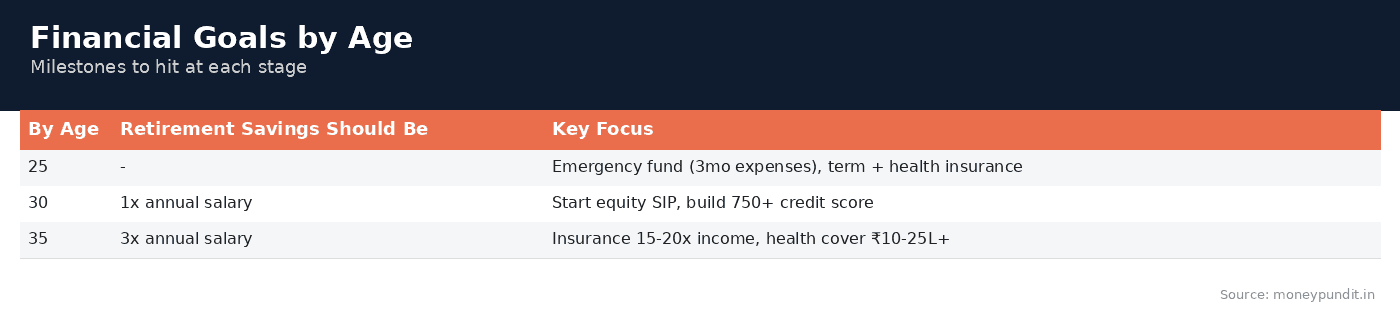
By 25: have an emergency fund of 3 months’ expenses, basic term life insurance if you have dependents, and health insurance beyond employer coverage. By 30: retirement savings should be at least 1x your annual salary (EPF + PPF + SIPs combined). Start at least one equity SIP, even ₹5,000/month. Build a strong credit score (750+) through responsible credit card use. Focus on skill development and career growth to maximize earning potential. Your 20s are your highest-return years for investment because of the decades of compounding ahead.
Your 30s: Accelerate Wealth Building
By 35: retirement savings should be 3x your annual salary. Have adequate insurance coverage: term insurance of 15-20x income, health insurance of ₹10-25 lakh plus super top-up. Start investing for children’s education if applicable. Begin saving for a home down payment if homeownership is a goal. Maximize tax-saving investments across 80C, 80D, 80CCD, and HRA. Your 30s are typically your highest savings years. Expenses increase in your 40s with children’s education costs.
Your 40s: Consolidate and Protect
By 45: retirement savings should be 6-8x your annual salary. Children’s education fund should be 50-70% of the target. Mortgage should be on track for payoff by retirement. Diversify investments, reduce concentration risk in any single stock or asset class. Start gradually shifting from aggressive equity to balanced allocation (60% equity, 40% debt). Review and update your will and estate plan. Consider long-term care insurance for parents if applicable.
Your 50s: Prepare for Retirement
By 55: retirement savings should be 12-15x your annual salary. Mortgage should be fully paid or very close. Shift to income-generating investments: dividend stocks, debt funds, SCSS, and POMIS. Catch-up contributions: maximize NPS, PPF, and SIP amounts. Plan your retirement healthcare: build a health insurance policy that you will carry into retirement (do not depend on employer coverage). Create a detailed retirement budget and test it by living on that budget for 6 months before retiring.
At Any Age: Universal Rules
Always have an emergency fund. Never take on debt for depreciating assets. Insure what you cannot afford to lose. Invest consistently regardless of market conditions. Increase savings rate with every salary increase. Review your financial plan annually and adjust for life changes. The best time to start investing was yesterday; the second-best time is today.
What if I am behind on these milestones?
Do not panic: many people start late and still achieve financial security. Focus on maximizing savings rate now (even 30-40% of income if possible), cutting unnecessary expenses, and investing aggressively in equity for remaining years. Consider delaying retirement by 2-3 years or developing additional income sources. Progress is more important than perfection.
Your 20s: Building the Foundation
Your 20s are the most financially powerful decade: not because of high income, but because of time. Every rupee invested in your 20s has 30-40 years to compound. Key milestones: build a ₹50,000-₹1 lakh emergency fund, start a monthly SIP (even ₹2,000-₹5,000 matters: ₹3,000/month from age 22 at 12% becomes ₹1 crore by age 52), get term life insurance if you have dependents (cheapest premiums are in your 20s), buy health insurance independently (don’t rely solely on employer cover), and build your CIBIL score with a first credit card used responsibly.
Avoid in your 20s: lifestyle inflation that eats up every salary hike, EMD traps on cars and gadgets you can’t afford, and ignoring employer benefits like EPF and group health insurance. The 50-30-20 budgeting rule provides a practical framework: aim for 20% savings rate and increase it with every raise.
Your 30s: Accelerating Wealth Building
Your 30s typically bring higher income alongside higher expenses, marriage, children, homeownership. Key milestones: increase SIP to 25-30% of income, maximise Section 80C investments (₹1.5 lakh in ELSS/PPF), buy a home strategically (EMI should be under 30% of take-home pay. Use our Home Loan EMI Calculator), start a child education fund, increase term life cover to 15-20x annual income, and upgrade health insurance to ₹15-25 lakh family floater.
Your 30s are also when you should have 6 months’ expenses in an emergency fund, a will and nomination on all accounts and investments, and a clear retirement corpus target. If you haven’t started investing yet, don’t panic: but start immediately. The 30s-40s period is when the steepest wealth accumulation happens through aggressive saving and equity investing.
Your 40s and 50s: Protecting and Transitioning
In your 40s, focus on: reviewing and rebalancing your portfolio (ensure you’re on track for retirement, if not, increase contributions aggressively), paying off high-interest debt completely, building your child’s education corpus with a shift toward safer instruments as the goal approaches, and maximising employer NPS contributions for the additional 80CCD(1B) tax benefit.
In your 50s, shift to preservation mode: gradually move equity allocation to 40-50% (from 70-80% in your 30s), build a 2-year cash reserve for early retirement flexibility, review insurance. You may no longer need term life insurance if your children are independent and corpus is adequate, but health insurance becomes more critical. Plan your post-retirement income strategy using SWP from mutual funds, FD laddering, and government schemes like SCSS. The decisions you make in your 50s directly determine your quality of life in retirement.
References: Amfiindia.com
Source: amfiindia.com
Financial goals by age: Key Takeaways
Key points on financial goals by age:
- By 25: have an emergency fund of 3 months’ expenses, basic term life insurance if you have dependents, and health insurance beyond employer coverage.
- Have adequate insurance coverage: term insurance of 15-20x income, health insurance of ₹10-25 lakh plus super top-up.
- By 45: retirement savings should be 6-8x your annual salary.
Related tools for financial goals by age: SIP calculator, tax calculator and FD calculator.
Verify the latest financial goals by age figures with RBI before you act.