

Best investment plan in brief: If you have ₹1 lakh to invest, you’re in a great position to start building real wealth.
Looking for the best investment plan 1 lakh in India? If you have ₹1 lakh to invest, you’re in a great position to start building real wealth. Whether it’s your first bonus, savings from a few months, or money sitting idle in a savings account, investing ₹1 lakh wisely can set the foundation for your financial future. But with dozens of options, from FDs to mutual funds to stocks, where should you actually put your money? The answer depends on your goals, timeline, and risk appetite.
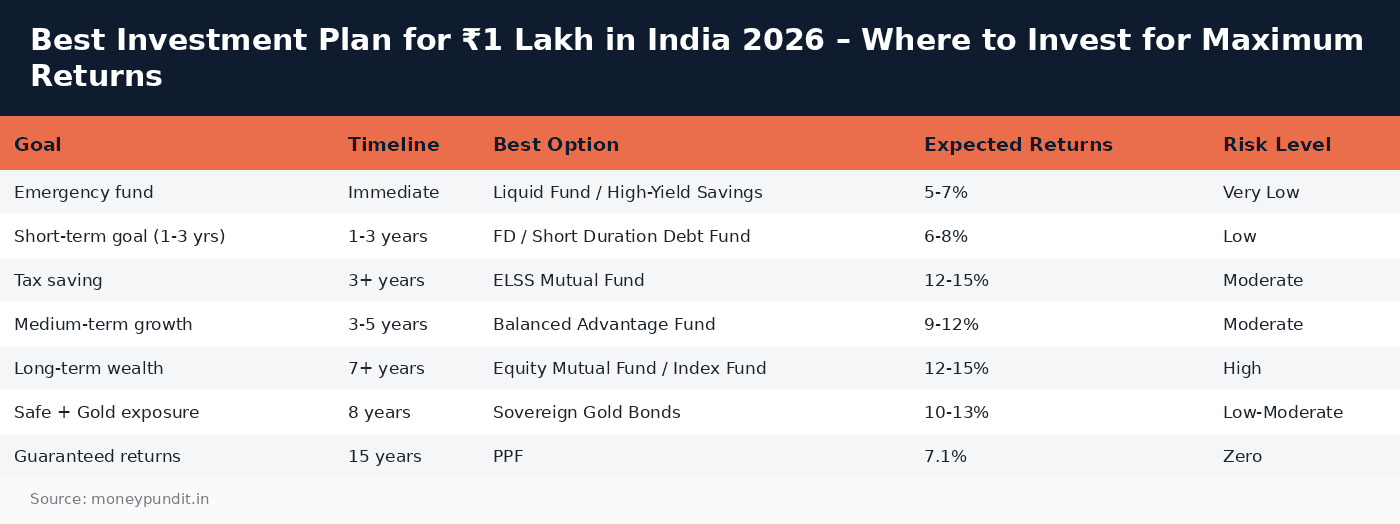
Best Investment Plan 1 Lakh: Quick Answer Based on Your Goal
| Goal | Timeline | Best Option | Expected Returns | Risk Level |
|---|---|---|---|---|
| Emergency fund | Immediate | Liquid Fund / High-Yield Savings | 5-7% | Very Low |
| Short-term goal (1-3 yrs) | 1-3 years | FD / Short Duration Debt Fund | 6-8% | Low |
| Tax saving | 3+ years | ELSS Mutual Fund | 12-15% | Moderate |
| Medium-term growth | 3-5 years | Balanced Advantage Fund | 9-12% | Moderate |
| Long-term wealth | 7+ years | Equity Mutual Fund / Index Fund | 12-15% | High |
| Safe + Gold exposure | 8 years | Sovereign Gold Bonds | 10-13% | Low-Moderate |
| Guaranteed returns | 15 years | PPF | 7.1% | Zero |
Option 1: Equity Mutual Funds via SIP (Best for Long-Term Wealth)
If you don’t need the ₹1 lakh for at least 5-7 years, equity mutual funds offer the highest growth potential. Rather than investing ₹1 lakh as a lump sum, consider a Systematic Transfer Plan (STP), park the money in a liquid fund and automatically transfer ₹8,000-10,000 per month into an equity fund over 10-12 months. This reduces the risk of investing everything at a market peak.
Recommended funds for a ₹1 lakh investment: Parag Parikh Flexi Cap Fund (diversified with US stock exposure), UTI Nifty 50 Index Fund (low-cost passive option), or Mirae Asset Large Cap Fund (consistent large-cap performer). At 13% CAGR, ₹1 lakh in equity mutual funds can grow to approximately ₹3.4 lakh in 10 years and ₹11.5 lakh in 20 years.
Option 2: ELSS Mutual Fund (Best for Tax Saving)
If you haven’t used your Section 80C limit of ₹1.5 lakh, investing ₹1 lakh in an ELSS (Equity Linked Savings Scheme) fund kills two birds with one stone, you get tax savings of up to ₹31,200 (in the 30% tax bracket under old regime) and long-term equity growth. ELSS has the shortest lock-in (3 years) among Section 80C options. Top ELSS funds include Quant ELSS Tax Saver, Mirae Asset Tax Saver, and Canara Robeco Equity Tax Saver.
Option 3: Index Funds / ETFs (Best for Passive Investors)
If you want market returns without the complexity of choosing active funds, put ₹1 lakh in a Nifty 50 or Nifty Next 50 index fund. The Nifty 50 has delivered approximately 12-13% CAGR over the past 20 years. For a more diversified approach, split ₹60,000 in Nifty 50 index fund and ₹40,000 in Nifty Next 50 index fund. Index funds have the lowest expense ratios (0.10-0.20%) and no fund manager risk.
Option 4: Fixed Deposit (Best for Capital Safety)
If you absolutely cannot afford to lose any money, a bank FD is the safest option. Top FD rates in 2026 range from 7-8.5% for 1-3 year tenures. Small finance banks like Unity SFB, Suryoday SFB, and AU SFB offer the highest rates (up to 8.5%), while SBI and HDFC offer 6.5-7%. For senior citizens, add 0.25-0.75% extra. A ₹1 lakh FD at 7.5% grows to ₹1.48 lakh in 5 years and ₹2.06 lakh in 10 years, safe but modest after inflation and tax.
Option 5: Sovereign Gold Bonds (Best for Gold Exposure)
If you want gold in your portfolio, invest ₹1 lakh in SGBs during the next RBI tranche. You’ll get approximately 13 grams of gold at current prices, earn 2.5% annual interest (₹2,500/year), and the capital gains are completely tax-free at maturity (8 years). SGBs have been one of the best-performing asset classes in recent years, with early tranches delivering 12-15% CAGR including interest.
Option 6: Split Strategy (Best Balanced Approach)
If you’re unsure and want a balanced approach, split your ₹1 lakh across multiple options. A suggested allocation: ₹40,000 in a flexi-cap or index equity mutual fund (for growth), ₹20,000 in a balanced advantage fund (for moderate growth with downside protection), ₹20,000 in PPF or debt mutual fund (for safety), and ₹20,000 in Sovereign Gold Bonds (for diversification). This gives you exposure to equity, debt, and gold, the three core asset classes.
How to Choose the Best Investment Plan 1 Lakh in 2026
Choosing the best investment plan 1 lakh requires careful consideration of several factors. Your age, income stability, existing investments, and financial goals all play a crucial role in determining the right allocation.
For investors under 30, the best investment plan 1 lakh typically involves higher equity allocation (70-80%) since you have time to ride out market volatility. A combination of equity mutual funds via SIP and an ELSS fund gives you both growth potential and tax savings under Section 80C.
For investors between 30-45, a balanced approach works better. Consider allocating 50% to equity mutual funds, 20% to debt instruments like FDs or debt mutual funds, and 30% to tax-saving options like ELSS or PPF. This balanced strategy represents the best investment plan 1 lakh at this life stage because it balances growth with stability.
For investors above 45 approaching retirement, capital preservation becomes important. Fixed deposits, sovereign gold bonds, and debt mutual funds should form the bulk of your portfolio. Even at this stage, maintaining 20-30% in equity through large-cap or index funds is advisable for inflation protection.
Choosing the best investment plan 1 lakh also means knowing which options to avoid entirely.
Where NOT to Invest ₹1 Lakh
Avoid LIC endowment or money-back policies: they promise “guaranteed returns” of 4-5% which doesn’t even beat inflation. Don’t put it all in a savings account earning 2.5-4%. Avoid cryptocurrency unless you fully understand the risks and tax implications (30% flat tax on gains). Don’t invest in “tip-based” penny stocks recommended on WhatsApp or Telegram groups. And don’t invest in real estate chit funds or unregulated schemes promising 15-20% guaranteed returns. If it sounds too good to be true, it usually is.
Best Investment Plan 1 Lakh: Lump Sum vs STP Deployment
For debt investments (FD, PPF, liquid fund), invest the full ₹1 lakh at once. Timing doesn’t matter much for fixed-income instruments. For equity investments, use a Systematic Transfer Plan (STP). Park ₹1 lakh in a liquid fund of the same AMC, then set up a weekly or monthly STP into the equity fund. This way, your money earns 5-6% in the liquid fund while being gradually transferred to equity, averaging out market volatility.
Best Investment Plan 1 Lakh: Expert Resources & Further Reading
Before finalizing your best investment plan 1 lakh, consider consulting these authoritative resources for the latest rates and regulations:
- AMFI India: Official Association of Mutual Funds in India for fund data and NAV
- SEBI: Securities and Exchange Board of India for investor protection guidelines
- Reserve Bank of India: For current FD and savings account interest rates
- Income Tax Department: Section 80C deduction limits and ELSS tax benefits
- NSE India: For index fund benchmarks like Nifty 50 and Nifty Next 50
Related MoneyPundit Guides & Calculators
Use these MoneyPundit tools and guides to build the best investment plan 1 lakh tailored to your financial situation:
- FD Calculator: Calculate fixed deposit maturity amount before locking in your money
- Best ELSS Funds 2026: Top tax-saving mutual funds ranked by returns
- Best Index Funds 2026: Low-cost passive funds for long-term wealth building
- SIP vs Lumpsum: Detailed comparison to decide how to deploy your 1 lakh
- PPF vs FD vs ELSS: Compare all tax-saving options side by side
- Power of Compounding: See how your 1 lakh can grow over 10-20 years
- NPS Calculator: Estimate your pension corpus for retirement planning
The best investment plan 1 lakh depends entirely on your goals, risk appetite, and time horizon. Start with the split strategy above if you are unsure, and use our calculators to model different scenarios before committing your money.
Now that you understand every option available, here is a summary of the most common questions people ask about the best investment plan 1 lakh strategy for Indian investors.
Frequently Asked Questions About Best Investment Plan 1 Lakh
Can ₹1 lakh grow to ₹10 lakh?
Yes, at 12% CAGR (achievable through equity mutual funds), ₹1 lakh grows to approximately ₹10.3 lakh in 20 years. At 15% CAGR, it reaches ₹10 lakh in about 17 years. The key is patience and not withdrawing during market downturns.
Should I invest ₹1 lakh in one fund or multiple funds?
For ₹1 lakh, 1-2 funds are sufficient. Over-diversifying with 5-6 funds at this level creates unnecessary complexity. A single flexi-cap or index fund provides enough diversification for this amount. As your portfolio grows beyond ₹5 lakh, you can add more funds.
What if I need the money back in 6 months?
If you might need the money within 6-12 months, avoid equity completely. Put it in a liquid mutual fund (5-6% returns, withdrawable within 1 day) or a short-term FD (6-7% with premature withdrawal option). Equity investments should only be made with money you won’t need for at least 3-5 years.
References: Amfiindia.com, Sebi.gov.in, Rbi.org.in, Nseindia.com
Best investment plan: Key Takeaways
Key points on best investment plan:
- If you don’t need the ₹1 lakh for at least 5-7 years, equity mutual funds offer the highest growth potential.
- ELSS has the shortest lock-in (3 years) among Section 80C options.
- If you want market returns without the complexity of choosing active funds, put ₹1 lakh in a Nifty 50 or Nifty Next 50 index fund.
Verify the latest best investment plan figures with RBI before you act.