
Etf vs index fund in brief: One needs a demat account and trades like a stock, the other doesn’t and settles once a day.
An ETF and an index fund can track the exact same benchmark and still behave very differently for you as an investor. One needs a demat account and trades like a stock, the other doesn’t and settles once a day. Here’s a detailed comparison for Indian investors deciding between the two.
Passive investing has exploded in India, with both ETFs (Exchange Traded Funds) and index mutual funds seeing massive inflows. Both track the same benchmarks like Nifty 50 or Sensex, yet they work differently in ways that matter for your returns. This guide explains the key differences between ETFs and index funds in India, helping you decide which is the better choice for your investment goals.
What Is an Index Fund?
An index fund is a mutual fund that replicates a market index like Nifty 50, Sensex, Nifty Next 50, or Nifty Midcap 150. It buys the same stocks in the same proportion as the index and aims to deliver returns that mirror the index performance (minus a small expense ratio). You invest in index funds through AMC websites, mutual fund apps (Groww, Zerodha Coin), or distributors. Just like any other mutual fund. Units are bought and sold at the day’s NAV (Net Asset Value), calculated at end of day.
What Is an ETF?
An ETF (Exchange Traded Fund) also tracks a market index, but it trades on the stock exchange like a regular share. You need a demat and trading account to buy ETFs, and you can buy/sell them anytime during market hours at real-time prices. ETFs typically have lower expense ratios than index funds, but they come with additional costs like brokerage, demat charges, and the impact of bid-ask spread.
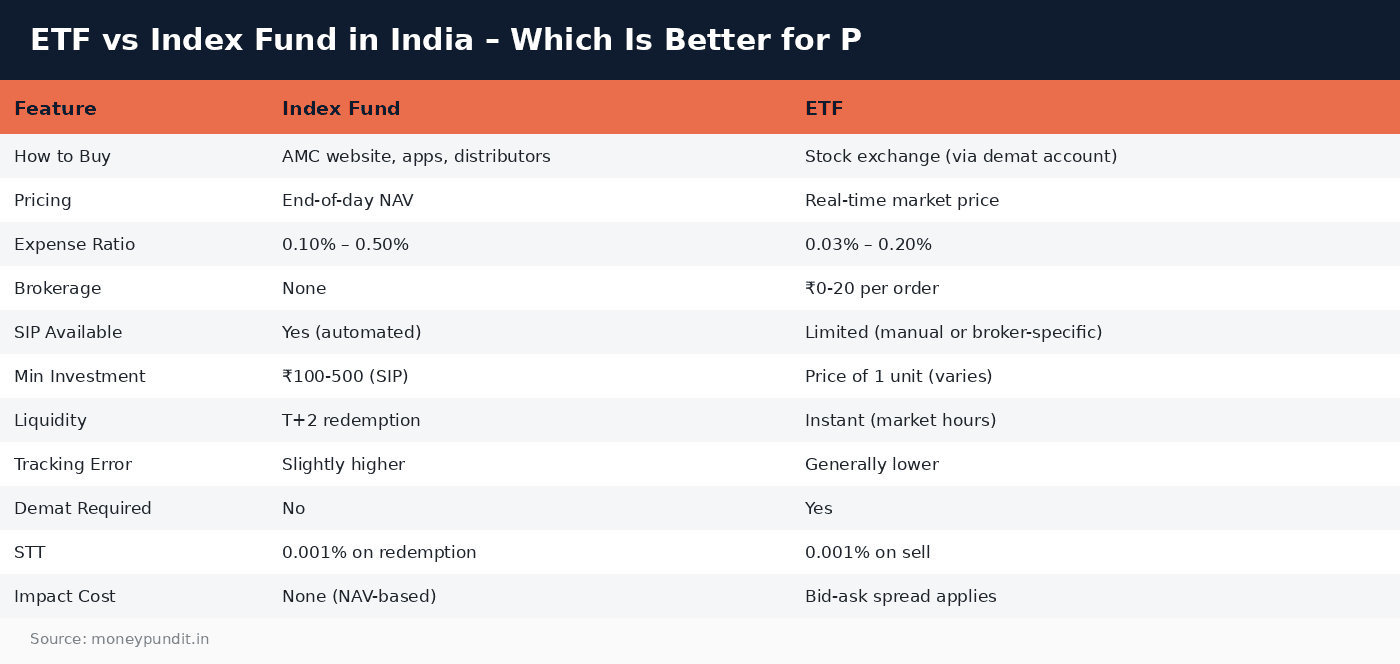
ETF vs Index Fund – Detailed Comparison
| Feature | Index Fund | ETF |
|---|---|---|
| How to Buy | AMC website, apps, distributors | Stock exchange (via demat account) |
| Pricing | End-of-day NAV | Real-time market price |
| Expense Ratio | 0.10% – 0.50% | 0.03% – 0.20% |
| Brokerage | None | ₹0-20 per order |
| SIP Available | Yes (automated) | Limited (manual or broker-specific) |
| Min Investment | ₹100-500 (SIP) | Price of 1 unit (varies) |
| Liquidity | T+2 redemption | Instant (market hours) |
| Tracking Error | Slightly higher | Generally lower |
| Demat Required | No | Yes |
| STT | 0.001% on redemption | 0.001% on sell |
| Impact Cost | None (NAV-based) | Bid-ask spread applies |
The Real Cost Comparison
On paper, ETFs look cheaper because of lower expense ratios. But the total cost of owning an ETF includes brokerage (₹0-20 per trade), demat AMC (₹0-300/year), bid-ask spread (the difference between buying and selling price, which can be 0.05-0.50% for less liquid ETFs), and the premium/discount to NAV (ETFs sometimes trade above or below their actual NAV).
For example, the Nippon India Nifty 50 BeES ETF has an expense ratio of 0.04%, but if the bid-ask spread is 0.10% and you pay ₹20 brokerage on a ₹10,000 investment (0.20%), your effective cost is 0.34%, higher than many index funds. This matters more for small, regular investments (SIPs) than for large lump sums.
When Index Funds Are Better
Index funds are the better choice when you want to invest through SIPs (automated monthly investing is seamless with index funds but cumbersome with ETFs), you invest small amounts regularly (brokerage on each ETF purchase eats into returns), you don’t have a demat account and don’t want to open one, and you prefer simplicity (buy and forget without worrying about market prices or liquidity).
When ETFs Are Better
ETFs make more sense when you’re investing large lump sums (the lower expense ratio saves more on bigger amounts), you want intraday liquidity (ability to buy/sell at exact market prices during trading hours), you already have a demat account for stock trading, and you’re investing in highly liquid ETFs like Nifty 50 BeES or Sensex ETFs where bid-ask spreads are minimal.
Best Index Funds and ETFs in India 2026
Top Nifty 50 Index Funds
UTI Nifty 50 Index Fund (expense ratio 0.18%, one of the oldest and largest), HDFC Index Fund – Nifty 50 (expense ratio 0.20%, consistent tracking), and Axis Nifty 50 Index Fund (expense ratio 0.12%, among the lowest cost) are top choices. All three have delivered returns within 0.1-0.3% of the Nifty 50 index over 5-year periods.
Top Nifty 50 ETFs
Nippon India Nifty 50 BeES (expense ratio 0.04%, highest liquidity), SBI Nifty 50 ETF (expense ratio 0.07%, good liquidity), and ICICI Prudential Nifty 50 ETF (expense ratio 0.05%, tight bid-ask spread) are the most popular. Nippon’s BeES has the highest trading volume, making it the best choice for minimal impact cost.
The Liquidity Problem With Indian ETFs
One major issue with ETFs in India is liquidity. While Nifty 50 ETFs trade actively, many thematic and sectoral ETFs have very low trading volumes. This means wider bid-ask spreads and difficulty in buying/selling at fair prices. For instance, some midcap and smallcap ETFs may have a bid-ask spread of 0.5-1%, completely negating their expense ratio advantage. Always check the daily trading volume of an ETF before investing. Ideally it should have average daily volumes above ₹5 crore.
Tax Treatment
Both index funds and ETFs are treated identically for taxation. Equity-oriented funds (tracking equity indices) attract 20% STCG (holding less than 1 year) and 12.5% LTCG (holding more than 1 year, with ₹1.25 lakh annual exemption). The tax treatment doesn’t differ between the two, so taxation should not be a deciding factor.
Frequently Asked Questions
Can I do SIP in ETFs?
Traditional automated SIPs are not available for most ETFs. Some brokers like ICICI Direct and HDFC Securities offer “ETF SIP” features, but these are essentially automated buy orders placed at market price, which may not execute at the ideal price. For hassle-free SIPs, index funds are clearly the better option.
Are ETFs safer than index funds?
Both carry the same market risk since they track the same index. In terms of counterparty risk, both are SEBI-regulated and your money is held separately from the fund house’s assets. ETFs have a slight structural advantage. They trade on the exchange and are backed by actual shares deposited with the depository.
Should I switch from index fund to ETF?
If you’re doing regular SIPs of moderate amounts, stick with index funds, the convenience and zero brokerage outweigh the slightly higher expense ratio. If you have a large lump sum (₹5 lakh+) and already trade stocks, consider a liquid Nifty 50 ETF for the lower ongoing cost. There’s no need to switch existing investments. The difference is marginal for most retail investors.
References: Amfiindia.com
Related reading: ETF vs Mutual Fund: Which Should You Choose?
ETF vs index fund: Key Takeaways
Key points on etf vs index fund:
- An index fund is a mutual fund that replicates a market index like Nifty 50, Sensex, Nifty Next 50, or Nifty Midcap 150.
- An ETF (Exchange Traded Fund) also tracks a market index, but it trades on the stock exchange like a regular share.
- On paper, ETFs look cheaper because of lower expense ratios.
Verify the latest etf vs index fund figures with AMFI before you act.