
Zerodha, Groww, and Angel One are the three most popular discount brokers in India, collectively serving over 3 crore active investors. Each has its strengths. Zerodha leads in trading tools, Groww in simplicity, and Angel One in free research. But which one should you choose? This detailed Zerodha vs Groww vs Angel One comparison for 2026 covers everything from charges and features to platform experience and customer support.
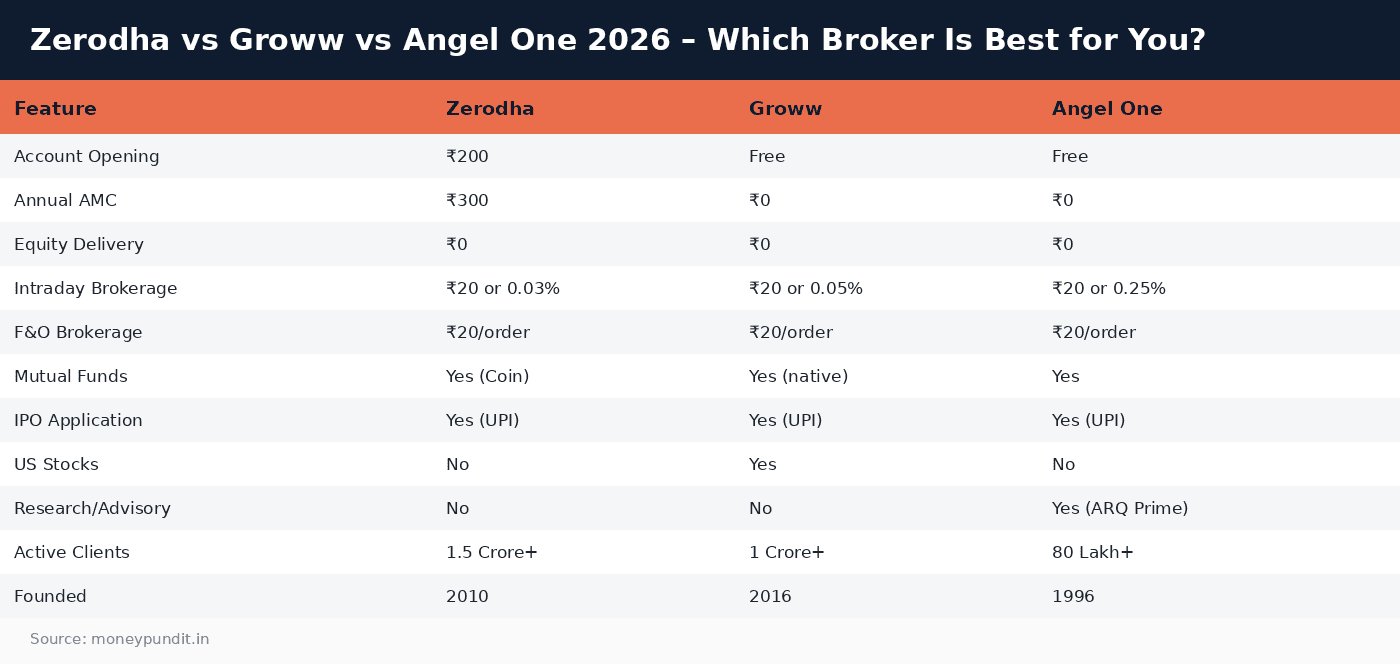
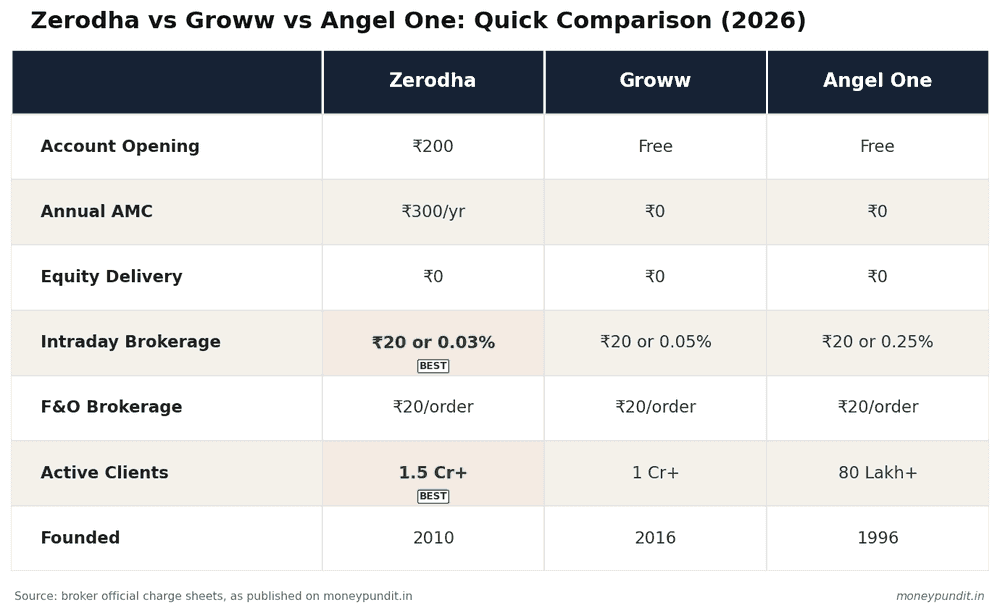
Quick Comparison: Zerodha vs Groww vs Angel One
| Feature | Zerodha | Groww | Angel One |
|---|---|---|---|
| Account Opening | ₹200 | Free | Free |
| Annual AMC | ₹300 | ₹0 | ₹0 |
| Equity Delivery | ₹0 | ₹0 | ₹0 |
| Intraday Brokerage | ₹20 or 0.03% | ₹20 or 0.05% | ₹20 or 0.25% |
| F&O Brokerage | ₹20/order | ₹20/order | ₹20/order |
| Mutual Funds | Yes (Coin) | Yes (native) | Yes |
| IPO Application | Yes (UPI) | Yes (UPI) | Yes (UPI) |
| US Stocks | No | Yes | No |
| Research/Advisory | No | No | Yes (ARQ Prime) |
| Active Clients | 1.5 Crore+ | 1 Crore+ | 80 Lakh+ |
| Founded | 2010 | 2016 | 1996 |
Zerodha – The Industry Pioneer
Strengths
Zerodha‘s Kite platform is the gold standard for Indian trading apps. It features TradingView-powered advanced charts with 100+ indicators, multiple order types (bracket, cover, GTT), a blazing-fast order execution engine, and a clean interface that works equally well on web and mobile. Zerodha’s ecosystem is extensive. Varsity for education, Console for analytics and tax P&L, Streak for algo trading without coding, and Coin for direct mutual funds.
Weaknesses
Zerodha is the only one of the three that charges for account opening (₹200) and annual maintenance (₹300/year). There’s no in-built stock recommendation or advisory service. You need to do your own research. Customer support has been a pain point, with most support handled through tickets rather than phone calls.
Best For
Active traders who need advanced charting and order types, tech-savvy investors who prefer a professional-grade platform, and those who value a proven and reliable trading engine. In the Zerodha vs Groww vs Angel One debate, Zerodha wins on platform maturity.
Groww – The Simplicity Champion
Strengths
Groww has the most beginner-friendly interface among all Indian brokers. The app design is clean, the navigation is intuitive, and complex financial concepts are explained in simple language within the app. Groww uniquely offers US stock investing directly from the app (fractional shares starting at $1), making it the only major Indian broker with this feature. Its mutual fund experience is excellent. It was originally a mutual fund platform and the UX shows.
Weaknesses
The trading platform lacks advanced charting tools that serious traders need. There are limited order types compared to Zerodha (no bracket orders or GTT in the free version). The stock screener and analysis tools are basic. Groww’s customer support, while improving, still relies heavily on chatbot and email.
Best For
When comparing Zerodha vs Groww vs Angel One for beginners, Groww is the clear winner. Complete beginners making their first investments, mutual fund focused investors who also want to buy stocks, investors interested in US stocks, and anyone who values simplicity over advanced features.
Angel One – The Value Leader
Strengths
Angel One stands out with its ARQ Prime: an AI-powered advisory engine that provides stock and mutual fund recommendations based on algorithms. It’s completely free and included with every account. The platform offers SmartAPI for algo trading, detailed research reports from Angel One’s in-house team, and a reward points system (Angel Bee) for trading activity. Being established in 1996, Angel One has one of the longest track records among Indian brokers.
Weaknesses
The intraday brokerage structure (0.25% or ₹20, whichever is lower) can be slightly more expensive for very small trades compared to Zerodha. The app interface, while improved significantly in recent years, still feels slightly cluttered compared to Groww. Some users report aggressive marketing calls and push notifications.
Best For
In the Zerodha vs Groww vs Angel One contest, Angel One stands out for AI recommendations. Investors who want free research recommendations and advisory, traders interested in algo trading through SmartAPI, and beginners who want guided stock picks rather than doing all research themselves.
Zerodha vs Groww vs Angel One: Platform & App Experience
In terms of pure trading experience, Zerodha Kite leads with its professional-grade charting, fast execution, and extensive keyboard shortcuts. Groww offers the cleanest, most beginner-friendly design with excellent onboarding. Angel One falls in between. More features than Groww but less polished than Zerodha. For mutual fund investing specifically, Groww has the best experience, followed by Zerodha Coin and then Angel One.
Customer Support: Zerodha vs Groww vs Angel One
Customer support is a common pain point across all three discount brokers. Angel One offers phone support and has physical branches in major cities, an advantage for investors who prefer face-to-face interaction. Zerodha relies on tickets and email (no phone support), which can be frustrating during urgent issues. Groww uses chatbot-first support with email escalation. For best customer support, Angel One has a slight edge due to phone and branch availability.
Zerodha vs Groww vs Angel One: Detailed Charges Comparison
Beyond basic brokerage, there are several hidden charges that can add up. Here is a detailed Zerodha vs Groww vs Angel One charges breakdown for 2026.
| Charge Type | Zerodha | Groww | Angel One |
|---|---|---|---|
| Account Opening | Rs 200 | Free | Free |
| Annual Maintenance (AMC) | Rs 300/year | Rs 0 | Rs 0 |
| Equity Delivery | Zero | Zero | Zero |
| Equity Intraday | Rs 20 or 0.03% | Rs 20 or 0.05% | Rs 20 or 0.25% |
| F and O (per order) | Rs 20 | Rs 20 | Rs 20 |
| DP Charges (per sell txn) | Rs 15.93 | Rs 15.93 | Rs 20 |
| Call and Trade | Rs 50/order | Not Available | Rs 20/order |
| Pledge/Unpledge | Rs 30 + GST | Rs 0 | Rs 20 + GST |
| Physical Contract Note | Rs 20/note + courier | Not Available | Rs 20/note |
| Margin Funding | Not Available | Not Available | Available (18% p.a.) |
For long-term delivery investors who make fewer than 10 trades per month, the total annual cost difference between these three brokers is minimal. However, for active intraday and F and O traders, Zerodha’s lower percentage-based brokerage (0.03% vs 0.25%) can result in significant savings on smaller trade sizes.
Zerodha vs Groww vs Angel One: Safety & Regulation
In the Zerodha vs Groww vs Angel One safety analysis, all three brokers are registered with SEBI (Securities and Exchange Board of India) and are members of major stock exchanges. Here is how they compare on safety parameters.
| Parameter | Zerodha | Groww | Angel One |
|---|---|---|---|
| SEBI Registration | INZ000031633 | INZ000274033 | INZ000078535 |
| NSE Member | Yes | Yes | Yes |
| BSE Member | Yes | Yes | Yes |
| MCX Member | Yes | No | Yes |
| Depository | CDSL | CDSL | CDSL |
| Two-Factor Auth | Yes (TOTP) | Yes (Biometric/PIN) | Yes (MPIN) |
| Insurance (CIPF) | Yes (up to Rs 25 lakh) | Yes (up to Rs 25 lakh) | Yes (up to Rs 25 lakh) |
| Years in Operation | 16 years (since 2010) | 10 years (since 2016) | 30 years (since 1996) |
Angel One has the longest track record at 30 years, which gives it an edge in terms of proven stability. Zerodha, despite being younger, has become the largest broker in India by active clients. All three brokers segregate client funds from their own, as required by SEBI regulations, so your money and shares remain safe even if the broker faces financial difficulties.
Mobile App Ratings and User Experience
The mobile trading app is where most investors spend their time. In the Zerodha vs Groww vs Angel One mobile app comparison, here is how the three apps compare based on Google Play Store ratings and user feedback as of 2026.
| App Feature | Zerodha Kite | Groww App | Angel One App |
|---|---|---|---|
| Play Store Rating | 4.3 stars | 4.4 stars | 4.2 stars |
| Downloads | 10 Cr+ | 10 Cr+ | 10 Cr+ |
| App Size | ~45 MB | ~55 MB | ~65 MB |
| Charting | TradingView (Advanced) | Basic Charts | Intermediate |
| Watchlist Limit | 50 per list (5 lists) | Unlimited | 50 per list |
| Dark Mode | Yes | Yes | Yes |
| Widgets | Yes | Yes | Yes |
| Biometric Login | Yes | Yes | Yes |
Groww leads in overall Play Store rating thanks to its clean, beginner-friendly design. Zerodha Kite offers the most powerful charting and analysis tools for serious traders. Angel One falls in between, with a feature-rich app that has improved significantly over the past two years but can feel slightly overwhelming for beginners.
Commodity and Currency Trading
If you want to trade commodities (gold, silver, crude oil) or currency pairs (USD/INR, EUR/INR), your broker choice matters because not all platforms support these segments.
Zerodha offers commodity trading on MCX and currency trading on NSE with the same Kite platform. Charges are Rs 20 per order, similar to equity. Angel One also supports both commodity and currency trading through MCX and NSE, making it a versatile choice for multi-asset traders. Groww currently does not support commodity trading on MCX, which is a notable limitation for investors who want to diversify into gold, silver, or crude oil futures. For currency trading, all three brokers offer access through the NSE currency derivatives segment.
Our Verdict: Zerodha vs Groww vs Angel One
In this Zerodha vs Groww vs Angel One comparison, there’s no single “best” broker. It depends on what you value most. Choose Zerodha if you’re serious about trading and want the best platform with advanced tools. Choose Groww if you’re a beginner, primarily invest in mutual funds, or want to invest in US stocks. Choose Angel One if you want free research and recommendations, plan to explore algo trading, or prefer having phone support and branch access.
Many experienced investors maintain accounts with two brokers. One for long-term investments and another for trading. You could combine Groww (for mutual funds and long-term stocks) with Zerodha (for active trading) for the best of both worlds.
Is it safe to keep money in Zerodha, Groww, or Angel One?
Yes, all three brokers are SEBI-registered and members of NSE and BSE. Client funds are kept in separate bank accounts as per SEBI regulations. Additionally, all investors are protected under the Customer Protection Fund (up to Rs 25 lakh) of the stock exchanges. Your shares are held in your own demat account with CDSL, so they remain yours even if the broker shuts down.
Can I have accounts with all three brokers at the same time?
Yes, there is no restriction on having multiple demat and trading accounts with different brokers. Many experienced investors maintain two or three accounts to take advantage of each platform’s strengths. For example, you might use Groww for mutual funds and long-term stock investments, while using Zerodha Kite for active intraday trading.
Which broker is best for options trading in 2026?
Zerodha is the best choice for options trading due to its advanced options chain analysis on Kite, Sensibull integration for options strategy building, and reliable execution speed. All three brokers charge Rs 20 per order for F and O trades, so the cost is identical. However, Zerodha’s charting tools and strategy analysis capabilities give it a clear edge for serious options traders.
Do any of these brokers offer margin funding for delivery trades?
Angel One offers margin funding (also called margin trade funding or MTF) at approximately 18% per annum interest, allowing you to buy delivery stocks with borrowed money. Zerodha and Groww do not currently offer margin funding for delivery trades. If leverage for delivery positions is important to you, Angel One has an advantage here.
Which broker has the fastest order execution?
Zerodha consistently ranks highest in order execution speed tests, with typical execution times under 50 milliseconds on the Kite platform. Groww and Angel One also offer fast execution, but Zerodha’s infrastructure, built specifically for high-frequency trading loads, gives it a measurable edge during volatile market conditions when speed matters most.
Related Articles & Tools
- Best Demat Accounts in India 2026: Complete comparison of charges and features
- How to Invest in Stock Market: Step-by-step guide for beginners
- SIP Calculator: Calculate your mutual fund SIP returns
- Top Mutual Funds 2026: Best performing funds across all categories
- How to Start SIP: Beginner guide to systematic investment plans
- Large Cap vs Mid Cap vs Small Cap: Which fund category is right for you?
In this comprehensive Zerodha vs Groww vs Angel One comparison, we have covered every aspect that matters to Indian investors, from brokerage charges and platform features to customer support and regulatory compliance. Whether you are a beginner starting with mutual funds or an experienced trader looking for advanced charting tools, this Zerodha vs Groww vs Angel One guide helps you make an informed decision based on your specific investment needs and trading style.
Frequently Asked Questions About Zerodha vs Groww vs Angel One
Which broker has the lowest charges overall?
Groww and Angel One tie for lowest overall charges: both offer free account opening, zero AMC, and zero delivery brokerage. Zerodha charges ₹200 + ₹300/year, which adds up over time. For delivery-only investors making a few trades per month, the difference is minimal.
Can I transfer my shares from one broker to another?
Yes, you can transfer shares between demat accounts through an off-market transfer or DIS (Delivery Instruction Slip). Most brokers allow online transfer initiation, and the process takes 2-3 working days. There may be a small charge (₹25-50 per ISIN) for the transfer.
Which broker is best for mutual fund SIP?
Groww has the best mutual fund experience with the widest selection and cleanest interface. Zerodha Coin is also excellent with direct mutual funds and consolidated portfolio view. Angel One’s mutual fund section is functional but not as polished as the other two.
Related guide: Read our guide on how to close a demat account in India.
Official source: SEBI.