
The large cap vs mid cap vs small cap debate is one of the most important decisions for Indian mutual fund investors. Understanding the difference between large-cap, mid-cap, and small-cap mutual funds is fundamental to building a well-structured investment portfolio. Each category offers different risk-return profiles, and the right mix depends on your investment horizon, risk appetite, and financial goals.
Large Cap vs Mid Cap vs Small Cap: What Defines Each Category?
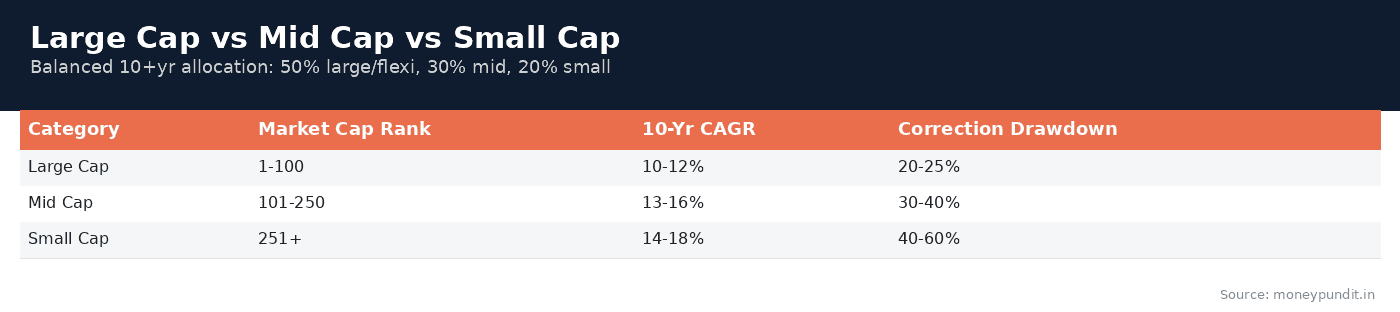
SEBI classifies Indian listed companies by market capitalization. Large-cap companies are ranked 1-100 by market cap. These are established giants like Reliance, TCS, HDFC Bank, and Infosys. Mid-cap companies are ranked 101-250 and include growing businesses like Persistent Systems, Indian Hotels, and Tube Investments. Small-cap companies are ranked 251 and below, encompassing emerging businesses across sectors.
Large Cap vs Mid Cap vs Small Cap: Why Large Caps Offer Stability
Large-cap funds invest at least 80% in top 100 companies. These funds offer lower volatility, consistent returns of 10-12% CAGR over long periods, and high liquidity. During market crashes, large-caps fall less and recover faster. They are ideal for conservative equity investors, those within 5 years of their goal, and as the core portfolio holding. However, the limited universe of 100 stocks and heavy institutional ownership means large-cap fund managers often struggle to significantly outperform the Nifty 50 index, making index funds a strong alternative in this category.
In the large cap vs mid cap vs small cap comparison, mid-cap funds often represent the best balance of growth potential and manageable risk.
Mid Cap Funds: Growth Sweet Spot
Mid-cap funds invest at least 65% in companies ranked 101-250. These represent businesses in their growth phase, too large to be risky small-caps but with significant expansion potential. Mid-cap funds have historically delivered 13-16% CAGR over 10-year periods, outperforming large-caps by 2-4% annually. The trade-off is higher volatility: mid-caps can drop 30-40% in corrections versus 20-25% for large-caps. Best suited for investors with 7+ year horizons who can handle interim volatility.
Small Cap Funds: High Risk, High Reward
Small-cap funds invest at least 65% in companies ranked 251 and below. These offer the highest return potential (14-18% CAGR historically) but come with extreme volatility and liquidity challenges. In bear markets, small-caps can fall 40-60% and take years to recover. Many small-cap companies fail or stagnate. Active fund management is crucial here as stock selection drives the majority of returns. Only invest money you will not need for at least 10 years.
Large Cap vs Mid Cap vs Small Cap: Ideal Portfolio Allocation
A balanced approach for moderate-risk investors with a 10+ year horizon: 50% in flexi-cap or large-cap funds, 30% in mid-cap funds, and 20% in small-cap funds. Conservative investors should increase large-cap allocation to 70% and limit small-cap to 10%. Aggressive investors under 35 can go with 30% large-cap, 35% mid-cap, and 35% small-cap. Review and rebalance annually to maintain target allocation.
Should beginners invest in small-cap funds?
Beginners should start with flexi-cap or large-cap funds to understand market volatility before venturing into small-caps. After 2-3 years of investing experience, gradually add mid-cap and then small-cap exposure.
What is a flexi-cap fund?
Flexi-cap funds can invest across all market capitalizations without restrictions, giving the fund manager complete flexibility. They are excellent core holdings as the manager can shift between large, mid, and small caps based on opportunities.
Understanding Market Capitalisation Categories
SEBI defines the categories clearly: Large-cap stocks are the top 100 companies by market capitalisation (₹50,000+ crore typically), mid-cap stocks rank 101st to 250th (₹15,000-₹50,000 crore), and small-cap stocks are ranked 251st and beyond (below ₹15,000 crore). Each category has distinct risk-return characteristics: large-caps offer stability with moderate growth (10-12% long-term CAGR), mid-caps provide higher growth with more volatility (14-16% CAGR), and small-caps deliver the highest potential returns with the highest risk (15-20%+ CAGR, but with sharp drawdowns).
During the 2020-2024 bull market, small-cap funds delivered 25-30% CAGR, making them the top performers. However, during the 2018-2019 correction, many small-cap funds lost 30-50% from their peaks. This volatility is why time horizon matters more than return expectations when choosing between these categories.
Large Cap vs Mid Cap vs Small Cap: Which Suits Your Goals?
Match the fund category to your investment horizon: Large-cap funds for goals 5-7 years away (house down payment, car purchase), they provide equity returns with lower drawdown risk. Mid-cap funds for 7-10 year goals (children’s education): they balance growth and risk well. Small-cap funds only for goals 10+ years away (retirement, long-term wealth), you need time to ride out 2-3 year bear markets that small-caps inevitably face.
Risk tolerance matters equally. If watching your portfolio drop 40% in a market correction would cause you to panic-sell (honest self-assessment is critical), stick to large-caps regardless of your time horizon. The best fund is the one you can hold through market volatility without emotional selling, a 12% return you actually stay invested for beats a theoretical 18% return you exit during a crash.
Large Cap vs Mid Cap vs Small Cap: Trusted Resources
Before making your large cap vs mid cap vs small cap allocation decision, consult authoritative sources. Check market capitalisation classifications on AMFI India, review regulatory guidelines on SEBI, compare fund performance on Value Research Online, and track index performance on NSE India.
Large Cap vs Mid Cap vs Small Cap: The Optimal Multi-Cap Allocation
Rather than choosing one category, most investors benefit from a blended approach. A commonly recommended allocation: 50% large-cap (stability core), 30% mid-cap (growth kicker), and 20% small-cap (alpha generator). This provides broad market exposure while tilting toward growth. For a simpler approach, a single flexi-cap fund or multi-cap fund automatically allocates across all three segments, with the fund manager adjusting the mix based on market conditions.
Rebalance your allocation annually: if small-caps have outperformed and grown to 35% of your portfolio, trim back to 20% by shifting profits to large-cap funds. This “sell high, buy low” discipline improves long-term returns and controls risk. Use our SIP Calculator to project returns for each category and the MF Returns Calculator to compare actual historical performance. Start with SIPs across your chosen allocation from day one. Don’t try to time which cap segment will outperform next.
References: Amfiindia.com, Sebi.gov.in, Nseindia.com
Source: amfiindia.com
Source: sebi.gov.in
Source: nseindia.com