

Best multi cap funds 2026 offer investors a unique opportunity to invest across large cap, mid cap and small cap stocks with a mandatory minimum allocation of 25% to each segment. This balanced approach ensures diversification across all market capitalisations while giving fund managers the flexibility to adjust the remaining 25% based on market conditions and opportunities.
Multi cap funds were redefined by SEBI in 2020 with strict allocation rules, making them truly diversified across the market spectrum. If you are searching for the best multi cap funds 2026, these schemes suit investors looking for broad equity exposure with built-in diversification and a 5+ year investment horizon.
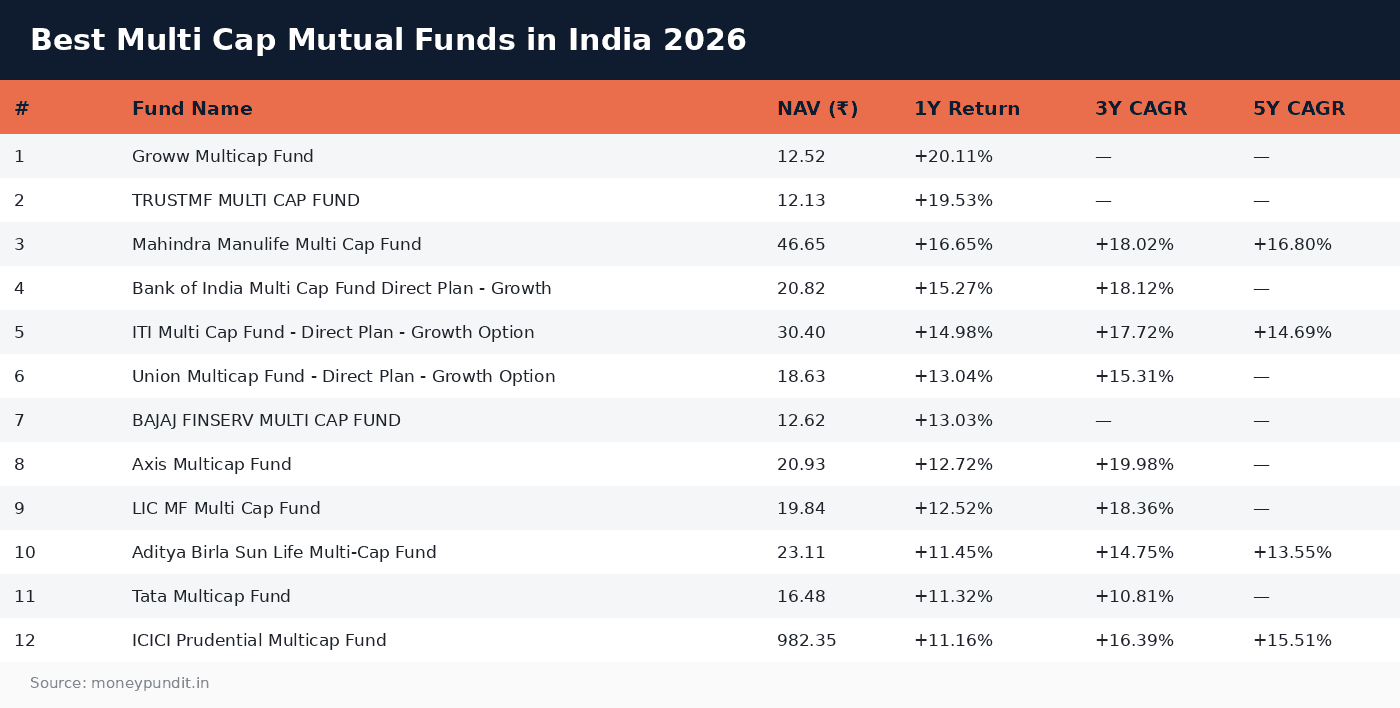
| # | Fund Name | NAV (₹) | 1Y Return ▼ | 3Y CAGR | 5Y CAGR |
|---|---|---|---|---|---|
| 1 | Groww Multicap Fund | 12.26 | +16.41% | — | — |
| 2 | TRUSTMF MULTI CAP FUND | 11.75 | +13.72% | — | — |
| 3 | ITI Multi Cap Fund | 29.51 | +10.42% | +16.11% | +13.66% |
| 4 | BANK OF INDIA MULTI CAP FUND | 20.07 | +9.99% | +16.83% | — |
| 5 | Bajaj Finserv Multi Cap Fund | 12.04 | +9.54% | — | — |
| 6 | Mahindra Manulife Multi Cap Fund | 44.73 | +8.75% | +16.25% | +14.75% |
| 7 | Axis Multicap Fund | 20.28 | +8.21% | +18.90% | — |
| 8 | HSBC Multi Cap Fund | 20.55 | +7.10% | +17.59% | — |
| 9 | Aditya Birla Sun Life Multi-Cap Fund | 22.01 | +6.78% | +14.05% | +11.88% |
| 10 | Union Multicap Fund | 17.85 | +6.37% | +13.94% | — |
| 11 | PGIM India Multi Cap Fund - Direct Plan | 10.64 | +5.24% | — | — |
| 12 | LIC MF Multi Cap Fund | 19.08 | +4.98% | +16.75% | — |
| 13 | Quant Multi Cap Fund | 711.83 | +4.46% | +9.51% | +10.92% |
| 14 | Franklin India Multi Cap Fund | 10.97 | +4.36% | — | — |
| 15 | WhiteOak Capital Multi Cap Fund | 16.35 | +3.83% | +17.23% | — |
| 16 | TATA MULTICAP FUND | 15.45 | +3.19% | +8.97% | — |
| 17 | ICICI Prudential Multi Cap Fund | 915.05 | +3.16% | +14.12% | +13.75% |
| 18 | Edelweiss Multi Cap Fund | 15.81 | +2.43% | — | — |
| 19 | Kotak Multi Cap Fund | 20.86 | +0.97% | +15.76% | +15.97% |
| 20 | UTI Multi Cap Fund | 10.46 | +0.46% | — | — |
| 21 | Baroda BNP Paribas Multi Cap Fund | 320.32 | +0.26% | +13.39% | +11.59% |
| 22 | Canara Robeco Multi Cap Fund | 14.90 | -0.20% | +13.42% | — |
| 23 | BANDHAN MULTI CAP FUND | 18.11 | -0.48% | +12.05% | — |
| 24 | Mirae Asset Multicap Fund | 14.74 | -1.26% | +12.29% | — |
| 25 | Invesco India Multi Cap Fund | 152.67 | -1.28% | +11.72% | +11.26% |
| 26 | DSP Multi Cap Fund | 12.27 | -1.37% | — | — |
| 27 | Samco Multi Cap Fund | 9.17 | -1.72% | — | — |
| 28 | Sundaram Multi Cap Fund | 420.69 | -2.17% | +11.55% | — |
| 29 | SBI MultiCap Fund | 17.17 | -2.53% | +12.00% | — |
| 30 | Nippon India Multi Cap Fund | 317.89 | -4.42% | +11.83% | +15.28% |
| 31 | HDFC Multi Cap Fund | 18.85 | -5.35% | +10.11% | — |
| 32 | The Wealth Company Multi Cap Fund | 9.82 | — | — | — |
Data sourced from AMFI & mfapi.in. Returns are annualised CAGR. Past performance doesn't guarantee future results. Last updated: 15 Oct 2026
Frequently Asked Questions About Best Multi Cap Funds 2026
What is the minimum allocation in multi cap funds?
SEBI mandates multi cap funds to invest at least 25% each in large cap, mid cap and small cap stocks, ensuring true diversification across the market.
How are multi cap funds different from flexi cap funds?
Multi cap funds have mandatory 25% allocation to each market cap segment. Flexi cap funds have no such restrictions and can allocate freely across market caps.
Are multi cap funds suitable for SIP?
Yes, SIP in the best multi cap funds 2026 is a great strategy as it gives you automatic diversification across all market segments while averaging out your purchase cost over time.
What returns do multi cap funds typically give?
The best multi cap funds 2026 have historically delivered 12-16% CAGR over 5-10 year periods, though returns vary based on market conditions and the fund manager’s stock selection.
What Are the Best Multi Cap Funds 2026?
The best multi cap funds 2026 are required by SEBI to maintain a minimum allocation of 25% each in large cap, mid cap, and small cap stocks, with the remaining 25% at the fund manager’s discretion. This mandated diversification across all three market cap segments makes the best multi cap funds 2026 a strong choice, ensuring true diversification, unlike flexi cap funds where managers might concentrate in one segment. Multi cap funds were created as a distinct category in 2020 specifically to ensure investors get genuine multi-capitalisation exposure.
The Unique Advantage of Mandatory Diversification
The 25-25-25 mandate is both a strength and a defining feature. In bull markets, the forced 25% small cap allocation ensures you participate in the highest-growth segment. In bear markets, the 25% large cap floor provides stability. This structural balance means multi cap funds deliver returns that are typically between large cap and small cap funds, historically 13-16% CAGR over 10-year periods, with moderate volatility.
The 25% discretionary allocation is where fund manager skill shows up in the best multi cap funds 2026. A good manager shifts this slice to the segment offering the best risk-reward at that time. Overweighting mid caps when valuations are attractive, or adding to large caps during uncertainty. This creates a built-in rebalancing mechanism that individual investors rarely execute on their own.
Best Multi Cap Funds 2026 vs Flexi Cap: Which Should You Choose?
If you want guaranteed diversification across all market caps with the best multi cap funds 2026 without worrying about fund manager allocation bias, choose multi cap. If you want maximum flexibility for the manager to concentrate where they see the best opportunities, choose flexi cap. In practice, multi cap funds tend to be slightly more volatile (due to the mandated small cap exposure) but also deliver slightly higher returns during broad-based bull markets. For most investors, having one of either is sufficient. You don’t need both.
How to Evaluate Best Multi Cap Funds 2026
Since the best multi cap funds 2026 hold similar market cap proportions, differentiation comes from stock selection within each segment. Compare the fund’s sector allocation, individual stock picks, and how the discretionary 25% is deployed. Check rolling returns against the Nifty 500 or BSE 500 benchmark, the fund should consistently outperform over 3-year rolling periods at least 65% of the time. Also review portfolio turnover, very high turnover (above 100%) suggests frequent trading that may generate short-term capital gains, reducing your post-tax returns.
Useful Resources for Best Multi Cap Funds 2026
Before investing in the best multi cap funds 2026, check the latest AMFI NAV data for multi cap funds and review fund factsheets on Value Research Online. For regulatory updates on multi cap fund allocation norms, refer to the SEBI circulars page. You can also track multi cap fund performance against the Nifty 500 index on NSE.
Compare the best multi cap funds 2026 with other categories like best ELSS funds, balanced advantage funds, and top mid cap funds to build a well-diversified portfolio. Use our lumpsum calculator and SIP calculator to plan your investments in the best multi cap funds 2026.
Start a monthly SIP with at least a 7-year commitment. Multi cap funds shine over long periods where all three segments get their time to outperform. Pair with an index fund for cost-efficient core exposure, and track your returns with our MF returns calculator.
Multi cap funds are the simplest way to hold all three market-cap bands in one scheme. Before you choose among multi cap funds, check the fund house’s record, the expense ratio and the 5-year CAGR, then start a monthly SIP.
Multi cap funds differ from flexi cap funds because SEBI fixes the minimum split. When you compare multi cap funds, check how far each scheme sits above the 25% floors in mid and small caps and how the manager has used the remaining 25%. The multi cap funds in the table are sorted by 1-year return, but the 3-year and 5-year CAGR show consistency better.
See every category side by side on our mutual fund categories hub.