

This page covers best hybrid funds india 2026 with current 2026 figures, worked examples and the mistakes to avoid.
Looking for the best hybrid funds India 2026? Aggressive hybrid mutual funds invest 65-80% in equity and 20-35% in debt instruments, offering a balanced approach to wealth creation. The equity component drives long-term growth while the debt portion provides stability and cushions the portfolio during market downturns. This makes them suitable for moderately aggressive investors who want equity-like returns with somewhat reduced volatility.
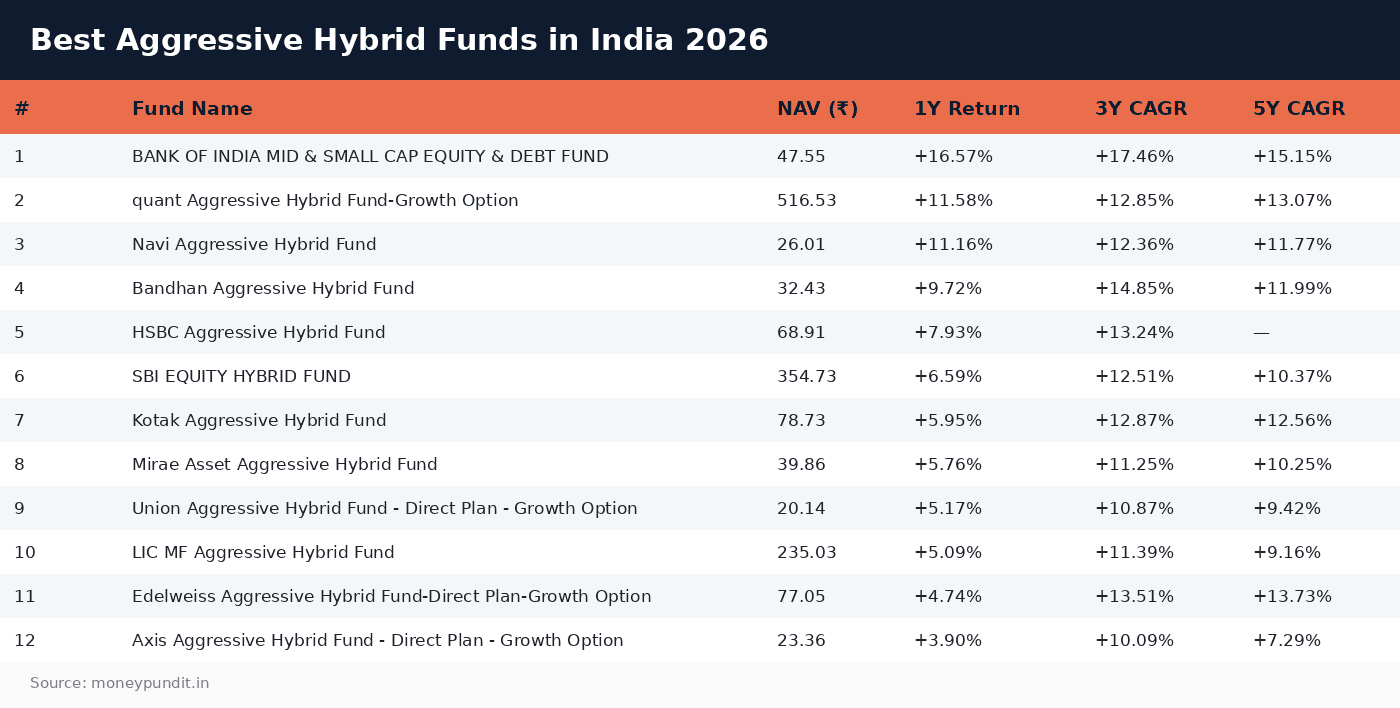
These funds are taxed as equity funds since their equity allocation exceeds 65%. The fund manager actively manages both the equity and debt portions, rebalancing periodically. Aggressive hybrid funds serve as an excellent single-fund solution for investors who want both growth and income components in their portfolio.
| # | Fund Name | NAV (₹) | 1Y Return ▼ | 3Y CAGR | 5Y CAGR |
|---|---|---|---|---|---|
| 1 | BANK OF INDIA AGGRESSIVE HYBRID FUND | 46.63 | +14.03% | +16.62% | +14.34% |
| 2 | Navi Aggressive Hybrid Fund | 26.34 | +7.52% | +12.39% | +10.97% |
| 3 | Quant Aggressive Hybrid Fund | 520.10 | +6.85% | +13.55% | +12.12% |
| 4 | Bandhan Aggressive Hybrid Fund | 33.06 | +4.84% | +13.95% | +10.94% |
| 5 | HSBC Aggressive Hybrid Fund | 69.16 | +4.74% | +13.48% | — |
| 6 | LIC MF Aggressive Hybrid Fund | 233.03 | +2.85% | +11.46% | +8.83% |
| 7 | Mirae Asset Aggressive Hybrid Fund | 40.74 | +1.54% | +10.73% | +9.34% |
| 8 | Union Aggressive Hybrid Fund | 20.24 | +1.46% | +10.38% | +8.34% |
| 9 | SBI AGGRESSIVE HYBRID FUND | 358.27 | +0.99% | +11.57% | +8.90% |
| 10 | Kotak Aggressive Hybrid Fund | 47.86 | +0.75% | +12.61% | +11.26% |
| 11 | Kotak Aggressive Hybrid Fund | 78.07 | +0.49% | +12.35% | +11.35% |
| 12 | Edelweiss Aggressive Hybrid Fund | 77.96 | +0.32% | +12.42% | +12.65% |
| 13 | Shriram Aggressive Hybrid Fund | 37.94 | -0.64% | +8.96% | +7.23% |
| 14 | Axis Aggressive Hybrid Fund | 23.78 | -0.71% | +8.83% | +6.11% |
| 15 | BARODA BNP PARIBAS AGGRESSIVE HYBRID FUND | 33.22 | -0.74% | +10.36% | — |
| 16 | Canara Robeco Aggressive Hybrid Fund | 433.45 | -0.85% | +10.24% | +8.69% |
| 17 | JM Aggressive Hybrid Fund | 142.73 | -1.49% | +12.04% | +12.33% |
| 18 | ICICI Prudential Aggressive Hybrid Fund | 459.04 | -1.53% | +12.64% | +13.27% |
| 19 | Nippon India Aggressive Hybrid Fund | 122.49 | -1.54% | +9.92% | +10.24% |
| 20 | Aditya Birla Sun Life Aggressive Hybrid Fund | 1,780.91 | -1.66% | +9.22% | +7.31% |
| 21 | Tata Aggressive Hybrid Fund | 499.48 | -2.59% | +7.64% | +7.54% |
| 22 | UTI Aggressive Hybrid Fund | 447.00 | -2.59% | +9.90% | +9.87% |
| 23 | Sundaram Aggressive Hybrid Fund | 186.79 | -3.67% | +8.66% | — |
| 24 | PGIM India Aggressive Hybrid Equity Fund - Direct Plan | 161.06 | -3.72% | +8.62% | +6.18% |
| 25 | Franklin India Aggressive Hybrid Fund | 309.27 | -3.86% | +9.00% | +8.73% |
| 26 | Groww Aggressive Hybrid Fund | 23.85 | -4.06% | +8.28% | +7.33% |
| 27 | Mahindra Manulife Aggressive Hybrid Fund | 30.37 | -4.32% | +11.09% | +10.54% |
| 28 | DSP Aggressive Hybrid Fund | 408.31 | -4.69% | +9.19% | +8.18% |
| 29 | HDFC Aggressive Hybrid Fund | 127.64 | -6.30% | +5.75% | +7.61% |
| 30 | Invesco India Aggressive Hybrid Fund | 24.97 | -6.96% | +10.50% | +8.80% |
| 31 | Nippon India Aggressive Hybrid Fund | 0.00 | — | — | — |
| 32 | Nippon India Aggressive Hybrid Fund | 0.13 | — | +31.23% | +17.71% |
| 33 | WhiteOak Capital Aggressive Hybrid Fund | 10.70 | — | — | — |
Data sourced from AMFI & mfapi.in. Returns are annualised CAGR. Past performance doesn't guarantee future results. Last updated: 10 Nov 2026
Official Resources
Before investing in the best hybrid funds India 2026, verify fund details through official sources. Check fund NAVs on AMFI India, review SEBI regulations on SEBI, compare fund performance on Value Research Online, and track benchmark indices on NSE India.
Frequently Asked Questions About Best Hybrid Funds India 2026
What is the equity-debt split in aggressive hybrid funds?
SEBI mandates 65-80% allocation to equity and 20-35% to debt instruments. This fixed range differentiates them from balanced advantage funds which can vary allocation more dynamically.
How are aggressive hybrid funds different from balanced advantage funds?
Aggressive hybrid funds maintain a fixed equity-debt range (65-80% equity), while balanced advantage funds dynamically adjust allocation based on market valuations, sometimes going as low as 30% equity.
Are aggressive hybrid funds good for retirees?
They can work for early retirees with a longer time horizon (10+ years of retirement). The debt component provides stability while equity helps beat inflation. However, pure retirees might prefer balanced advantage or conservative hybrid funds.
What returns do aggressive hybrid funds typically deliver?
Aggressive hybrid funds have historically delivered 10-14% CAGR over 5-10 year periods, with lower volatility compared to pure equity funds due to their debt cushion.
What Are Aggressive Hybrid Mutual Funds?
Aggressive hybrid funds maintain a fixed allocation of 65-80% in equity and 20-35% in debt instruments. Unlike balanced advantage funds that dynamically shift allocations, aggressive hybrid funds keep a relatively stable equity-debt mix, rebalancing within the defined range. The 65%+ equity allocation ensures they qualify for equity taxation (12.5% LTCG after 1 year), while the 20-35% debt component provides a cushion during market corrections and a source of regular income through coupon payments.
One key reason these rank among the best hybrid funds India 2026 is the built-in portfolio rebalancing mechanism.
The Built-In Rebalancing Advantage
The most underappreciated feature of aggressive hybrid funds is automatic rebalancing. When equity markets rise sharply, the equity portion exceeds 80%, the fund manager sells some equity and buys debt to bring it back to range. When markets fall, equity drops below 65%, the manager sells debt and buys equity. This systematic “buy low, sell high” across asset classes happens within the fund without you paying capital gains tax on each rebalance. If you tried to do this manually across separate equity and debt funds, each rebalancing event would trigger capital gains tax.
This tax-free internal rebalancing can add 0.5-1% to your effective annual returns over the long term. A significant advantage over managing separate funds. Aggressive hybrid funds have historically delivered 11-13% CAGR over 10-year periods, outperforming pure debt funds by 4-5% while experiencing 30-40% lower drawdowns than pure equity funds.
Who Should Invest in Aggressive Hybrid Funds?
These funds are ideal for several investor profiles. First-time equity investors who want market participation with built-in risk management. Retirees seeking moderate growth with reduced volatility: the debt cushion smooths out the equity ups and downs, making SWP withdrawals more predictable. Goal-based investors with 3-5 year time horizons where pure equity is too risky but pure debt won’t generate sufficient returns, examples include saving for a car, home down payment, or vacation fund.
They’re also excellent for lump sum investments during uncertain markets. If you receive a bonus or inheritance and aren’t sure whether to invest in equity or wait, an aggressive hybrid fund provides instant 65-80% equity exposure with the debt component acting as a natural hedge. It’s a simpler alternative to the STP (Systematic Transfer Plan) strategy of parking money in a liquid fund and transferring to equity. Use our lumpsum calculator to project returns.
When comparing the best hybrid funds India 2026 options, understanding how aggressive hybrid differs from other categories is essential.
Aggressive Hybrid vs Balanced Advantage vs Flexi Cap
Choose aggressive hybrid if you want a stable 65-80% equity allocation with automatic rebalancing and equity tax treatment. Predictable asset allocation. Choose balanced advantage if you want dynamic allocation that responds to market valuations. Better downside protection but potentially lower returns in sustained bull markets. Choose flexi cap if you want 100% equity exposure with market-cap flexibility, highest return potential but full equity risk.
How to Select an Aggressive Hybrid Fund
Evaluate the equity portfolio quality (should mirror a good large cap or flexi cap fund’s holdings), the debt portfolio quality (focus on high-rated AAA/AA bonds with low credit risk), the historical asset allocation range (some funds stay close to 75% equity while others vary more between 65-80%), and downside performance during corrections. Start a monthly SIP and plan for a minimum 5-year horizon to allow the equity-debt synergy to deliver its full potential. Track returns with our MF returns calculator.
Using This Best Hybrid Funds Page
Aggressive Hybrid Funds: Key Takeaways
Aggressive hybrid funds keep 65% to 80% in equity and 20% to 35% in debt, which cushions falls while still giving equity-like growth over 5 years or more. Check how much of the debt portion sits in government and AAA-rated paper, since that is what protects you in a crash. Because equity is above 65%, gains are taxed as equity: 20% within 12 months and 12.5% above Rs 1.25 lakh a year after that. Compare other categories on the mutual fund categories hub, see balanced advantage funds for a dynamic mix, estimate returns with the SIP calculator and read scheme documents on AMFI and SEBI before you invest. Mutual fund investments are subject to market risks.
Hybrid funds in the aggressive category suit people who find pure equity too bumpy. Compare hybrid funds on 5-year CAGR and on how far they fell in past market corrections.
When you compare hybrid funds in this category, look at the equity share, the quality of the debt holdings and the 5-year CAGR rather than the latest year alone. Aggressive hybrid funds sit between pure equity and pure debt, so they suit investors who want growth with a smaller drawdown.