
Stock splits bonus shares in brief: A 1:2 split converts one ₹1,000 share into two ₹500 shares, your investment value remains the same.
A stock split, a bonus share issue, and a rights issue can all make your shareholding look bigger overnight, but only one of them actually asks you for more money, confusing the three leads investors to misjudge what a corporate action really means for them. Here’s how each one works.
Corporate actions like stock splits, bonus issues, and rights offerings directly affect shareholders and can create both opportunities and confusion. Understanding what these events mean, how they impact your holdings, and whether they create real value helps you make informed decisions as a stock investor.
Stock Splits
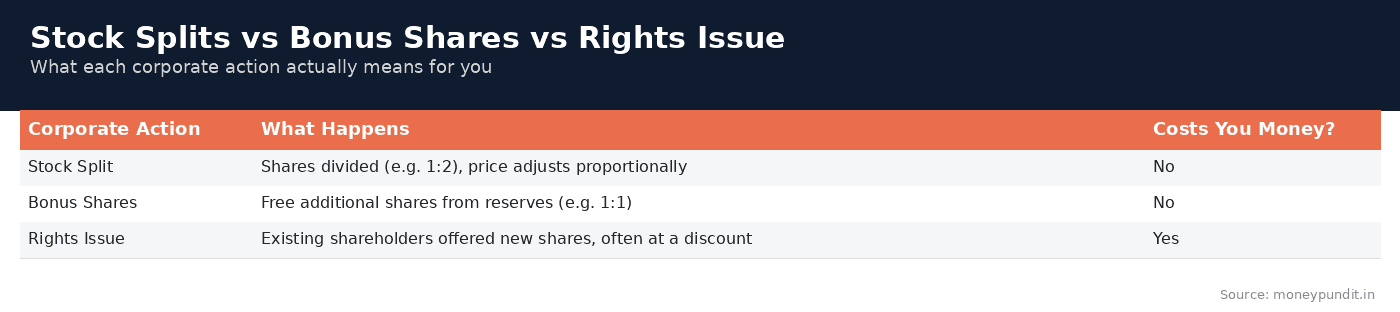
A stock split divides existing shares into multiple shares, reducing the price proportionally while keeping total value unchanged. A 1:2 split converts one ₹1,000 share into two ₹500 shares, your investment value remains the same. Companies split stocks to improve liquidity and make shares more affordable for retail investors. A ₹10 face value stock splitting to ₹2 face value means you get 5 shares for every 1 held. Stock splits do not create value by themselves, but improved liquidity and retail participation can positively impact price over time.
Bonus Shares
Bonus shares are free additional shares issued to existing shareholders from the company’s reserves. A 1:1 bonus means one free share for every share held. If you had 100 shares at ₹500, you now have 200 shares at approximately ₹250 each. The company’s total market capitalization and your investment value remain the same post-bonus. Bonus issues signal that the company has strong accumulated profits and confidence in future earnings. They reward long-term shareholders and improve stock liquidity.
Rights Issues
A rights issue offers existing shareholders the right to buy new shares at a discounted price in proportion to their existing holdings. Unlike bonus shares, rights issues require you to invest additional money. Example: a 1:5 rights issue at ₹200 for a stock trading at ₹400 lets you buy 1 new share at ₹200 for every 5 shares held. This is a capital-raising exercise. Evaluate why the company needs funds before subscribing. Growth capex is positive; debt repayment may signal financial stress.
Impact on Your Portfolio
Stock splits: adjust your per-share cost basis proportionally. If you bought 10 shares at ₹1,000 and a 1:5 split occurs, your new cost basis is ₹200 per share for 50 shares. Bonus shares: your per-share cost basis reduces proportionally. For tax purposes, the acquisition date of bonus shares is the record date, and the cost of acquisition is zero (for bonuses declared after March 31, 2018). Rights shares: the cost is the amount you pay plus any premium. Unexercised rights can sometimes be sold on the exchange (RE or RE-N series).
Should You Participate in Rights Issues?
Evaluate the rights issue like a fresh investment decision. If the discounted price offers good value based on the company’s fundamentals and growth prospects, subscribe. If you are already overweight in the stock, consider selling the rights entitlement on the exchange. Not participating leads to dilution of your ownership percentage, which may or may not matter depending on your investment thesis.
Do bonus shares or stock splits mean the company is doing well?
Bonus shares typically signal strong accumulated profits and management confidence. Stock splits indicate the company wants to improve accessibility. However, neither guarantees future performance, evaluate the underlying business fundamentals independently of these corporate actions.
Understanding These Corporate Actions
A stock split divides existing shares into more shares at a proportionally lower price, a 1:2 split turns 100 shares of ₹500 into 200 shares of ₹250. Your total investment value stays identical, but the lower per-share price improves liquidity and makes the stock accessible to smaller investors. Companies like Reliance, TCS, and Avenue Supermarts have done stock splits when share prices became very high.
Bonus shares are free additional shares given to existing shareholders from the company’s reserves. A 1:1 bonus means you get 1 free share for every share held. Your 100 shares become 200, but the price adjusts proportionally (₹1,000 becomes ₹500). The company’s total market capitalisation doesn’t change. Bonus issues signal management’s confidence in future profitability and reward long-term shareholders. A rights issue is different. The company offers existing shareholders the right (not obligation) to buy new shares at a discounted price, typically to raise capital for expansion or debt reduction.
Impact on Your Portfolio and Tax
For stock splits and bonus shares, your cost of acquisition is adjusted proportionally for capital gains tax calculation. If you bought 100 shares at ₹200 each and received a 1:1 bonus, your cost per share becomes ₹100 for all 200 shares. The holding period for bonus shares starts from the date of allotment (not original purchase), so bonus shares sold within 12 months attract short-term capital gains tax at 20%.
Rights issues require a decision: exercise the rights (buy at the discounted price), sell/renounce the rights in the market, or let them lapse. If the company’s fundamentals are strong and the rights price offers good value, exercising is usually beneficial. Use fundamental analysis to evaluate whether the capital raise purpose justifies dilution before deciding. Track your adjusted cost basis carefully after these corporate actions. Incorrect cost calculation leads to wrong tax computation when you eventually sell.
None of these corporate actions change the fundamental value of your holding on their own, what matters is why the company is doing it, so always read the company’s stated rationale before reacting to the announcement.
References: Nseindia.com
Source: nseindia.com
Stock splits bonus shares: Key Takeaways
Key points on stock splits bonus shares:
- A stock split divides existing shares into multiple shares, reducing the price proportionally while keeping total value unchanged.
- Bonus shares are free additional shares issued to existing shareholders from the company’s reserves.
- A rights issue offers existing shareholders the right to buy new shares at a discounted price in proportion to their existing holdings.
Verify the latest stock splits bonus shares figures with SEBI before you act.
Related guides: Best Demat Account in India 2026, How to Invest in Stock Market in India, Nifty 50 Explained.