

Real estate in brief: Residential rental yields in major Indian cities average just 2-3% of the property value annually.
Physical property in India has historically delivered lower liquidity-adjusted returns than equity mutual funds over most 10-year periods, yet real estate remains the default ‘safe’ investment for most families. Here’s how buying, renting, and REITs actually compare as ways to gain real estate exposure.
Real estate has been the preferred investment for Indian families for generations. The tangible nature of property, potential for rental income, and long-term capital appreciation make it an emotionally appealing asset class. However, the landscape has evolved significantly with the emergence of REITs, fractional ownership, and changing market dynamics. This guide helps you navigate the various ways to invest in Indian real estate in 2026.
Ways to Invest in Real Estate
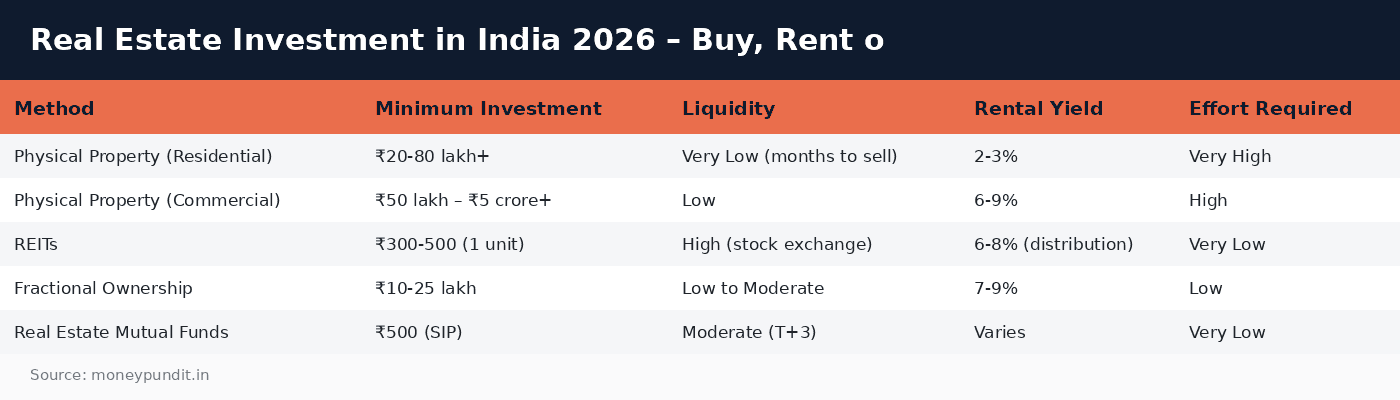
| Method | Minimum Investment | Liquidity | Rental Yield | Effort Required |
|---|---|---|---|---|
| Physical Property (Residential) | ₹20-80 lakh+ | Very Low (months to sell) | 2-3% | Very High |
| Physical Property (Commercial) | ₹50 lakh – ₹5 crore+ | Low | 6-9% | High |
| REITs | ₹300-500 (1 unit) | High (stock exchange) | 6-8% (distribution) | Very Low |
| Fractional Ownership | ₹10-25 lakh | Low to Moderate | 7-9% | Low |
| Real Estate Mutual Funds | ₹500 (SIP) | Moderate (T+3) | Varies | Very Low |
Physical Property: The Traditional Route
Residential Property
Buying a residential property for investment has been the default Indian approach. However, the math often does not work in favour of investors. Residential rental yields in major Indian cities average just 2-3% of the property value annually. A ₹1 crore apartment in Bangalore or Mumbai typically rents for ₹20,000-₹30,000 per month, a 2.4-3.6% yield before maintenance, property tax, and vacancy costs. After these expenses, the net yield drops to 1.5-2.5%.
Capital appreciation varies dramatically by location. While some emerging micro-markets have delivered 10-15% annual appreciation, mature markets in metro cities have seen 3-7% growth over the past decade. After accounting for stamp duty (5-7%), registration (1%), brokerage (1-2%), and maintenance costs, the net returns from residential property investment have been mediocre compared to equity mutual funds for most investors.
Commercial Property
Commercial real estate offers significantly better rental yields, 6-9% for office spaces and 8-12% for retail spaces in prime locations. Leases are typically longer (3-9 years with annual escalation clauses of 5-15%), providing stable, predictable income. However, the entry barrier is high (₹50 lakh to several crores for quality commercial spaces), and the risk is concentrated in a single tenant and location.
REITs: The Modern Alternative
Real Estate Investment Trusts (REITs) have transformed real estate investing in India since their introduction in 2019. REITs allow you to invest in premium commercial real estate through stock exchange-listed units starting from just ₹300-500. India currently has four listed REITs: Embassy Office Parks, Mindspace Business Parks, Brookfield India Real Estate Trust, and Nexus Select Trust (retail-focused).
How REITs Work
A REIT owns and operates income-generating commercial properties, office parks, shopping malls, or warehouses. They are required to distribute at least 90% of their net distributable income to unit holders. This creates a regular income stream (typically paid quarterly) combined with potential capital appreciation of the units on the stock exchange.
REIT Returns and Taxation
Indian REITs have delivered total returns of 10-14% annually (6-8% distribution yield + 4-6% unit price appreciation). The distributions have three components: interest income (taxed at slab rate), dividend income (tax-free in investor hands if already taxed at REIT level), and return of capital (reduces your cost basis, taxed as capital gains on sale). Capital gains on REIT units follow the same rules as listed equity, 12.5% LTCG above ₹1.25 lakh after 12 months.
Buy vs Rent: The Financial Analysis
The rent vs buy decision should be driven by financial analysis, not emotion. If the annual rent is less than 3% of the property price, renting is financially better. You can invest the down payment and EMI difference in equity mutual funds for potentially higher returns. In cities like Mumbai, where property prices are extremely high relative to rents, renting and investing often makes more financial sense than buying.
However, buying makes sense when you plan to live in the property for 10+ years (eliminating the rent escalation risk), the rental yield exceeds 3.5-4%, you get significant tax benefits on a home loan (Section 24 + 80C), or the property is in a high-growth corridor with strong appreciation potential. Emotional factors like stability, customisation freedom, and the security of ownership also have real value that financial models cannot capture.
Key Factors for Property Investment
Location
The oldest rule in real estate remains the most important. Proximity to employment hubs, metro connectivity, social infrastructure (schools, hospitals, malls), and upcoming infrastructure projects drive both rental demand and appreciation. Properties within 1 km of metro stations typically command 10-20% premium over similar properties further away.
Builder Reputation and RERA
Post-RERA (Real Estate Regulatory Authority), buying from registered projects with reputable builders has become essential. RERA ensures project completion timelines, financial transparency, and buyer protection. Always verify the RERA registration number, check the builder’s track record of on-time delivery, and review the project’s financial health before investing.
Title Clarity
Ensure the property has clear title with no encumbrances, pending litigation, or disputed ownership. Hire an independent property lawyer to verify the title chain for at least 30 years, check all government approvals (building plan, environmental clearance, occupation certificate), and review the society formation status for apartments.
Real Estate in Your Portfolio
Financial advisors recommend limiting real estate exposure to 20-30% of your total portfolio. Many Indian households have 60-80% of their wealth locked in a single residential property. This over-concentration creates risk. Diversifying through REITs allows you to gain real estate exposure without the concentration, illiquidity, and high capital requirements of physical property. A balanced approach might include your primary home for living plus REIT investments for the real estate allocation in your investment portfolio.
Frequently Asked Questions
Are REITs better than physical property?
For most investors, REITs are the better choice for real estate investment (not residence). They offer higher rental yields (6-8% vs 2-3% residential), instant diversification across multiple properties, professional management, stock exchange liquidity, and no maintenance hassles. Physical property makes sense primarily for your own residence or if you have deep local market knowledge and the capital for commercial real estate.
Is real estate a good hedge against inflation?
Historically, yes: property prices and rents tend to rise with inflation over long periods. However, the correlation is not perfect, and there can be extended periods (like 2015-2020 in many Indian cities) where property prices stagnate despite moderate inflation. REITs with built-in annual rent escalation clauses provide more reliable inflation protection than speculative residential land or property.
How is rental income taxed?
Rental income from property is taxed under “Income from House Property.” You can deduct 30% of the annual rental value as a standard deduction (for repairs, maintenance) regardless of actual expenses, plus the entire interest paid on any home loan against that property. The net amount is added to your total income and taxed at your slab rate. Municipal taxes paid are also deductible before calculating the standard deduction.
What are the hidden costs of buying property?
Beyond the property price, budget for: stamp duty (3-7% depending on state), registration charges (1%), GST on under-construction property (5% without ITC), brokerage (1-2%), legal fees, interior fit-out costs, society maintenance deposits, parking charges, and property tax. These costs can add 10-15% to the base property price, significantly impacting your total investment and returns calculation.
References: Amfiindia.com
Real estate: Key Takeaways
Key points on real estate:
- Buying a residential property for investment has been the default Indian approach.
- Real Estate Investment Trusts (REITs) have transformed real estate investing in India since their introduction in 2019.
- The rent vs buy decision should be driven by financial analysis, not emotion.
Verify the latest real estate figures with RBI before you act.