

Intraday trading in brief: Intraday trading requires squaring off every position before market close, hold overnight by mistake and your broker may auto-square it off at a price you didn’t choose.
Intraday trading requires squaring off every position before market close, hold overnight by mistake and your broker may auto-square it off at a price you didn’t choose. Here’s how intraday actually differs from delivery trading, and the rules beginners get wrong most often.
Intraday trading involves buying and selling stocks within the same trading day, aiming to profit from short-term price movements. Unlike delivery-based investing where you hold stocks for months or years, intraday positions are squared off before the market closes at 3:30 PM. While intraday trading offers the allure of quick profits, it is one of the riskiest activities in the stock market, SEBI data shows that over 90% of individual intraday traders lose money.
How Intraday Trading Works
When you place an intraday order, your broker provides leverage (margin), typically 5x to 20x your capital. With ₹1 lakh in your account, you can take positions worth ₹5-20 lakh. This amplifies both profits and losses. If a stock moves 2% in your favour on a 10x leveraged position, you make 20% on your capital. But a 2% move against you wipes out 20% of your capital. If the stock moves 10% against you, your entire capital is gone.
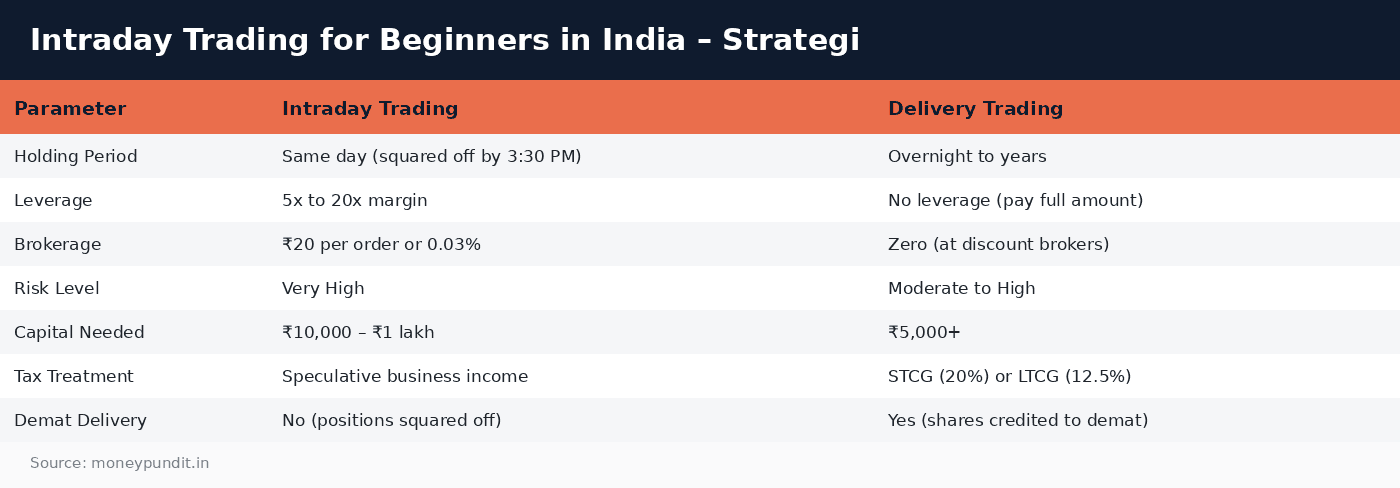
Intraday Trading vs Delivery Trading
| Parameter | Intraday Trading | Delivery Trading |
|---|---|---|
| Holding Period | Same day (squared off by 3:30 PM) | Overnight to years |
| Leverage | 5x to 20x margin | No leverage (pay full amount) |
| Brokerage | ₹20 per order or 0.03% | Zero (at discount brokers) |
| Risk Level | Very High | Moderate to High |
| Capital Needed | ₹10,000 – ₹1 lakh | ₹5,000+ |
| Tax Treatment | Speculative business income | STCG (20%) or LTCG (12.5%) |
| Demat Delivery | No (positions squared off) | Yes (shares credited to demat) |
Basic Intraday Trading Strategies
Momentum Trading
This strategy involves identifying stocks that are moving strongly in one direction on high volume. Traders look for stocks that gap up or gap down at open, breaking through key support or resistance levels with above-average volume. The idea is to ride the momentum until signs of reversal appear. This requires quick decision-making and strict stop-losses.
Breakout Trading
Breakout traders identify key price levels where a stock has been consolidating and enter when the price breaks above resistance (for long trades) or below support (for short trades) with strong volume. The breakout is confirmed when the stock sustains above/below the level with increasing volume. False breakouts are common, so traders use volume confirmation and wait for a retest of the breakout level.
Moving Average Crossover
A simple strategy using two moving averages: typically the 9-period EMA (Exponential Moving Average) and 21-period EMA on a 5-minute or 15-minute chart. When the shorter EMA crosses above the longer EMA, it signals a buy. When it crosses below, it signals a sell. This strategy works well in trending markets but generates false signals in sideways conditions.
VWAP Strategy
Volume Weighted Average Price (VWAP) is one of the most popular intraday indicators. Institutional traders use VWAP as a benchmark. They buy below VWAP and sell above VWAP. Retail intraday traders can use this: buy when price crosses above VWAP with volume, sell when it drops below. VWAP acts as dynamic support/resistance throughout the trading day.
Risk Management Rules
The 1% Rule
Never risk more than 1% of your total trading capital on a single trade. If you have ₹2 lakh in your trading account, the maximum loss per trade should be ₹2,000. This means setting your stop-loss at a level where the maximum loss equals 1% of capital. This rule ensures that even a string of 10 consecutive losses only depletes 10% of your capital.
Always Use Stop-Losses
A stop-loss is a non-negotiable rule in intraday trading. Before entering any trade, decide the maximum amount you are willing to lose and set a stop-loss order at that price. Never move your stop-loss further away from entry (hoping the stock will recover). This is the most common mistake that turns small losses into account-wiping disasters.
Risk-Reward Ratio
Only take trades where the potential reward is at least 2x the risk. If your stop-loss is ₹5 away from entry, your target should be at least ₹10 away. With a 2:1 reward-risk ratio, you only need to be right 40% of the time to be profitable. Without this discipline, even a 60% win rate can result in net losses if your losses are larger than your wins.
Common Mistakes to Avoid
Overtrading
Many beginners feel compelled to trade every day and take multiple trades per session. Quality matters more than quantity. Professional intraday traders often take just 1-3 carefully selected trades per day. Overtrading increases brokerage costs, leads to emotional decisions, and reduces the quality of analysis applied to each trade.
Averaging Down
When a stock moves against you, buying more to reduce your average cost is extremely dangerous in intraday trading. With leverage, averaging down can multiply your losses rapidly. If your analysis was wrong about the trade direction, adding to the position compounds the error. Accept the loss, exit at your stop-loss, and look for the next opportunity.
Trading Without a Plan
Every trade should have a predefined entry price, stop-loss, target, and position size before execution. Trading based on tips, impulse, or gut feeling is gambling, not trading. Write down your trading plan for each trade and follow it mechanically, regardless of what your emotions tell you during the trade.
Tax Implications of Intraday Trading
Intraday trading profits are classified as speculative business income and taxed at your income tax slab rate. Speculative losses can only be set off against speculative gains (not against other income or delivery-based capital gains). Unabsorbed speculative losses can be carried forward for 4 years. If you trade intraday regularly, you should file ITR-3 (business income) and can claim trading-related expenses like brokerage, internet charges, and charting software as business deductions.
Frequently Asked Questions
How much capital do I need to start intraday trading?
While you can technically start with ₹5,000-₹10,000, a practical minimum is ₹50,000-₹1 lakh. With proper risk management (1% per trade), ₹1 lakh allows you to take meaningful positions while limiting each trade’s risk to ₹1,000. Starting with too little capital leads to taking outsized risks to make meaningful returns, which inevitably leads to losses.
Can intraday trading be a full-time career?
For a very small percentage of disciplined traders, yes. However, it typically takes 2-3 years of consistent practice, significant capital (₹10-20 lakh minimum for sustainable income), and emotional discipline that most people cannot sustain. It is advisable to keep your regular job while learning intraday trading as a secondary activity. Only consider going full-time after at least 12-18 months of consistent profitability.
Is F&O trading better than equity intraday?
Futures and Options (F&O) offer more leverage and flexibility (you can profit from falling markets through options), but they are also more complex and riskier. Options have time decay working against buyers, and Futures require understanding of concepts like margin, roll-over, and expiry. Beginners should start with equity intraday before moving to F&O, and only after thorough education on derivatives.
What are the best indicators for intraday trading?
No single indicator is the “best.” Successful traders typically use a combination: VWAP for institutional price reference, Relative Strength Index (RSI) for overbought/oversold conditions, Moving Averages for trend direction, and volume for confirmation. The key is mastering 2-3 indicators thoroughly rather than cluttering your chart with dozens of conflicting signals.
References: Sebi.gov.in
Intraday trading: Key Takeaways
Key points on intraday trading:
- When you place an intraday order, your broker provides leverage (margin), typically 5x to 20x your capital.
- The idea is to ride the momentum until signs of reversal appear.
- Never risk more than 1% of your total trading capital on a single trade.
Verify the latest intraday trading figures with SEBI before you act.