

Best flexi cap mutual in brief: A flexibility that can work strongly for or against you depending entirely on the manager’s skill.
Flexi cap funds give the fund manager complete freedom to move between large, mid, and small caps without any allocation restriction. A flexibility that can work strongly for or against you depending entirely on the manager’s skill. Here’s what to look for and which funds are currently worth considering.
Flexi cap mutual funds offer the ultimate flexibility in equity investing, the fund manager can invest across large cap, mid cap, and small cap stocks in any proportion based on market conditions. This freedom makes flexi cap funds an excellent core holding for investors who want a single, well-diversified equity fund managed by professionals.
What Are Flexi Cap Mutual Funds?
SEBI introduced the flexi cap category in November 2020, requiring these funds to invest at least 65% of assets in equity across all market capitalisations. Unlike large cap funds (minimum 80% in top 100 stocks) or mid cap funds (minimum 65% in 101-250 ranked stocks), flexi cap funds have no market cap restrictions. The fund manager has complete discretion to shift between large, mid, and small caps based on where they see the best opportunities.
This flexibility is particularly valuable during market transitions. When large caps appear overvalued, the manager can increase mid and small cap allocation. During market downturns, they can shift towards the safety of blue-chip large caps. This dynamic allocation can potentially deliver superior risk-adjusted returns over complete market cycles.
Top Flexi Cap Mutual Funds for 2026
| Fund Name | 3-Year Return (CAGR) | 5-Year Return (CAGR) | Expense Ratio | AUM (₹ Cr) |
|---|---|---|---|---|
| Parag Parikh Flexi Cap Fund | 20.8% | 23.5% | 0.63% | 72,000 |
| Quant Flexi Cap Fund | 24.2% | 28.1% | 0.58% | 7,500 |
| HDFC Flexi Cap Fund | 22.5% | 21.8% | 0.77% | 55,000 |
| JM Flexicap Fund | 26.3% | 25.4% | 0.45% | 4,800 |
| Franklin India Flexi Cap Fund | 19.2% | 20.6% | 0.95% | 16,000 |
Returns as of April 2026. Past performance does not guarantee future results.
Why Choose Flexi Cap Over Other Categories?
The primary advantage of flexi cap funds is simplification. Instead of maintaining separate allocations to large cap, mid cap, and small cap funds, and periodically rebalancing them, you can invest in a single flexi cap fund and let the fund manager handle the allocation decisions. This is especially beneficial for investors who lack the time or expertise to monitor and rebalance their portfolio regularly.
Flexi cap funds also solve the problem of style drift that plagued the old multi-cap category. Before SEBI’s reclassification, many multi-cap funds were essentially large cap funds in disguise, with 70-80% in large caps. The flexi cap category openly acknowledges this flexibility, making it transparent for investors.
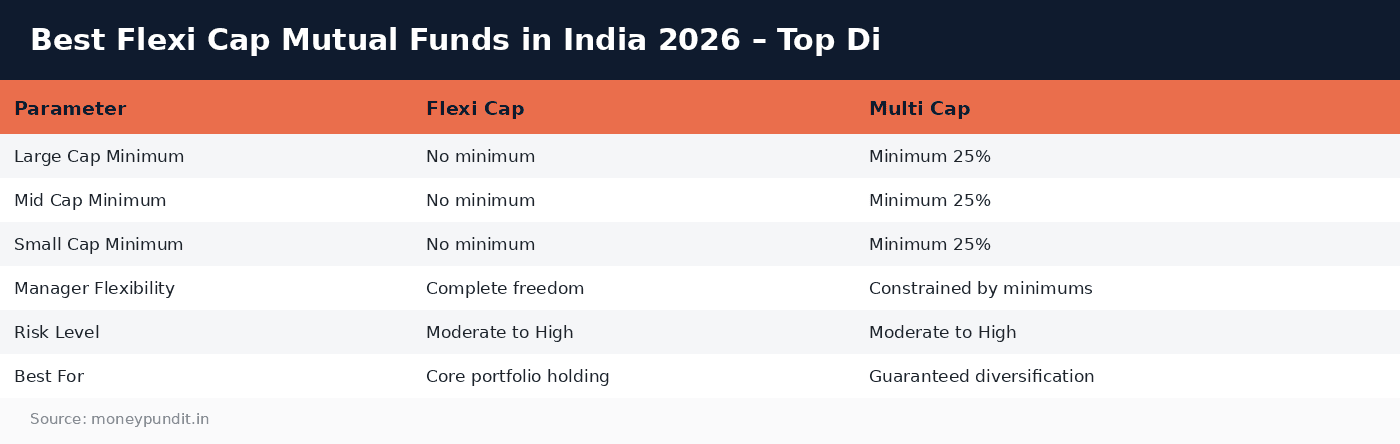
Flexi Cap vs Multi Cap Funds
| Parameter | Flexi Cap | Multi Cap |
|---|---|---|
| Large Cap Minimum | No minimum | Minimum 25% |
| Mid Cap Minimum | No minimum | Minimum 25% |
| Small Cap Minimum | No minimum | Minimum 25% |
| Manager Flexibility | Complete freedom | Constrained by minimums |
| Risk Level | Moderate to High | Moderate to High |
| Best For | Core portfolio holding | Guaranteed diversification |
How to Select the Best Flexi Cap Fund
Consistency Over Short-Term Returns
Look for funds that have delivered consistent returns across different market conditions rather than those that top charts in a single year. A fund that ranks in the top quartile across multiple time frames (1, 3, 5, and 10 years) is generally more reliable than one that had a spectacular single year but mediocre performance otherwise.
Portfolio Composition
Examine how the fund manager allocates across market caps. Some flexi cap funds maintain 70%+ in large caps, essentially behaving like large cap funds with a flexi cap label. Others take more aggressive mid and small cap positions. Choose one that aligns with your risk appetite. If you already have large cap exposure through index funds, a flexi cap fund with higher mid/small cap allocation adds better diversification.
Fund House Reputation
In the flexi cap category, you are trusting the fund manager with significant allocation decisions. The quality of research, risk management processes, and investment philosophy of the fund house matters greatly. Established fund houses with strong research teams and transparent communication tend to deliver better long-term outcomes.
Tax Treatment of Flexi Cap Funds
Flexi cap funds are classified as equity funds for taxation. Short-term capital gains (units held less than 12 months) are taxed at 20%. Long-term capital gains above ₹1.25 lakh per financial year attract 12.5% tax. The equity classification also means you can claim the ₹1.25 lakh LTCG exemption, which effectively makes gains up to this threshold tax-free if held for over a year.
Frequently Asked Questions
Can a flexi cap fund be my only equity investment?
Yes, a well-managed flexi cap fund can serve as a standalone equity investment for many investors. Funds like Parag Parikh Flexi Cap additionally provide international diversification. However, if your investment amount is substantial (above ₹50,000 monthly SIP), diversifying across 2-3 funds from different categories and fund houses is prudent to reduce concentration risk.
Is SIP better than lumpsum for flexi cap funds?
SIP works well for flexi cap funds as it provides disciplined investing and rupee cost averaging. However, since flexi cap managers already adjust their large/mid/small cap allocation based on market conditions, the fund itself provides some built-in market timing. Lumpsum investments during significant market corrections can also work well in this category.
How is flexi cap different from balanced advantage funds?
Balanced advantage funds dynamically adjust between equity and debt based on market valuations, while flexi cap funds are purely equity-oriented and shift between market cap segments. Balanced advantage funds have lower volatility due to their debt component but also typically deliver lower returns over long periods compared to pure equity flexi cap funds.
Flexi cap works best as a core holding precisely because of that flexibility. Just make sure you’re comfortable with the specific fund manager’s track record and style, since that decision matters more here than in a category with fixed allocation rules.
References: Amfiindia.com
Best flexi cap mutual: Key Takeaways
Key points on best flexi cap mutual:
- SEBI introduced the flexi cap category in November 2020, requiring these funds to invest at least 65% of assets in equity across all market capitalisations.
- Flexi cap funds also solve the problem of style drift that plagued the old multi-cap category.
- Look for funds that have delivered consistent returns across different market conditions rather than those that top charts in a single year.
Verify the latest best flexi cap mutual figures with AMFI before you act.