
Money management in brief: Your 20s and 30s are the most financially powerful decades of your life, not because you earn the most, but because every rupee you invest now has 30-40 years to compound.
Most financial advice assumes you already have savings to manage, but the real challenge in your 20s and 30s is building that first habit while juggling rent, EMIs, and a paycheck that never quite stretches far enough. These 15 rules are built for exactly that stage of life, starting with the one habit that makes all the others easier.
Your 20s and 30s are the most financially powerful decades of your life, not because you earn the most, but because every rupee you invest now has 30-40 years to compound. Yet most young Indians make critical money mistakes during these years: overspending on lifestyle, ignoring investments, or following bad financial advice from social media. These 15 money management rules will help you build a strong financial foundation while still enjoying your youth.
Rule 1: Pay Yourself First
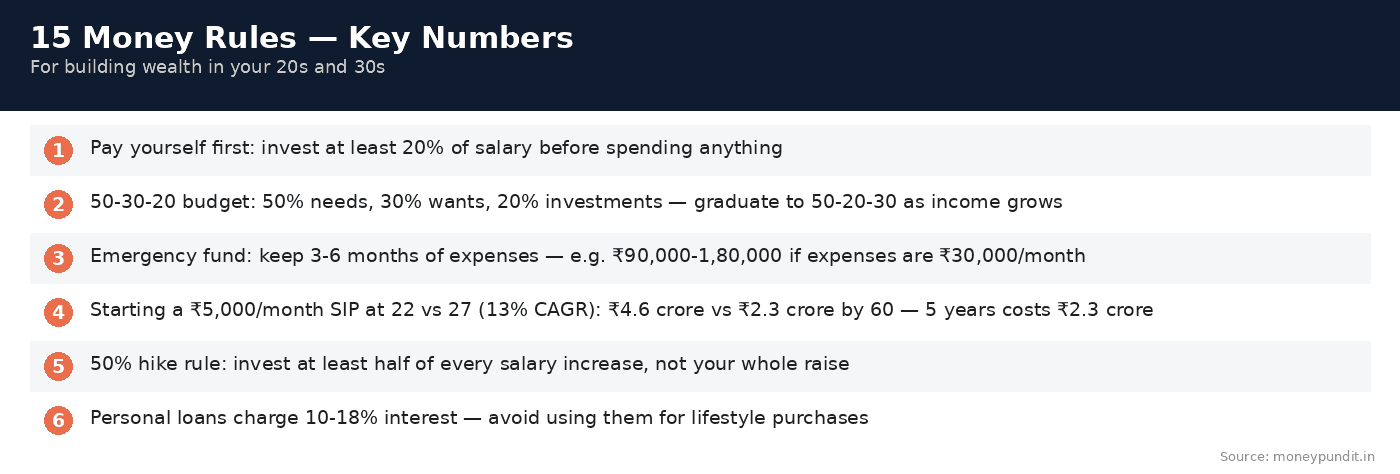
The moment your salary hits your account, transfer a fixed percentage (at least 20%) to your investment accounts before spending anything. Set up auto-debit SIPs that trigger on your salary date. Most people save what’s left after spending. Wealthy people spend what’s left after saving. This single habit, investing before spending, separates people who build wealth from those who don’t.
Rule 2: Follow the 50-30-20 Budget (Then Graduate to 50-20-30)
Start with 50% of your take-home salary for needs (rent, groceries, utilities, EMIs), 30% for wants (dining out, shopping, entertainment, subscriptions), and 20% for investments. As your income grows, flip the wants and investments: 50% needs, 20% wants, 30% investments. Even better, aim for the aggressive version: invest 40-50% of your income by keeping lifestyle inflation in check.
Rule 3: Build an Emergency Fund Before Investing
Keep 3-6 months of expenses in a high-yield savings account or liquid fund. This is your financial safety net, it prevents you from breaking your investments or taking high-interest personal loans during emergencies. If your monthly expenses are ₹30,000, aim for ₹90,000-1,80,000 in your emergency fund. Only after this is set up should you start investing aggressively.
Rule 4: Start SIPs Immediately: Don’t Wait for the “Right Time”
The best time to start investing was yesterday. The second-best time is today. A 22-year-old investing ₹5,000/month till 60 at 13% CAGR accumulates approximately ₹4.6 crore. A 27-year-old with the same SIP accumulates ₹2.3 crore, less than half. Those 5 years of delay cost ₹2.3 crore. Stop waiting for the market to correct, for your salary to increase, or for the “perfect fund.” Just start.
Rule 5: Avoid Lifestyle Inflation Like the Plague
When you get a salary hike of ₹15,000/month, the temptation is to upgrade your lifestyle, better phone, bigger apartment, fancier car. Instead, follow the 50% hike rule: invest at least 50% of every salary increase. If your salary goes from ₹60,000 to ₹75,000, increase your SIPs by at least ₹7,500. This way your investments grow faster than your expenses.
Rule 6: Never Take a Personal Loan for Lifestyle Purchases
Personal loans charge 10-18% interest. That new iPhone on a 12-month EMI? You’re paying 12-15% extra for the privilege of having it now. Buy-now-pay-later schemes and credit card EMIs are even worse. They normalise debt for things that lose value. If you can’t pay for it in cash, you probably can’t afford it. The only acceptable debt is a home loan (it builds an asset and offers tax benefits) and an education loan (it increases your earning potential).
Rule 7: Get Term Insurance and Health Insurance Early
A ₹1 crore term insurance policy costs a 25-year-old just ₹600-800/month. At 35, the same policy costs ₹1,200-1,500. At 45, it may cost ₹3,000+ or be difficult to get if you have health issues. Buy term insurance as soon as someone depends on your income. Similarly, a personal health insurance policy is cheaper when you’re young and healthy, a ₹10 lakh cover costs ₹5,000-8,000/year in your mid-20s vs ₹15,000-25,000 in your 40s.
Rule 8: Learn About Taxes: You’ll Save Lakhs Over Your Career
Many young employees blindly opt for the new tax regime without checking if the old regime saves more. If you pay rent, have a home loan, or invest in PPF/NPS/ELSS, the old regime might save you ₹20,000-80,000 more per year. Over a 30-year career, poor tax planning can cost you ₹30-50 lakh in unnecessary taxes. Spend 2 hours each March understanding your tax options, it’s the highest hourly ROI activity you’ll ever do.
Rule 9: Track Every Rupee for the First Year
Use an expense tracker app (Walnut, Money Manager, or even a simple spreadsheet) to record every expense for at least one year. You’ll be shocked at how much goes to subscriptions you don’t use, food delivery, and impulse purchases. Most people discover they can redirect ₹5,000-10,000/month to investments just by becoming aware of their spending patterns.
Rule 10: Your Credit Score Matters: Build It Early
A CIBIL score above 750 gets you the best interest rates on home loans, car loans, and credit cards. Build your credit history by getting a basic credit card, using it for 20-30% of the limit, and paying the full bill every month. Never miss an EMI payment. Never pay only the “minimum due” on credit cards. Check your CIBIL score for free quarterly through platforms like Paytm, CRED, or cibil.com.
Rule 11: Don’t Invest Based on Social Media Tips
Instagram reels and YouTube thumbnails promising “₹500 to ₹5 crore” or “this penny stock will 10x” are designed for engagement, not your financial benefit. Many “finfluencers” earn from paid promotions, not from investing. Stick to evidence-based investing, diversified mutual fund SIPs, index funds, and quality stocks analysed through fundamentals. Boring investing makes you rich. Exciting investing makes you poor.
Rule 12: Invest in Your Skills: The Best ROI Investment
Your earning potential is your biggest financial asset. A ₹50,000 course that helps you get a ₹2 lakh/year salary hike gives you a 400% annual return. No mutual fund can match that. Invest in certifications, courses, and skills that increase your market value. In your 20s, the gap between a ₹5 LPA and ₹15 LPA salary is often just skills and positioning, not intelligence.
Rule 13: Avoid Comparing Your Finances with Peers
Your colleague’s new car might be on a 7-year EMI. Your friend’s vacation might be on a credit card. What people show on the outside rarely reflects their actual financial health. Focus on your own net worth (assets minus liabilities), your savings rate, and your investment growth, not what others are spending on.
Rule 14: Use Credit Cards Wisely: They’re Tools, Not Income
Credit cards offer 1-5% cashback, reward points, lounge access, and purchase protection, making them excellent financial tools when used correctly. The golden rules: always pay the full outstanding balance by the due date, never use more than 30% of your credit limit, use auto-pay to avoid missed payments, and never take cash advances or convert purchases to EMIs. If you can’t control the urge to overspend with credit cards, use a debit card instead.
Rule 15: Set Clear Financial Goals with Deadlines
Vague goals like “I want to be rich” don’t work. Set specific, time-bound targets: ₹50 lakh for a home down payment by age 32, ₹20 lakh emergency fund by age 30, ₹2 crore retirement corpus by age 50, or ₹30 lakh for children’s education by age 40. Then reverse-engineer how much you need to invest monthly to reach each goal. This transforms investing from a vague habit into a purposeful strategy.
Frequently Asked Questions
I earn only ₹20,000/month. Can I still follow these rules?
Absolutely. Start with whatever you can: even ₹1,000/month in a SIP. The rules scale to any income level. At ₹20,000/month: keep ₹10,000 for needs, ₹4,000 for wants, ₹4,000 for SIPs, and ₹2,000 for emergency fund building. The habit and discipline matter more than the amount.
Should I pay off my education loan first or invest?
If your education loan interest rate is below 8%, invest simultaneously. Your mutual fund SIPs will likely earn more than 8% over the long term. If the rate is above 10%, prioritise paying off the loan while maintaining a small SIP (even ₹500/month) to keep the investing habit alive. Remember, education loan interest is tax-deductible under Section 80E with no upper limit.
How do I convince my parents that mutual funds are safe?
Show them the data: the Nifty 50 has never given negative returns over any 15-year period since its inception. Start by investing alongside their preferred options. If they trust FDs, put some money in FDs and some in a large-cap or index fund. Over 2-3 years, the performance difference will speak for itself.
References: Amfiindia.com
Money management: Key Takeaways
Key points on money management:
- The moment your salary hits your account, transfer a fixed percentage (at least 20%) to your investment accounts before spending anything.
- Start with 50% of your take-home salary for needs (rent, groceries, utilities, EMIs), 30% for wants (dining out, shopping, entertainment, subscriptions), and 20% for investments.
- Keep 3-6 months of expenses in a high-yield savings account or liquid fund.
Verify the latest money management figures with RBI before you act.
Using money management in Your Plan
Putting money management into practice starts with your own numbers. Run them through our SIP calculator and tax calculator to see how money management fits your goals, then compare options in our FD rates guide. Whatever you decide about money management, review it every year and keep records.
In short, money management works best when matched to your time horizon, your tax bracket and your risk comfort. Revisit money management whenever rules or rates change.