
Advance tax in brief: If your total tax liability after TDS exceeds ₹10,000 in a financial year, you are required to pay advance tax.
Advance tax is the income tax paid in installments during the financial year rather than as a lump sum when filing your ITR. If your total tax liability after TDS exceeds ₹10,000 in a financial year, you are required to pay advance tax. Missing payments attracts interest under Sections 234B and 234C.
Who Needs to Pay Advance Tax
Freelancers and consultants with no TDS deduction on their income. Business owners and professionals with tax liability above ₹10,000. Salaried individuals with significant non-salary income: rental income, capital gains, interest income, or freelance income alongside their job. Senior citizens (above 60) with no business income are exempt from advance tax. If your employer deducts adequate TDS covering all income sources, advance tax may not be needed.
Advance Tax Due Dates
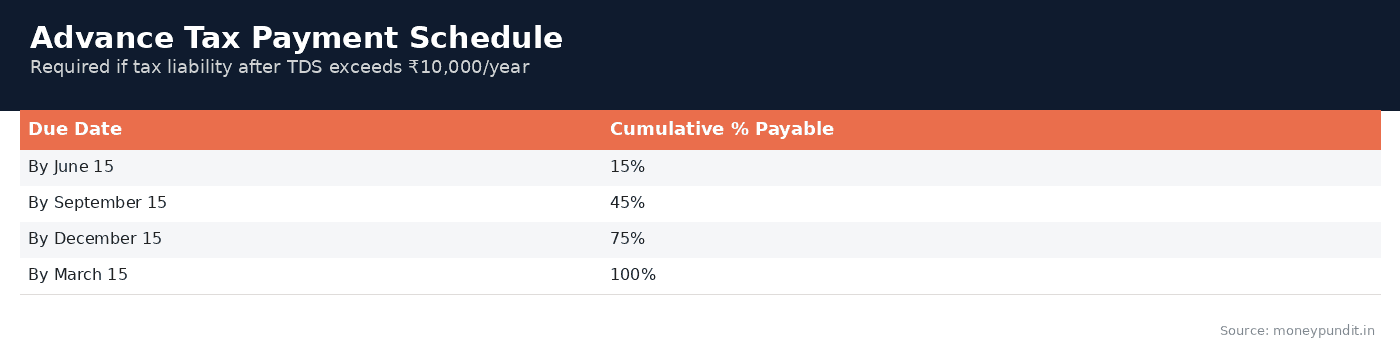
For individuals and businesses not under presumptive taxation: 15% by June 15, 45% by September 15, 75% by December 15, and 100% by March 15. For businesses under presumptive taxation (Section 44AD/44ADA), the entire advance tax must be paid by March 15 in a single installment. These dates are the same every financial year and should be marked in your calendar if applicable.
How to Calculate Advance Tax
Estimate your total income for the year from all sources. Calculate tax using applicable slab rates and regime. Subtract TDS already deducted or expected to be deducted. If the remaining tax exceeds ₹10,000, pay in quarterly installments as per the schedule. Review and adjust your estimates each quarter based on actual income, particularly important for variable income from freelancing or investments.
Interest for Non-Payment or Short Payment
Under Section 234B, interest at 1% per month is charged if advance tax paid is less than 90% of the assessed tax. Under Section 234C, interest at 1% per month is charged for each quarter where cumulative advance tax paid falls short of the required percentage. These interest charges are not deductible and add to your total tax outgo. Even a slight miscalculation in the final quarter can trigger 234C interest, so it is better to marginally overpay and claim a refund.
Can I pay advance tax online?
Yes, advance tax can be paid through the e-filing portal or through net banking using Challan 280. Select the correct assessment year and payment type (advance tax). The receipt (BSR code and challan number) should be kept safely for ITR filing.
What if I overestimate and overpay advance tax?
Overpaid advance tax is refunded when you file your ITR. The income tax department pays 6% annual interest on excess tax from the date of payment to the date of refund. So overpaying is not ideal but is better than underpaying and attracting 12% interest plus potential scrutiny.
Who Needs to Pay Advance Tax?
Advance tax applies to anyone whose total tax liability for the financial year exceeds ₹10,000 after accounting for TDS. While salaried employees usually have most tax covered through TDS by their employer, advance tax becomes relevant if you have significant income beyond salary, rental income, capital gains from stock trading or mutual fund redemptions, freelance earnings, interest income, or business profits. Self-employed professionals, business owners, and freelancers are the most common advance tax payers.
Senior citizens (aged 60+) who don’t have business or professional income are exempt from advance tax. They can pay their entire tax at the time of filing their return. However, if a senior citizen has business income, the advance tax obligation applies to them as well. Use our Tax Calculator to estimate your total annual tax liability and determine whether you need to pay advance tax.
Advance Tax Due Dates and Percentages
Advance tax is paid in four quarterly instalments during the financial year: 15% by June 15, 45% cumulative by September 15, 75% cumulative by December 15, and 100% by March 15. For example, if your estimated annual tax liability is ₹2 lakh: pay ₹30,000 by June 15, ₹60,000 by September 15 (bringing the total to ₹90,000), ₹60,000 by December 15 (total ₹1,50,000), and ₹50,000 by March 15 (total ₹2,00,000).
Freelancers and professionals under the presumptive taxation scheme (Section 44AD/44ADA) get a simpler option. They can pay 100% of advance tax in a single instalment by March 15. This is significantly more convenient than tracking four quarterly deadlines, though it requires setting aside funds throughout the year rather than paying as you earn.
Interest Penalties for Late or Short Payment
Missing advance tax deadlines triggers two types of interest under the Income Tax Act. Section 234B applies if you pay less than 90% of your total tax liability as advance tax, you’re charged 1% per month simple interest on the shortfall from April 1 of the assessment year until the date of actual payment. Section 234C applies for short payment in any quarterly instalment, 1% per month interest for 3 months on the shortfall amount.
These interest charges are not deductible from taxable income and can add up quickly. On a ₹1 lakh shortfall, Section 234B interest alone costs ₹1,000 per month. The smart approach: overestimate slightly rather than underestimate. If you overpay advance tax, the excess is refunded with 6% annual interest (0.5% per month) from April of the assessment year. Track your income quarterly, especially capital gains from investments, and adjust subsequent advance tax payments if your income trajectory changes during the year.
References: Amfiindia.com
Source: amfiindia.com
Frequently Asked Questions About Advance tax
What is advance tax?
Advance tax is income tax paid in instalments during the financial year, instead of as a lump sum when you file your return.
Who has to pay advance tax?
Freelancers and consultants with no TDS deducted on their income, and business owners and professionals with a tax liability, need to pay advance tax in instalments.
How do I calculate advance tax?
Estimate your total income for the year, work out the tax on it, subtract any TDS, and pay the balance in instalments by the due dates listed on this page.
Where can I check the latest advance tax due dates?
Confirm the current due dates and rules on the Income Tax Department website before paying.
Advance tax: Key Takeaways
Key points on advance tax:
- Freelancers and consultants with no TDS deduction on their income.
- For individuals and businesses not under presumptive taxation: 15% by June 15, 45% by September 15, 75% by December 15, and 100% by March 15.
- If the remaining tax exceeds ₹10,000, pay in quarterly installments as per the schedule.
Verify the latest advance tax figures with Income Tax Department before you act.
Using advance tax in Your Plan
Putting advance tax into practice starts with your own numbers. Run them through our SIP calculator and tax calculator to see how advance tax fits your goals, then compare options in our FD rates guide. Whatever you decide about advance tax, review it every year and keep records.
In short, advance tax works best when matched to your time horizon, your tax bracket and your risk comfort. Revisit advance tax whenever rules or rates change.