
How to file income tax return in brief: Filing your Income Tax Return (ITR) is a legal obligation for every Indian whose gross income exceeds the basic exemption limit (₹3 lakh under new regime, ₹2.5 lakh under old regime).
Filing ITR late by even a single day can mean losing your right to carry forward capital losses into future years, a consequence that surprises a lot of first-time filers who assume the only penalty is a late fee. Here’s the complete step-by-step process for FY 2026.
Filing your Income Tax Return (ITR) is a legal obligation for every Indian whose gross income exceeds the basic exemption limit (₹3 lakh under new regime, ₹2.5 lakh under old regime). Beyond compliance, filing ITR on time unlocks several benefits, easier loan approvals, visa processing, carry forward of losses, and claiming refunds for excess TDS. With the Income Tax Department’s e-filing portal, the entire process can be completed online in 30-60 minutes.
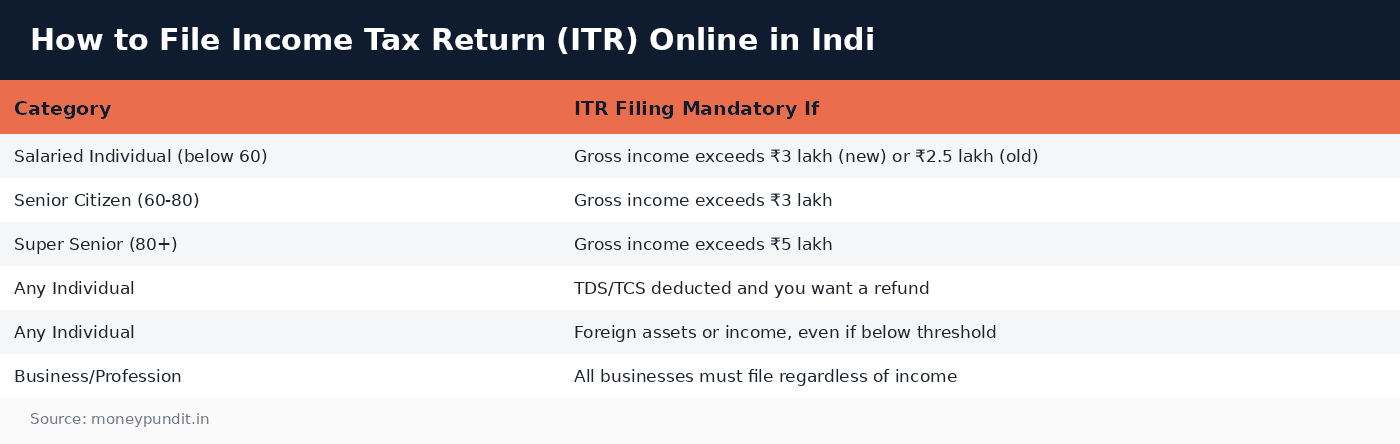
Who Must File ITR?
| Category | ITR Filing Mandatory If |
|---|---|
| Salaried Individual (below 60) | Gross income exceeds ₹3 lakh (new) or ₹2.5 lakh (old) |
| Senior Citizen (60-80) | Gross income exceeds ₹3 lakh |
| Super Senior (80+) | Gross income exceeds ₹5 lakh |
| Any Individual | TDS/TCS deducted and you want a refund |
| Any Individual | Foreign assets or income, even if below threshold |
| Business/Profession | All businesses must file regardless of income |
Even if your income is below the threshold, filing ITR is strongly recommended. Banks require 2-3 years of ITR for loan processing, embassies require ITR for visa applications, and losses (capital gains, business) can only be carried forward if you file ITR by the due date.
Which ITR Form to Use?
| ITR Form | Applicable To |
|---|---|
| ITR-1 (Sahaj) | Salaried, income up to ₹50 lakh, one house property, interest/other income |
| ITR-2 | Salary + Capital gains, multiple house properties, foreign income, income above ₹50 lakh |
| ITR-3 | Business or professional income (including F&O trading, freelancing) |
| ITR-4 (Sugam) | Presumptive taxation (Section 44AD/44ADA), small business/freelancers |
Most salaried employees with only salary income, one house property, bank interest, and no capital gains can use ITR-1. If you have sold stocks, mutual funds, or property during the year (even at a loss), you need ITR-2 or higher.
Documents Needed for ITR Filing
Before starting, gather: Form 16 (from employer: TDS certificate), Form 26AS (auto-populated tax credit statement), AIS (Annual Information Statement, shows all financial transactions), bank statements showing interest earned, investment proofs for deductions (80C, 80D, 24b), capital gains statements from your broker and mutual fund houses, and rent receipts (if claiming HRA).
Step-by-Step Filing Process
Step 1: Login to E-Filing Portal
Visit incometax.gov.in and log in using your PAN as the user ID. If you are a first-time user, register using your PAN, date of birth, and mobile number linked to Aadhaar. After login, go to e-File → Income Tax Returns → File Income Tax Return.
Step 2: Select Assessment Year and ITR Form
Choose the assessment year (e.g., AY 2026-27 for income earned in FY 2025-26), select the applicable ITR form, and choose between original return or revised return. Select your tax regime (old or new), this choice is important as it affects which deductions you can claim.
Step 3: Pre-Filled Data Verification
The portal auto-fills salary details, TDS information, interest income, and other financial data from Form 26AS and AIS. Carefully verify this pre-filled information against your Form 16, bank statements, and actual records. Discrepancies should be addressed with the relevant deductor before filing.
Step 4: Enter Income and Deduction Details
Add any income not pre-filled (freelance income, rental income, capital gains). Enter deduction claims, Section 80C investments, 80D health insurance, 80E education loan interest, 80G donations, and Section 24 home loan interest. Ensure the total 80C claim does not exceed ₹1.5 lakh.
Step 5: Compute Tax and Verify
The portal calculates your total tax liability and compares it with TDS already paid. If TDS exceeds the liability, you are eligible for a refund. If there is additional tax due, you can pay it through the portal using net banking, UPI, or debit card before submitting the return.
Step 6: E-Verify Your Return
After submission, e-verify your return within 30 days. The easiest methods are Aadhaar OTP (sent to your Aadhaar-linked mobile), net banking (most banks support this), or DSC (Digital Signature Certificate). Without e-verification, your return is not considered filed and will be treated as a defective return.
Important Deadlines
| Category | Due Date | Late Fee |
|---|---|---|
| Individuals (no audit) | July 31 | ₹5,000 (if income > ₹5L) / ₹1,000 (if ≤ ₹5L) |
| Businesses requiring audit | October 31 | ₹5,000 |
| Transfer pricing cases | November 30 | ₹5,000 |
| Revised return | December 31 (of AY) | No additional fee |
| Belated return | December 31 (of AY) | ₹5,000 + loss of carry-forward |
Common ITR Filing Mistakes
Not Reporting All Income
The AIS now captures virtually all financial transactions: bank interest, mutual fund redemptions, stock sales, dividends, and even high-value purchases. Not reporting income that appears in your AIS triggers notices and can lead to penalties. Always reconcile your AIS before filing and report all income sources.
Incorrect Tax Regime Selection
Choosing the wrong tax regime (old vs new) can result in paying more tax. Salaried individuals with significant deductions (80C, 80D, HRA, home loan interest exceeding ₹3.5 lakh) usually benefit from the old regime. Those with fewer deductions often save more under the new regime. Compare both calculations before selecting.
Not Filing for Capital Losses
If you sold stocks or mutual funds at a loss, you must file ITR by July 31 to carry forward these losses. Capital losses can be set off against future gains for 8 years, potentially saving significant taxes. Many investors skip filing when they have net losses, losing this valuable tax benefit permanently.
Frequently Asked Questions
Can I file ITR myself or do I need a CA?
Most salaried individuals can file ITR-1 themselves using the pre-filled data on the e-filing portal. It takes 20-30 minutes once you have all documents ready. You may need a CA if you have complex situations like business income, multiple capital gains sources, foreign income, or if you received a tax notice.
What happens if I miss the July 31 deadline?
You can file a belated return until December 31 of the assessment year, but with a late fee of ₹5,000 (₹1,000 if income is below ₹5 lakh). Additionally, you lose the ability to carry forward losses (except house property loss), may face interest under Section 234A, and cannot choose between tax regimes for that year (new regime becomes mandatory).
How long does it take to get a refund?
Refunds for e-verified returns are typically processed within 4-8 weeks. The refund is directly credited to your bank account linked to your PAN. You can track the refund status on the e-filing portal under “My Account → Refund/Demand Status.” Delays usually occur when there are mismatches in data or bank account validation issues.
Do I need to file ITR if my only income is from salary and TDS is fully deducted?
If your gross salary exceeds the basic exemption limit, filing is mandatory regardless of whether TDS covers your full tax liability. Even if TDS equals your exact tax, you must file. The only exception is if your income is below the exemption limit and no TDS has been deducted. In this case, filing is not mandatory but still recommended.
References: Amfiindia.com
Related Resources
Before you file, make sure you understand your Form 16: see our full explainer.
How to file income tax return: Key Takeaways
Key points on how to file income tax return:
- Banks require 2-3 years of ITR for loan processing, embassies require ITR for visa applications, and losses (capital gains, business) can only be carried forward if you file ITR by the due date.
- Most salaried employees with only salary income, one house property, bank interest, and no capital gains can use ITR-1.
- Visit incometax.gov.in and log in using your PAN as the user ID.
Verify the latest how to file income tax return figures with Income Tax Department before you act.