
How to build 1 crore corpus in brief: ₹1 crore sounds like an enormous, distant number until you break it into a monthly SIP figure, at 12% returns, even a modest ₹5,000/month reaches seven figures well within a working career.
₹1 crore sounds like an enormous, distant number until you break it into a monthly SIP figure, at 12% returns, even a modest ₹5,000/month reaches seven figures well within a working career. Here’s the actual math and investment plans across different budget levels.
Building a ₹1 crore corpus might seem daunting, but with disciplined investing and the power of compounding, it is achievable for most working Indians. The key variables are how much you invest monthly, the return rate, and how many years you have. This guide shows specific investment plans for different budgets and timelines.
The Math Behind ₹1 Crore
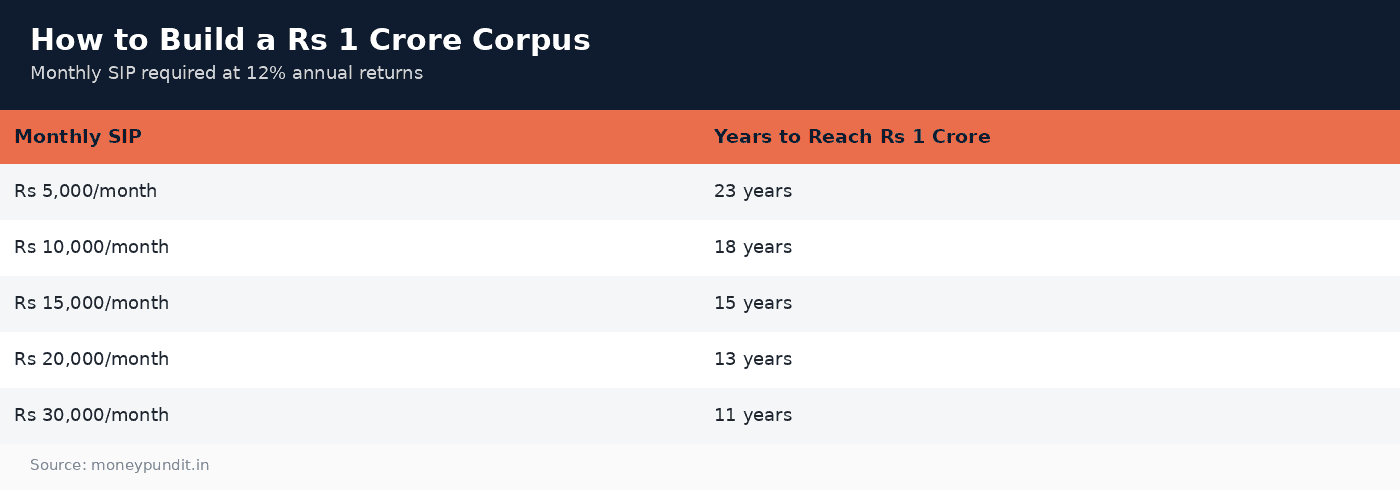
At 12% annual returns (historical equity mutual fund average), reaching ₹1 crore requires: ₹5,000/month for 23 years, ₹10,000/month for 18 years, ₹15,000/month for 15 years, ₹20,000/month for 13 years, or ₹30,000/month for 11 years. Starting early dramatically reduces the monthly requirement. A 25-year-old has 35 years to retirement, needing just ₹2,000/month at 12% to reach ₹1 crore. A 35-year-old with 25 years needs ₹5,300/month. A 40-year-old with 20 years needs ₹10,000/month.
Investment Plan: ₹5,000/Month Budget
Allocate ₹3,000 to a flexi-cap equity mutual fund SIP for long-term growth. Put ₹1,000 in PPF for guaranteed tax-free returns and 80C benefit. Invest ₹1,000 in a mid-cap fund SIP for additional growth. Increase the SIP by 10% annually as your income grows (step-up SIP). With 10% annual step-up, ₹5,000 starting SIP reaches ₹1 crore in approximately 17 years at 12% returns instead of 23 years, cutting 6 years off your timeline.
Investment Plan: ₹15,000/Month Budget
₹6,000 in a flexi-cap fund SIP (core holding). ₹4,000 in a mid-cap fund SIP (growth booster). ₹2,000 in a small-cap fund SIP (high-growth satellite). ₹1,500 in PPF (guaranteed tax-free returns). ₹1,500 in NPS (additional tax benefit under 80CCD(1B)). This diversified approach targets 12-14% blended returns while maintaining tax efficiency. At 13% returns, ₹1 crore is reached in approximately 14 years.
Investment Plan: ₹30,000/Month Budget
₹10,000 in a Nifty 50 index fund SIP (low-cost core). ₹7,000 in a flexi-cap active fund SIP. ₹5,000 in a mid-cap fund SIP. ₹3,000 in a small-cap fund SIP. ₹2,500 in PPF. ₹2,500 in NPS or ELSS for tax saving. This reaches ₹1 crore in approximately 10-11 years at 12-13% returns, and then continues compounding toward ₹3-5 crore by retirement.
Critical Success Factors
Never stop SIPs during market crashes: these are the best times to accumulate units at lower prices. Increase SIP by at least 10% every year. Do not withdraw from long-term investments for short-term wants. Stay invested for at least 10 years, equity returns become more predictable over longer periods. Rebalance annually to maintain your target allocation.
Is ₹1 crore enough for retirement?
At 4% withdrawal rate, ₹1 crore provides approximately ₹33,000 per month adjusted for inflation. For most urban families, ₹3-5 crore is a more realistic retirement target. ₹1 crore is an excellent milestone but should be viewed as a stepping stone, not the final goal.
How To Build A 1 Crore Corpus: The Math Behind ₹1 Crore
Building a ₹1 crore corpus sounds daunting, but the numbers become surprisingly manageable when you start early and invest consistently. At a 12% annual return (the historical average for Indian equity mutual funds), here’s what you need: starting at age 25 (20-year horizon), a monthly SIP of just ₹10,000 grows to ₹1 crore. Starting at 30 (15 years), you need ₹20,000/month. At 35 (10 years), it jumps to ₹43,000/month. The message is clear. Time is your most powerful wealth-building ally.
Use our SIP Calculator to model your exact scenario. The power of compounding means that in a 20-year SIP, roughly 75% of your final corpus comes from investment returns rather than your contributions. Your ₹24 lakh total investment (₹10,000 × 240 months) grows to ₹1 crore because compounding accelerates dramatically in the later years, your corpus might take 12 years to reach ₹30 lakh but only 4 more years to go from ₹60 lakh to ₹1 crore.
Investment Plans for Different Income Levels
If you earn ₹30,000-₹50,000/month: Start with a ₹5,000-₹10,000 SIP in a diversified equity fund and increase by 10% annually using a step-up SIP. A ₹5,000 monthly SIP with 10% annual step-up for 20 years at 12% returns reaches ₹1.05 crore, making the target achievable even on a modest salary.
If you earn ₹50,000-₹1 lakh/month: Allocate ₹15,000-₹25,000 across 2-3 funds, a large-cap or index fund (60%), a mid-cap fund (25%), and a small-cap fund (15%). This diversification provides growth with manageable risk. Your ₹1 crore timeline shortens to 12-15 years with this allocation.
If you earn above ₹1 lakh/month: Aggressive SIPs of ₹30,000-₹50,000 combined with lump-sum investments during market corrections can compress the timeline to 8-10 years. Consider adding direct equity and international fund exposure for diversification once your mutual fund portfolio crosses ₹25-30 lakh.
Common Mistakes That Derail Your ₹1 Crore Goal
The biggest enemy isn’t poor fund selection: it’s inconsistency. Stopping SIPs during market downturns, withdrawing corpus for lifestyle upgrades, or pausing investments “temporarily” destroys compounding momentum. Keep your SIPs non-negotiable like EMI payments. Avoid these additional mistakes: investing everything in one fund (diversify across 3-4 fund categories), chasing last year’s top performer (past returns don’t guarantee future performance), and ignoring tax efficiency, ELSS funds combine tax savings under Section 80C with equity returns, effectively reducing your investment cost.
References: Amfiindia.com
Source: amfiindia.com
Frequently Asked Questions
How long does it take to build ₹1 crore?
It depends on your monthly investment and return. At an assumed 12% a year, a monthly SIP of ₹30,000 reaches ₹1 crore in about 12 years, while a smaller SIP needs more time or yearly step-ups.
Is ₹1 crore enough to retire?
It depends on your expenses and inflation. A ₹1 crore corpus today may not support the same lifestyle in 20 years, so plan against inflation-adjusted expenses.
Can I reach ₹1 crore with a small monthly SIP?
Yes, with a longer horizon and annual step-ups. Use our SIP calculator to see the effect of starting early and raising your SIP each year.
How to build 1 crore corpus: Key Takeaways
Key points on how to build 1 crore corpus:
- Starting early dramatically reduces the monthly requirement.
- Allocate ₹3,000 to a flexi-cap equity mutual fund SIP for long-term growth.
- At 13% returns, ₹1 crore is reached in approximately 14 years.
Verify the latest how to build 1 crore corpus figures with RBI before you act.