
Gst registration filing in brief: Goods and Services Tax (GST) is India’s unified indirect tax system that replaced multiple state and central taxes in July 2017.
GST registration becomes mandatory the moment your business crosses ₹40 lakh in turnover (₹20 lakh for services), but plenty of small businesses register voluntarily before that threshold specifically to claim input tax credit. Here’s who needs to register, current rates, and how filing actually works.
Goods and Services Tax (GST) is India’s unified indirect tax system that replaced multiple state and central taxes in July 2017. For small business owners, freelancers, and entrepreneurs, understanding GST registration, filing, and compliance is essential. Non-compliance can lead to penalties, legal issues, and loss of business opportunities. This guide simplifies GST for the everyday business owner.
Who Needs GST Registration?
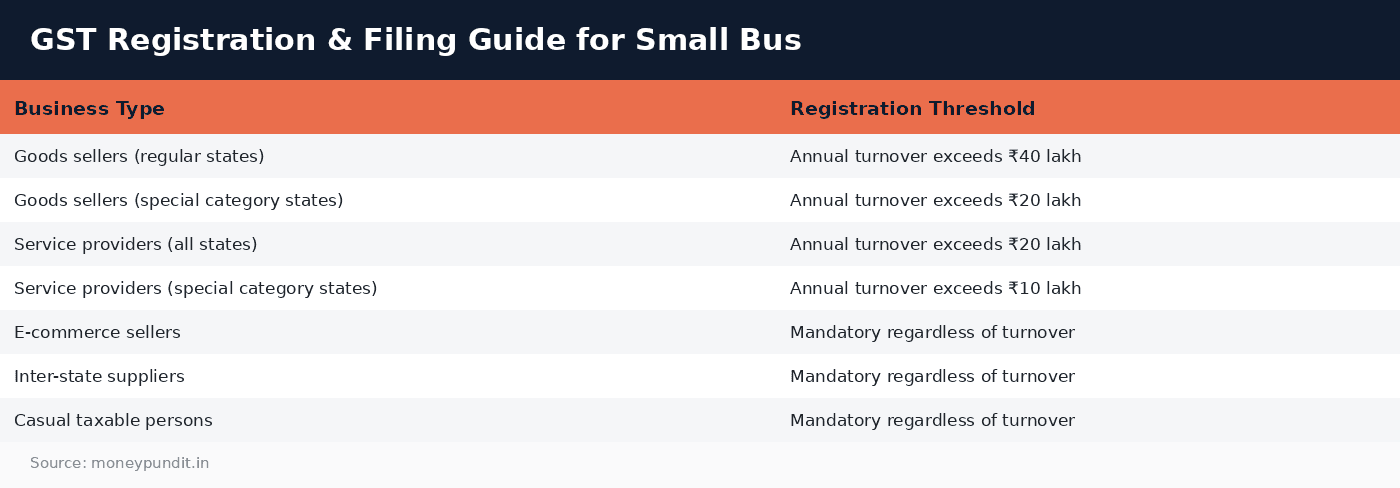
| Business Type | Registration Threshold |
|---|---|
| Goods sellers (regular states) | Annual turnover exceeds ₹40 lakh |
| Goods sellers (special category states) | Annual turnover exceeds ₹20 lakh |
| Service providers (all states) | Annual turnover exceeds ₹20 lakh |
| Service providers (special category states) | Annual turnover exceeds ₹10 lakh |
| E-commerce sellers | Mandatory regardless of turnover |
| Inter-state suppliers | Mandatory regardless of turnover |
| Casual taxable persons | Mandatory regardless of turnover |
GST Tax Rates
| Rate | Applicable Items (Examples) |
|---|---|
| 0% (Exempt) | Fresh fruits, vegetables, milk, bread, education, healthcare |
| 5% | Packaged food, economy airline tickets, shoes under ₹500 |
| 12% | Processed food, mobile phones, business class airline |
| 18% | Most services, electronics, financial services, restaurants (AC) |
| 28% | Luxury items, automobiles, tobacco, aerated drinks |
Types of GST
CGST (Central GST) and SGST (State GST) apply on intra-state transactions, both are levied at half the total GST rate each. For example, on an 18% GST item sold within the same state, 9% goes as CGST and 9% as SGST. IGST (Integrated GST) applies on inter-state transactions at the full rate. For a sale from Delhi to Mumbai, 18% IGST is charged. The end consumer pays the same total amount regardless, the split only determines which government receives the revenue.
GST Registration Process
Step 1: Gather Documents
You need PAN card, Aadhaar card, photograph, business address proof (rental agreement or property ownership document), bank account details (cancelled cheque or bank statement), business registration certificate (if applicable), and digital signature (for companies and LLPs).
Step 2: Apply Online
Visit the GST Portal (gst.gov.in), click “Register Now,” and fill Part A with basic details (PAN, mobile, email). After OTP verification, fill Part B with business details, promoter/partner information, bank account details, and upload required documents. The entire process is online and typically completed in 15-30 minutes.
Step 3: Receive GSTIN
After verification, the GST officer issues your GSTIN (GST Identification Number), a 15-digit unique number. The typical processing time is 3-7 working days. For Aadhaar-authenticated applications, approval may be faster. Once approved, you can start issuing GST-compliant invoices.
Composition Scheme: Simplified Option for Small Businesses
If your turnover is below ₹1.5 crore (₹75 lakh for special category states), you can opt for the Composition Scheme. Under this scheme, you pay GST at a reduced fixed rate (1% for manufacturers, 1% for traders, 5% for restaurants, 6% for other service providers) without maintaining detailed records of every transaction. You file quarterly returns instead of monthly ones. The downside: you cannot claim Input Tax Credit, cannot make inter-state supplies, and cannot collect GST from customers separately.
Input Tax Credit (ITC): The Core Benefit
ITC is the most important concept in GST for businesses. You can claim credit for the GST paid on your business purchases (inputs) against the GST collected on your sales (output). If you collect ₹18,000 GST on sales and pay ₹12,000 GST on purchases, you only remit ₹6,000 to the government. This prevents the cascading effect of tax-on-tax that existed under the old regime.
To claim ITC, you must have a valid tax invoice from a registered supplier, the goods or services must be used for business purposes, the supplier must have filed their return and paid the GST collected from you, and the invoice must match in the GST portal (auto-reconciliation through GSTR-2B).
GST Return Filing Schedule
| Return | Purpose | Due Date | Who Files |
|---|---|---|---|
| GSTR-1 | Outward supplies (sales) | 11th of next month | Regular taxpayers |
| GSTR-3B | Monthly summary + tax payment | 20th of next month | Regular taxpayers |
| GSTR-4 | Annual return | 30th April | Composition dealers |
| GSTR-9 | Annual return | 31st December | Regular taxpayers (turnover > ₹2 crore) |
Common GST Compliance Mistakes
Late Filing
Late filing attracts a penalty of ₹50 per day (₹25 CGST + ₹25 SGST) for GSTR-3B, capped at ₹10,000 per return. For Nil returns (no transactions), the penalty is ₹20 per day. Additionally, late filing blocks your ITC claims and can lead to cancellation of GST registration after prolonged non-filing.
Invoice Mismatch
If your purchase invoices do not match the supplier’s GSTR-1 filing, your ITC claim can be rejected. Regularly reconcile your purchase records with the GSTR-2B statement available on the GST portal. Follow up with suppliers whose invoices do not appear in your GSTR-2B. They may not have filed their returns.
Frequently Asked Questions
Do freelancers need GST registration?
Freelancers providing services must register for GST if their annual revenue exceeds ₹20 lakh (₹10 lakh in special category states). If you provide services to clients outside India (export of services), you may still need registration to claim refunds on input GST paid. Freelancers on e-commerce platforms may need registration regardless of turnover.
Can I cancel my GST registration?
Yes, you can apply for cancellation if your turnover falls below the threshold, you close the business, or the business is transferred. Apply through the GST portal using Form GST REG-16. Final return GSTR-10 must be filed within 3 months of cancellation. Any ITC balance or stock on hand at cancellation is reversed (you pay back the ITC claimed).
What is e-invoicing and does it apply to me?
E-invoicing is mandatory for businesses with turnover above ₹5 crore. It requires generating invoices through the Invoice Registration Portal (IRP) which assigns a unique Invoice Reference Number (IRN). For businesses below this threshold, e-invoicing is currently not mandatory, but maintaining GST-compliant invoice formats is still required.
How is GST calculated on services like restaurants?
Non-AC restaurants without liquor license charge 5% GST without ITC. AC restaurants and those serving liquor charge 5% GST without ITC. Restaurants in hotels with room tariff above ₹7,500 charge 18% GST with ITC. Outdoor catering services attract 18% GST with ITC. The rate determines whether you can claim input credit on your supplies and expenses.
References: Nseindia.com
GST registration filing: Key Takeaways
Key points on gst registration filing:
- CGST (Central GST) and SGST (State GST) apply on intra-state transactions, both are levied at half the total GST rate each.
- After OTP verification, fill Part B with business details, promoter/partner information, bank account details, and upload required documents.
- Under this scheme, you pay GST at a reduced fixed rate (1% for manufacturers, 1% for traders, 5% for restaurants, 6% for other service providers) without maintaining detailed records of every transaction.
Verify the latest gst registration filing figures with GST Portal before you act.