

Sip vs lump sum in brief: Example: You invest ₹10,000 every month in an equity mutual fund.
Whether a lump sum beats a SIP comes down almost entirely to one unknowable factor, where the market happens to be when you invest, which is exactly why most financial planners recommend SIP as the safer default. Here’s the actual comparison, market condition by market condition.
Every investor in India faces this question at some point – should I invest through a Systematic Investment Plan (SIP) or put in a lump sum amount? The answer depends on your financial situation, risk appetite, and market conditions. This guide breaks down both strategies with real numbers so you can decide what works best for you.
What Is SIP?
A Systematic Investment Plan (SIP) lets you invest a fixed amount in mutual funds at regular intervals – typically monthly. Instead of timing the market, you invest consistently regardless of whether the market is up or down.
Example: You invest ₹10,000 every month in an equity mutual fund. Over 12 months, you invest ₹1,20,000 total, buying units at different NAVs each month.
What Is Lump Sum Investment?
Lump sum investing means putting a large amount of money into a mutual fund or other investment in one go. This could be a bonus, inheritance, matured FD, or any windfall amount.
Example: You receive a ₹5,00,000 bonus and invest the entire amount in an equity fund at once.
SIP vs Lump Sum: Head-to-Head Comparison
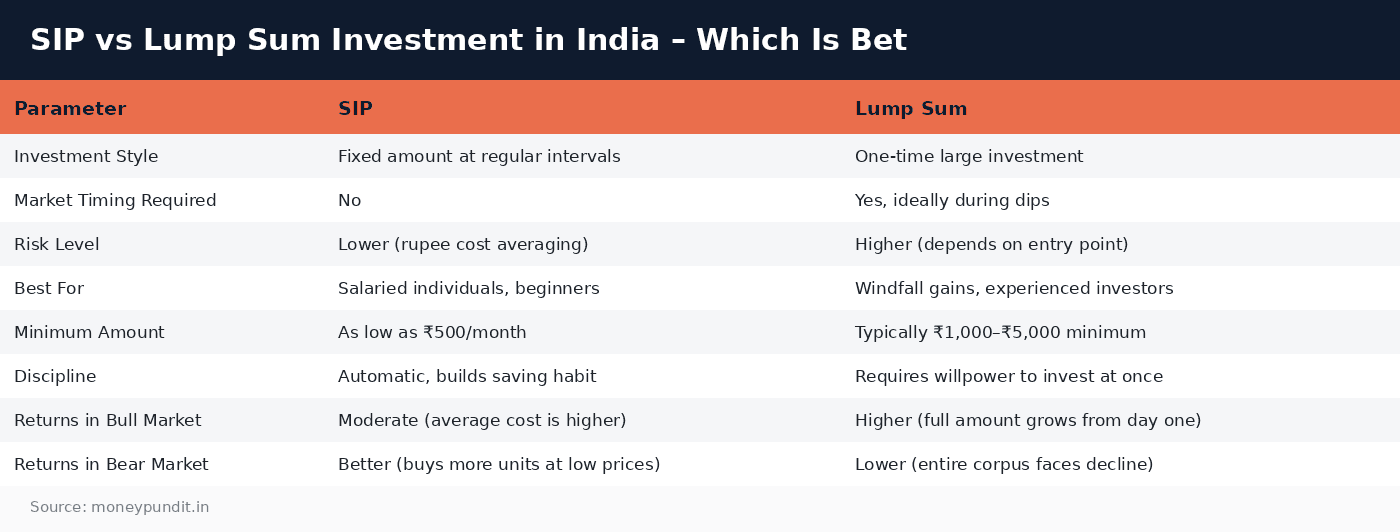
| Parameter | SIP | Lump Sum |
|---|---|---|
| Investment Style | Fixed amount at regular intervals | One-time large investment |
| Market Timing Required | No | Yes, ideally during dips |
| Risk Level | Lower (rupee cost averaging) | Higher (depends on entry point) |
| Best For | Salaried individuals, beginners | Windfall gains, experienced investors |
| Minimum Amount | As low as ₹500/month | Typically ₹1,000–₹5,000 minimum |
| Discipline | Automatic, builds saving habit | Requires willpower to invest at once |
| Returns in Bull Market | Moderate (average cost is higher) | Higher (full amount grows from day one) |
| Returns in Bear Market | Better (buys more units at low prices) | Lower (entire corpus faces decline) |
How Rupee Cost Averaging Works in SIP
The biggest advantage of SIP is rupee cost averaging. When the market falls, your fixed SIP amount buys more units. When it rises, you buy fewer units. Over time, this averages out your purchase cost and reduces the impact of market volatility.
| Month | NAV (₹) | SIP Amount (₹) | Units Purchased |
|---|---|---|---|
| January | 50 | 10,000 | 200.00 |
| February | 45 | 10,000 | 222.22 |
| March | 40 | 10,000 | 250.00 |
| April | 42 | 10,000 | 238.10 |
| May | 48 | 10,000 | 208.33 |
| June | 52 | 10,000 | 192.31 |
In this example, ₹60,000 invested over 6 months buys 1,310.96 units at an average cost of ₹45.77 per unit. If you had invested ₹60,000 as a lump sum in January at NAV ₹50, you would have only 1,200 units. The SIP investor ends up with more units and a lower average cost.
When SIP Is the Better Choice
1. You have a regular monthly income: If you are salaried, SIP aligns perfectly with your cash flow. Set up auto-debit and your investments happen without any effort.
2. You are new to investing: SIP removes the stress of “when to invest.” You do not need to track markets or worry about buying at the peak.
3. Markets are volatile or at highs: When Sensex and Nifty are near all-time highs, SIP helps you avoid putting all your money at the top. If markets correct, your subsequent SIPs buy at lower prices.
4. You want to build a long-term corpus: For goals like retirement, children’s education, or buying a home 10+ years away, SIP is ideal for disciplined wealth accumulation.
When Lump Sum Is the Better Choice
1. You receive a windfall: Bonus, inheritance, sale of property, or matured FD – if you have a large amount sitting idle, investing it as a lump sum puts your money to work immediately.
2. Markets have corrected significantly: After a 15–20% market correction, lump sum investing can deliver excellent returns when markets recover. Historical data shows that investing during corrections tends to outperform SIP over the subsequent 3–5 years.
3. You are investing in debt funds: For debt mutual funds where volatility is low, lump sum investing is often more efficient than SIP. The returns difference between SIP and lump sum in debt funds is minimal, and lump sum gives you full exposure from day one.
4. Short-term investment horizon: If you are investing for 1–2 years, a lump sum in a liquid or ultra-short-duration fund makes more sense than setting up a SIP.
Tax Implications: SIP vs Lump Sum
The tax treatment is identical for both SIP and lump sum investments in the same fund category. However, there is an important difference in how holding period is calculated:
For SIP: Each monthly installment is treated as a separate investment. So the first SIP installment may complete 1 year (for LTCG eligibility) while the last installment is still within the short-term period. This means when you redeem, some units may attract STCG tax while others qualify for LTCG.
For Lump Sum: The entire investment has a single purchase date. After 1 year (for equity funds) or 2 years (for debt funds under new rules), the full amount qualifies for long-term capital gains tax rates.
| Fund Type | STCG Tax Rate | LTCG Tax Rate | LTCG Threshold |
|---|---|---|---|
| Equity Funds (65%+ equity) | 20% | 12.5% (above ₹1.25 lakh) | 12 months |
| Debt Funds | As per income slab | 12.5% (above ₹1.25 lakh) | 24 months |
| Hybrid Funds (65%+ equity) | 20% | 12.5% (above ₹1.25 lakh) | 12 months |
The Best Strategy: Combine Both
Smart investors in India often use a combination of SIP and lump sum. Here is a practical approach:
Core portfolio via SIP: Set up monthly SIPs for your long-term goals. This should form 70–80% of your equity investments. Choose 2–3 diversified equity funds and maintain SIPs regardless of market conditions.
Tactical lump sum during corrections: Keep 20–30% of your investable surplus in a liquid fund. When markets correct by 10% or more from recent highs, deploy this amount as a lump sum into your existing equity funds. This is called the “SIP + VTP (Value Transfer Plan)” strategy.
Lump sum for windfalls: When you receive a bonus or unexpected income, invest 50% as a lump sum immediately and put the remaining 50% into a Systematic Transfer Plan (STP) from a liquid fund to equity fund over 3–6 months.
Common Mistakes to Avoid
Stopping SIP during market falls: This is the worst thing you can do. Market dips are when SIP works hardest for you by buying more units at lower prices. Continue your SIP regardless of short-term market movements.
Investing lump sum at market peaks: If you invest a large amount when Nifty is at all-time highs without any strategy, you risk significant short-term losses if markets correct. Use an STP instead.
Too many SIPs in similar funds: Running 10 SIPs in 10 large-cap funds does not diversify your portfolio – it duplicates holdings. Stick to 3–4 funds across different categories.
Ignoring asset allocation: Whether you choose SIP or lump sum, your overall asset allocation (equity, debt, gold) matters more than the mode of investment.
Frequently Asked Questions
Can I do SIP in stocks directly?
Yes, many brokers like Zerodha, Groww, and Angel One offer stock SIP where you can buy a fixed number or value of shares at regular intervals. However, mutual fund SIPs are more popular due to professional management and diversification.
What is the ideal SIP amount for beginners?
Start with an amount you can comfortably invest every month without affecting your essential expenses. Even ₹1,000–₹5,000 per month is a good starting point. Increase your SIP by 10–15% every year as your income grows (step-up SIP).
Is SIP guaranteed to give positive returns?
No. SIP in equity mutual funds is subject to market risk. However, historically, SIPs held for 7+ years in diversified equity funds have rarely delivered negative returns in India. The longer your SIP tenure, the higher the probability of positive and inflation-beating returns.
Should I invest lump sum in ELSS for tax saving?
You can do either. Many people invest a lump sum in ELSS in January–March to claim Section 80C deduction. However, spreading it via monthly SIP is better for rupee cost averaging. Each SIP installment has its own 3-year lock-in period.
SIP vs lump sum: Key Takeaways
Key points on sip vs lump sum:
- A Systematic Investment Plan (SIP) lets you invest a fixed amount in mutual fund s at regular intervals – typically monthly.
- Lump sum investing means putting a large amount of money into a mutual fund or other investment in one go.
- When the market falls, your fixed SIP amount buys more units.
Verify the latest sip vs lump sum figures with AMFI before you act.