
Upi payments in brief: UPI PIN is entered only on your phone’s UPI app during a transaction you initiate.
India processes more UPI transactions in a single month than most countries process card payments in a year, yet many users still don’t know their actual per-transaction and daily limits until a payment unexpectedly fails. Here’s how UPI works, current 2026 limits, and how the major apps compare.
How UPI Works
UPI is a real-time payment system that connects your bank account to a UPI app (Google Pay, PhonePe, Paytm, BHIM, etc.) through a unique Virtual Payment Address (VPA) like yourname@upi. When you send money, the request goes from your UPI app to NPCI (National Payments Corporation of India), which routes it to your bank for authentication (via UPI PIN), debits your account, and credits the receiver’s account, all within 2-3 seconds. No account numbers, IFSC codes, or NEFT/RTGS forms needed.
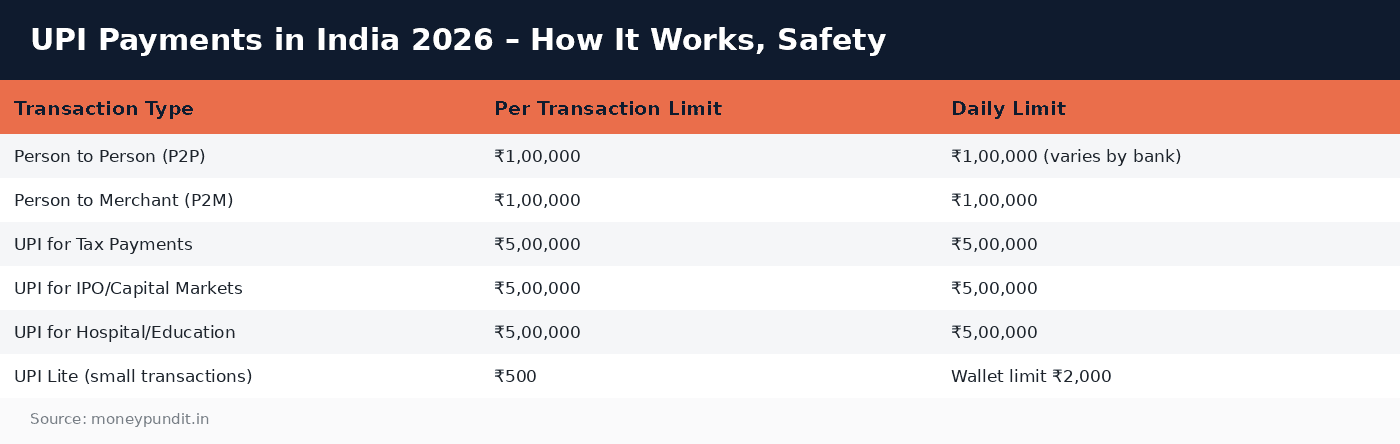
UPI Transaction Limits (2026)
| Transaction Type | Per Transaction Limit | Daily Limit |
|---|---|---|
| Person to Person (P2P) | ₹1,00,000 | ₹1,00,000 (varies by bank) |
| Person to Merchant (P2M) | ₹1,00,000 | ₹1,00,000 |
| UPI for Tax Payments | ₹5,00,000 | ₹5,00,000 |
| UPI for IPO/Capital Markets | ₹5,00,000 | ₹5,00,000 |
| UPI for Hospital/Education | ₹5,00,000 | ₹5,00,000 |
| UPI Lite (small transactions) | ₹500 | Wallet limit ₹2,000 |
Some banks set lower limits: check with your specific bank for their UPI transaction limits.
Popular UPI Apps Compared
| App | Market Share | Key Features | Rewards |
|---|---|---|---|
| PhonePe | ~48% | Multi-bank, insurance, MF, gold | Cashback on select transactions |
| Google Pay | ~35% | Clean interface, NFC tap-to-pay | Scratch cards, rewards |
| Paytm | ~8% | Wallet + UPI, shopping, travel | Cashback on recharges |
| BHIM | ~3% | Government app, simple interface | Limited |
| Amazon Pay | ~2% | Amazon shopping integration | Amazon cashback |
UPI Safety: Essential Tips
Never Share Your UPI PIN
Your UPI PIN is equivalent to your ATM PIN or bank password. No legitimate entity, bank, UPI app, RBI, or merchant, will ever ask for your UPI PIN via call, SMS, or email. UPI PIN is entered only on your phone’s UPI app during a transaction you initiate. Anyone asking for your PIN is attempting fraud.
Beware of “Request Money” Scams
This is the most common UPI fraud. A scammer sends you a “Collect Request” claiming to send you money (refund, lottery, cashback). When you enter your PIN to “accept” the payment, money is actually debited from your account. Remember: you never need to enter a PIN to receive money. If someone asks you to enter PIN to receive payment, it is a scam.
Verify Before Sending
Always double-check the UPI ID and name before confirming a payment. Scammers create UPI IDs similar to legitimate businesses. When scanning QR codes, verify the merchant name displayed on your screen matches the actual merchant. In online scams, fraudsters send QR codes via chat claiming you need to scan them to receive a refund. Scanning and paying means losing money.
Set Transaction Limits
Most UPI apps allow you to set daily transaction limits lower than the bank’s maximum. If you typically make payments of ₹5,000-₹10,000, set a daily limit of ₹20,000-₹25,000. This limits potential loss if your phone is compromised. Also enable app lock (fingerprint or PIN) on your UPI app for an additional security layer.
UPI for Financial Transactions
Mutual Fund Investments
Most mutual fund platforms accept UPI for SIP and lumpsum investments up to ₹1 lakh. You can set up UPI AutoPay mandates for monthly SIPs, eliminating the need for a net banking setup. The UPI mandate deduction happens automatically on SIP dates directly from your bank account.
Tax Payments
Income tax, GST, and advance tax payments up to ₹5 lakh can be made through UPI on the government’s tax portal. This is significantly more convenient than net banking for smaller tax payments. The higher ₹5 lakh limit for tax payments was specifically enabled to encourage digital tax compliance.
International UPI
UPI has expanded internationally, currently accepted in Singapore, UAE, France, Sri Lanka, Mauritius, and Nepal. Indian travellers can make UPI payments at participating merchants in these countries. The transaction is settled at the prevailing exchange rate with minimal charges compared to international card transactions.
What to Do If You Face UPI Fraud
Report immediately to your UPI app’s dispute resolution mechanism (usually within the app under “Help” or “Transaction History” → dispute). File a complaint on NPCI’s portal (npci.org.in) within 48 hours. Report to your bank’s customer care and get a complaint reference number. File a complaint on the Cyber Crime portal (cybercrime.gov.in) or call 1930. Under RBI’s rules, if you report an unauthorised transaction within 3 working days, your liability is limited to ₹10,000 or the transaction amount, whichever is lower.
UPI Charges From 15 October 2026: Who Pays the 0.4% Fee?
From 15 October 2026, a new NPCI framework lets banks charge a merchant discount rate (MDR) of 0.4% on person-to-merchant (P2M) UPI payments above ₹2,000. The fee is capped at ₹300 per transaction, which is reached at a payment of ₹75,000. The Ministry of Finance has said the charge falls on merchants, not on the person paying, and that it will apply to only about 4% of merchant transactions.
| UPI payment type (from 15 Oct 2026) | Fee |
|---|---|
| Sending money to a person (P2P) | No MDR |
| Paying a merchant ₹2,000 or less | No MDR |
| Small merchants receiving up to ₹1 lakh a month through UPI QR | Zero MDR |
| Paying a merchant above ₹2,000 | 0.4% of the amount, maximum ₹300 |
| Railways, telecom, insurance and fuel payments above ₹2,000 | Flat ₹5 |
| Mutual funds, stockbrokers and securities payments | 0.02%, maximum ₹300 |
Example: if a shop receives ₹10,000 by UPI, the 0.4% MDR is ₹40, so the merchant gets ₹9,960. You still pay ₹10,000. A ₹1,500 payment to the same shop carries no MDR.
What this means for you: your daily UPI routine does not change. Keep checking the amount on the payment screen, and note that the 0.4% fee is a charge on the merchant side. Details were reported by Inc42 after the NPCI notification in September 2026. Check NPCI circulars for the latest rules.
Frequently Asked Questions
Is UPI completely free?
UPI transactions are currently free for most users. NPCI does not charge end-users, and most banks absorb the interchange cost. For you as the payer, UPI stays free: P2P transfers and payments to merchants are not charged to the customer. From 15 October 2026, merchants face a 0.4% MDR (maximum ₹300) on P2M payments above ₹2,000, with exemptions for P2P, small merchants and payments up to ₹2,000.
Will I be charged when paying a merchant by UPI after 15 October 2026?
The 0.4% MDR is charged to the merchant, not to you. Payments to merchants of ₹2,000 or less carry no MDR, and neither do P2P transfers. Merchants receiving up to ₹1 lakh a month through UPI QR also pay zero MDR.
How much is the UPI merchant fee on a ₹10,000 payment?
The MDR is 0.4% of ₹10,000, which is ₹40, paid by the merchant. The fee never exceeds ₹300 per transaction.
Can I use multiple bank accounts with one UPI app?
Yes, most UPI apps allow you to link multiple bank accounts. You can switch between accounts when making payments. Each bank account gets its own UPI ID within the app. This is convenient if you maintain salary, savings, and investment accounts at different banks.
What happens if UPI payment fails but money is debited?
Failed UPI transactions where money is debited are automatically reversed within 2-5 working days. If the auto-reversal does not happen, raise a complaint through your UPI app. The resolution timeline is 5-7 working days for most cases. For persistent issues, escalate to your bank and NPCI. RBI mandates that banks must resolve failed transaction complaints within 5 working days and credit any stuck amounts.
Is UPI safer than credit/debit cards?
UPI has several security advantages: no card details shared with merchants (reducing data breach risk), two-factor authentication for every transaction (device + UPI PIN), and no chargeback disputes since transactions are authenticated by the sender. However, UPI fraud through social engineering (collect request scams) remains a significant risk that card transactions don’t face. Both payment methods are safe when used carefully.
References: Amfiindia.com
UPI payments: Key Takeaways
Key points on upi payments:
- UPI is a real-time payment system that connects your bank account to a UPI app (Google Pay, PhonePe, Paytm, BHIM, etc.) through a unique Virtual Payment Address (VPA) like yourname@upi.
- Some banks set lower limits: check with your specific bank for their UPI transaction limits.
- Your UPI PIN is equivalent to your ATM PIN or bank password.
Verify the latest upi payments figures with RBI before you act.