
Emergency fund in brief: Yet, surveys suggest that over 60% of Indian households do not have an adequate emergency fund.
An emergency fund is the foundation of every sound financial plan. It is a readily accessible cash reserve that protects you from unexpected expenses, job loss, medical emergencies, car breakdowns, or urgent home repairs, without forcing you to sell investments at a loss, take high-interest personal loans, or dip into retirement savings. Yet, surveys suggest that over 60% of Indian households do not have an adequate emergency fund.
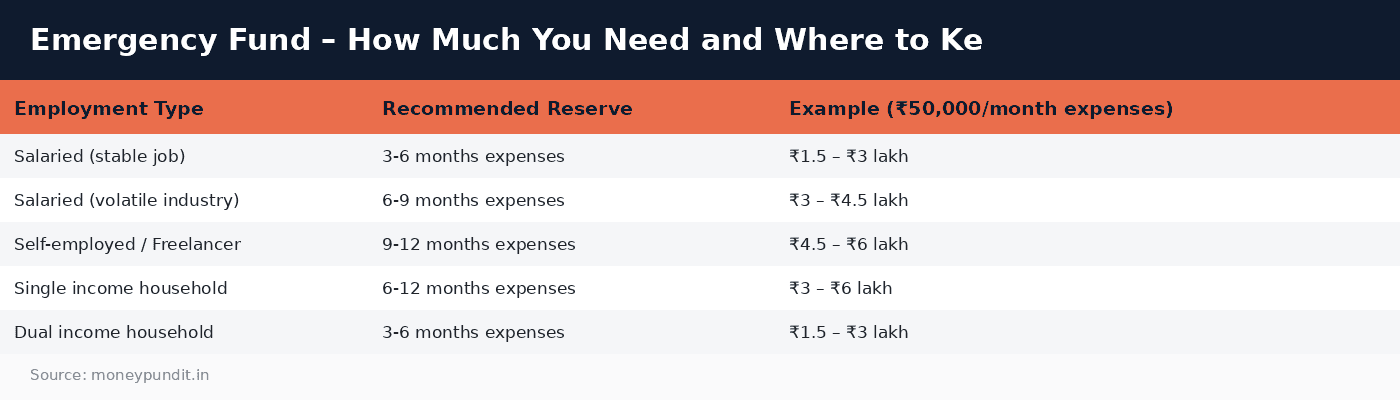
How Much Emergency Fund Do You Need?
| Employment Type | Recommended Reserve | Example (₹50,000/month expenses) |
|---|---|---|
| Salaried (stable job) | 3-6 months expenses | ₹1.5 – ₹3 lakh |
| Salaried (volatile industry) | 6-9 months expenses | ₹3 – ₹4.5 lakh |
| Self-employed / Freelancer | 9-12 months expenses | ₹4.5 – ₹6 lakh |
| Single income household | 6-12 months expenses | ₹3 – ₹6 lakh |
| Dual income household | 3-6 months expenses | ₹1.5 – ₹3 lakh |
Where to Keep Your Emergency Fund
Tier 1: Instant Access (1-2 months expenses)
Keep 1-2 months of expenses in your savings account for immediate access. Many banks offer 3-4% interest on savings accounts, while some digital banks and small finance banks offer 6-7%. This tier covers immediate emergencies like medical bills or urgent repairs where you need cash within hours.
Tier 2: Quick Access (2-3 months expenses)
Park this portion in liquid mutual funds or overnight funds. These provide T+1 redemption and many platforms offer instant redemption up to ₹50,000. Returns are typically 6-7%, significantly better than savings accounts. Liquid funds investing in government securities carry virtually zero credit risk while offering better tax efficiency than FD interest for higher tax brackets.
Tier 3: Short-Term Reserve (2-3 months expenses)
This layer can be in sweep-in fixed deposits linked to your savings account, or ultra-short-term debt funds. Sweep-in FDs automatically break the minimum required FD amount when your savings balance drops below a threshold, giving you FD returns (6.5-7.5%) with savings account liquidity.
Building Your Emergency Fund Step by Step
Step 1: Start Small: Target 1 Month
If you have no emergency fund, the first goal is accumulating one month of essential expenses. Set up an automatic transfer of 10-20% of your salary to a separate savings account earmarked for emergencies. Even ₹5,000-₹10,000 per month adds up quickly. This first month of coverage eliminates the most acute financial vulnerability.
Step 2: Build to 3 Months
Once you have one month covered, continue the automatic transfers and add any windfalls, bonuses, tax refunds, gifts, to the emergency fund. Reaching 3 months is the critical milestone where you can handle most common emergencies without financial stress. At this point, start moving the excess beyond 1 month into liquid funds for better returns.
Step 3: Complete the Full Reserve
Gradually build towards your target (6-12 months based on your situation). This phase can be slower, prioritise other financial goals alongside emergency fund building. Once the full reserve is established, redirect the monthly contributions to investments.
Common Mistakes with Emergency Funds
Using It for Non-Emergencies
A sale on electronics, a vacation deal, or a wedding expense is not an emergency. The fund should be touched only for genuine unexpected events that threaten your financial stability. Create separate savings buckets for planned large expenses to avoid raiding your emergency fund.
Investing It in Equity or Volatile Assets
The purpose of an emergency fund is capital preservation and immediate accessibility, not growth. Investing it in stocks, equity mutual funds, or even gold defeats the purpose, these can lose 20-40% of value precisely when economic conditions worsen and you are most likely to need the emergency fund.
Not Replenishing After Use
When you withdraw from your emergency fund, make it a priority to rebuild it. Set up higher automatic transfers until the fund is back to its target level. An emergency fund that is not replenished after use is a one-time safety net that leaves you vulnerable to the next emergency.
Emergency Fund vs Health Insurance
An emergency fund does not replace health insurance, and vice versa. Health insurance covers hospitalisation costs (which can run into lakhs), while the emergency fund covers the deductibles, non-covered expenses, income loss during illness, and non-medical emergencies. Both are essential components of a complete financial safety net.
Frequently Asked Questions
Should I build an emergency fund before investing?
Yes, an emergency fund should be your first financial priority after covering basic insurance (term life + health). Without an emergency fund, any unexpected expense forces you to sell investments, potentially at a loss, or take expensive loans. Start with at least 1 month’s reserve before beginning SIPs, then build both simultaneously.
Is ₹1 lakh enough as an emergency fund?
It depends on your monthly expenses. If your essential monthly expenses are ₹25,000, then ₹1 lakh covers 4 months, adequate for a salaried person with a stable job. If your expenses are ₹50,000, ₹1 lakh covers only 2 months, which is on the lower side. Always calculate based on your specific expenses, not a fixed rupee amount.
Can I use credit cards instead of an emergency fund?
Credit cards can bridge immediate cash needs during an emergency, but they are not a substitute for an emergency fund. Credit card interest rates are 24-42% per annum. Using a credit card during a job loss emergency means you accumulate expensive debt with no income to pay it off. The emergency fund exists precisely to avoid this debt trap.
Should I keep my emergency fund in a separate bank?
Having your emergency fund in a separate bank from your primary spending account is a good practice. It creates a psychological barrier against casual spending and ensures that a technical issue with one bank does not lock out all your funds. However, ensure you have easy digital access to the separate account for genuine emergencies.
References: Amfiindia.com
Emergency fund: Key Takeaways
Key points on emergency fund:
- Keep 1-2 months of expenses in your savings account for immediate access.
- If you have no emergency fund, the first goal is accumulating one month of essential expenses.
- A sale on electronics, a vacation deal, or a wedding expense is not an emergency.
Verify the latest emergency fund figures with AMFI before you act.