

Use this FD calculator to instantly compute the maturity amount and interest earned on your fixed deposit. This FD calculator supports both simple and compound interest calculations with quarterly, monthly, and annual compounding options. Compare FD returns from SBI, HDFC Bank, ICICI Bank, and other leading banks before investing.
FD Calculator
Calculate maturity amount on your Fixed Deposit with simple or compound interest.
FD Interest Calculation
Most banks in India compound FD interest quarterly. The formula is: A = P(1 + r/n)^(nt) where P = principal, r = annual rate, n = compounding frequency per year, t = time in years.
Current FD Rates in India (2026)
Large banks such as SBI, HDFC Bank and ICICI Bank offer about 6.25% to 6.5% on 1 to 5 year FDs for regular customers and about 6.75% to 7.1% for senior citizens (October 2026). Small finance banks and some private banks pay more, for example up to 8.5% on select senior citizen tenures. Always confirm the current rate on the bank’s own site before booking.
What is a Fixed Deposit (FD)?
A Fixed Deposit is a financial instrument where you deposit a lump sum amount with a bank or NBFC for a fixed tenure at a predetermined interest rate. FDs are one of India’s most popular savings instruments, offering guaranteed returns, capital safety, and flexible tenures ranging from 7 days to 10 years. They are ideal for conservative investors who prioritize capital protection over high returns.
How is FD Interest Calculated?
Banks in India use two methods to calculate FD interest:
Simple Interest (for FDs under 6 months)
SI = P x R x T / 100
Compound Interest (for FDs of 6 months or longer)
A = P x (1 + r/n)^(n x t)
Where: P = Principal, r = Annual interest rate, n = Compounding frequency (usually quarterly = 4), t = Time in years
FD Calculation Example
For a deposit of Rs. 5,00,000 at 7.25% annual interest for 5 years (quarterly compounding):
| Parameter | Value |
|---|---|
| Principal Amount | Rs. 5,00,000 |
| Interest Earned | Rs. 2,13,850 |
| Maturity Amount | Rs. 7,13,850 |
Current FD Interest Rates in India (2026)
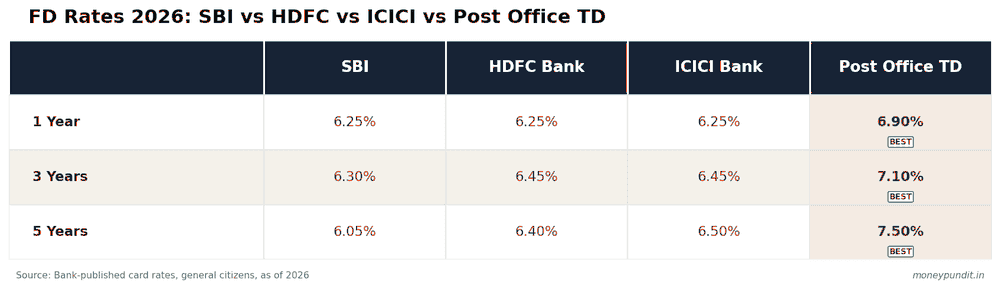
| Bank | 1 Year | 3 Years | 5 Years | Senior Citizen |
|---|---|---|---|---|
| SBI | 6.25% | 6.30% | 6.05% | +0.50% |
| HDFC Bank | 6.25% | 6.45% | 6.40% | +0.50% |
| ICICI Bank | 6.25% | 6.45% | 6.50% | +0.50% |
| Post Office TD | 6.90% | 7.10% | 7.50% | N/A |
FD Maturity Example: ₹5 Lakh at 6.5%
Interest on a fixed deposit compounds at the frequency your bank uses, usually quarterly. This table shows ₹5,00,000 at 6.5% a year, compounded quarterly.
| Year | Balance at year end |
|---|---|
| 1 | ₹5,33,301 |
| 2 | ₹5,68,819 |
| 3 | ₹6,06,704 |
| 4 | ₹6,47,111 |
| 5 | ₹6,90,210 |
After 5 years the interest earned is ₹1,90,210. With monthly compounding the same deposit reaches ₹6,91,409, and with annual compounding ₹6,85,043. At 7.0% (a typical senior citizen rate for 5 years) the maturity is about ₹7,07,389. Rates differ by bank and tenure, so compare before you book. Interest is taxable at your slab rate.
Types of Fixed Deposits
1. Regular FD
Standard fixed deposit with interest paid at maturity or periodic intervals. Most common choice for lump sum savings.
2. Tax-Saving FD (Section 80C)
5-year lock-in FD that qualifies for tax deduction up to Rs. 1.5 lakh under Section 80C. Interest is still taxable. Offered by all banks.
3. Recurring Deposit (RD)
Monthly fixed contributions with FD-like interest rates. Good for salaried individuals wanting systematic savings with guaranteed returns.
4. Flexi FD / Sweep-in FD
Linked to savings account: excess balance is auto-transferred to FD, and auto-broken when needed. Gives FD interest with savings account liquidity.
FD vs Other Investment Options
| Parameter | FD | Debt MF | PPF |
|---|---|---|---|
| Returns | 6.5-7.5% | 7-9% | 7.1% |
| Tax on Returns | As per slab | As per slab | Tax-free |
| Lock-in | Flexible | None | 15 years |
| Risk | Very Low | Low | Zero |
Related Calculators & Guides
- RD Calculator: Calculate recurring deposit maturity amount
- PPF Calculator: Compare PPF returns with FD
- SIP Calculator: Explore higher returns with mutual fund SIPs
- Best FD Rates 2026: Compare rates across all major banks
- NSC Guide: 7.7% guaranteed returns with tax benefits
- FD vs Debt Mutual Funds: Which gives better post-tax returns?
- SIP vs Lumpsum vs FD vs PPF: Compare all four investment options side by side
Frequently Asked Questions
Is FD interest taxable?
Yes, FD interest is fully taxable as per your income tax slab. Banks deduct TDS at 10% if annual interest exceeds Rs. 50,000 (Rs. 1,00,000 for senior citizens). You can submit Form 15G/15H if your total income is below the taxable limit to avoid TDS deduction.
Can I break my FD before maturity?
Yes, premature withdrawal is allowed by most banks with a penalty of 0.5-1% reduction in interest rate. Some banks offer no-penalty premature withdrawal on specific FD products. Tax-saving FDs (5-year) cannot be broken before maturity.
What happens to FD on maturity?
You have three options: (1) withdraw principal + interest to your savings account, (2) renew the FD for another term at prevailing rates, or (3) auto-renewal if you’ve opted for it. Most banks auto-renew if no instructions are given.
Are FDs safe? What if the bank fails?
FDs are among the safest investments. Under DICGC (Deposit Insurance), deposits up to Rs. 5,00,000 per depositor per bank are insured. For larger amounts, spread across multiple banks or choose top-rated banks (SBI, HDFC, ICICI) for additional safety.
Should I choose cumulative or non-cumulative FD?
Choose cumulative FD if you don’t need regular income, interest compounds quarterly and is paid at maturity, giving higher effective returns. Choose non-cumulative if you need monthly/quarterly interest income (suitable for retirees).
Disclaimer: Interest rates are indicative and subject to change. Please verify current rates with respective banks before investing. FD returns are subject to TDS and income tax as per applicable laws.
FD Calculator: Official Resources and Rates
Fixed deposit interest rates in India are influenced by the repo rate set by the Reserve Bank of India (RBI). When RBI raises the repo rate, banks typically increase FD rates as well. Senior citizens usually get 0.25-0.50% higher FD interest rates at most banks.
Tax-saving FDs under Section 80C have a 5-year lock-in period but provide tax deductions up to Rs 1.5 lakh per year under the Income Tax Act. However, unlike PPF and ELSS, the interest earned on FDs is fully taxable. If your total FD interest exceeds Rs 50,000 per year (Rs 1,00,000 for senior citizens), TDS is deducted at 10%. The DICGC (Deposit Insurance and Credit Guarantee Corporation) insures bank deposits including FDs up to Rs 5 lakh per depositor per bank.
Related FD Calculator Tools and Articles
Use our FD calculator alongside these related tools for comprehensive financial planning:
- PPF Calculator: Compare PPF returns with FD for tax-free growth
- SIP Calculator: See how mutual fund SIP compares with FD returns
- NSC Interest Rate 2026: Another safe investment alternative to FD
- Best FD Rates in India 2026: Latest FD rates from top banks
- PPF vs FD vs ELSS: Which investment gives best tax-adjusted returns?
- Section 80C Deductions: Maximize tax savings with tax-saving FDs
Reviewed by: MoneyPundit Team | Last updated: July 2, 2026
Data source: Rates are user-input based on your own bank’s published card rate; this calculator does not assume any single bank’s FD rate. For current bank-specific rates, see our SBI FD Calculator or Best FD Rates in India 2026. See how rates got here in our FD Interest Rate History (2019-2026).
Methodology: Standard quarterly-compounding fixed deposit formula: A = P(1+r/n)^(nt), where P is principal, r is annual rate, n is compounding frequency, and t is tenure in years.
Comparing options beyond bank FDs? See how RBI Floating Rate Bonds compare to fixed deposits on rate, tax and liquidity.