
Zero based budgeting in brief: Step 1: List your income: Include your salary, any side income, rent received, freelance earnings.
Zero-based budgeting forces every single rupee of income to be assigned a job, savings, bills, or spending, before the month even starts, which is a very different discipline from just tracking expenses after the fact. Here’s how to actually set one up and manage the variable-expense categories that usually break it.
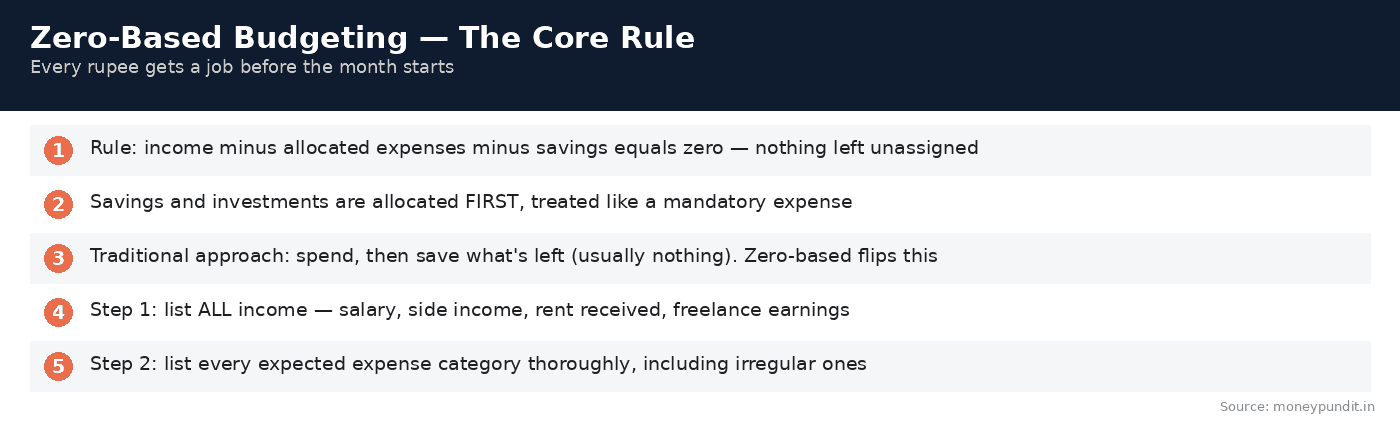
Most people budget by looking backward: reviewing what they spent last month and vaguely resolving to spend less. Zero-based budgeting flips this completely. You start from zero at the beginning of every month and deliberately assign every rupee of income to a specific purpose before the month begins. Income minus all planned allocations equals zero. Nothing is left unassigned, including savings.
The Core Principle
In zero-based budgeting, “zero” doesn’t mean you spend everything. It means your income minus your allocated expenses and savings equals zero. Savings and investments are treated as expenses. Allocated first, not saved from whatever is left over. This is the critical shift that makes the method so powerful.
Traditional approach: Spend what you need, save what’s left. Problem: there’s usually nothing left.
Zero-based approach: Allocate savings first, then allocate the rest to expenses. Savings happen automatically.
How to Set It Up
Step 1: List your income: Include your salary, any side income, rent received, freelance earnings. Use conservative estimates for variable income.
Step 2: List every expected expense category: Be thorough. Groceries, rent, electricity, internet, fuel, dining out, subscriptions, EMIs, school fees, medical, haircuts, household supplies, gifts, entertainment. Everything.
Step 3: Assign amounts: Give each category a budget for the month based on actual past spending and your goals.
Step 4: Allocate savings first: Before assigning amounts to discretionary categories, lock in your SIP investments, PPF contribution, and emergency fund top-up as fixed line items.
Step 5: Make it balance: Adjust category amounts until Income − All Allocations = 0. If you’re over budget, cut wants categories. Never cut savings.
Managing Variable Expenses
Some expenses don’t occur monthly: annual insurance premiums, car servicing, festival gifts, vacation costs. Handle these with a “sinking fund”, divide the annual cost by 12 and set aside that amount every month in a dedicated savings account. When the expense comes due, the money is already there. No budget stress.
Tracking During the Month
The budget is useless if you don’t track against it. Check your spending weekly, not monthly. Weekly check-ins let you course-correct mid-month. Monthly check-ins are retrospective and mostly useless for behavioral change.
Tools: YNAB (paid, excellent), a simple Google Sheet, or even a notebook. The best tool is the one you’ll actually use consistently.
Why It Works
Zero-based budgeting works because it makes spending intentional. Every category has a finite amount. When the dining-out budget is gone, it’s gone. You can see it depleting in real time. This visibility creates natural restraint without willpower. Most people who stick with zero-based budgeting for 3 months find they’ve increased savings by 20–40% without feeling deprived.
How Zero-Based Budgeting Differs from Traditional Budgeting
In traditional budgeting, you track expenses after spending: essentially recording where your money went. Zero-based budgeting (ZBB) flips this: before the month begins, you assign every rupee of your income a specific purpose until you reach zero. Income minus allocated expenses equals zero. This doesn’t mean you spend everything, savings and investments are line items in your budget, given a purpose just like rent or groceries.
For example, with a ₹80,000 take-home salary, your zero-based budget might look like: rent ₹25,000, groceries ₹8,000, utilities ₹3,000, transportation ₹4,000, insurance ₹2,000, SIP investments ₹15,000, emergency fund ₹5,000, dining out ₹3,000, entertainment ₹2,000, personal care ₹2,000, clothing ₹3,000, miscellaneous ₹3,000, gifts/charity ₹2,000, and savings buffer ₹3,000. Total: ₹80,000. Every rupee has a job, and the budget balances to zero.
Implementing ZBB Step by Step
Start by listing your total monthly income: including salary, freelance earnings, rental income, or any other regular sources. Use our Take Home Salary Calculator to determine your exact post-tax income. Then list all expense categories in priority order: essentials first (housing, food, utilities, insurance, minimum loan payments), then financial goals (SIPs, emergency fund, debt prepayment), and finally discretionary spending (entertainment, dining, shopping).
The priority ordering is crucial: it ensures that if money runs tight, essential expenses and savings are covered before discretionary items. Many people using the 50-30-20 rule find ZBB a natural next step: the 50-30-20 framework sets the broad allocation, while ZBB provides the granular line-item control within each category.
Tools and Tips for Sticking to Your Budget
Digital tools make ZBB practical. Apps like Walnut, Money Manager, or even a simple Google Sheet help track every transaction against your budget categories. The envelope method, a physical cash version where you put allocated amounts in labelled envelopes. Works surprisingly well for controlling discretionary spending, especially dining out and shopping.
Review your budget weekly for the first 2-3 months, then shift to bi-weekly once you’ve established the habit. Expect the first month to be imperfect. ZBB is a skill that improves with practice. Build a “miscellaneous” buffer of 3-5% of income for unexpected small expenses so they don’t blow your entire budget. The biggest benefit of ZBB isn’t just controlling spending, it forces consciousness about financial priorities. Many practitioners report finding ₹5,000-₹15,000 of “invisible” spending monthly that they redirect toward SIP investments or debt prepayment, significantly accelerating their financial goals over time.
References: Amfiindia.com
Source: amfiindia.com
Frequently Asked Questions
What is zero-based budgeting?
It is a method where income minus all planned spending and saving equals zero, so every rupee is assigned a purpose before the month starts.
How is it different from the 50/30/20 rule?
The 50/30/20 rule uses fixed percentages. Zero-based budgeting is line-by-line and more detailed, which takes more effort but gives tighter control.
How often should I update a zero-based budget?
Review it monthly, and adjust whenever income, rent, EMIs or goals change.
Zero based budgeting: Key Takeaways
Key points on zero based budgeting:
- In zero-based budgeting, “zero” doesn’t mean you spend everything.
- Groceries, rent, electricity, internet, fuel, dining out, subscriptions, EMIs, school fees, medical, haircuts, household supplies, gifts, entertainment.
- Some expenses don’t occur monthly: annual insurance premiums, car servicing, festival gifts, vacation costs.
Verify the latest zero based budgeting figures with RBI before you act.