

Looking for the best pension plans India 2026? Planning for retirement is one of the most important financial decisions you’ll make. A good pension plan ensures a steady income after you stop working, helping you maintain your lifestyle without depending on others. In India, there are several pension plans available, from government-backed schemes to private annuity plans, each with different features, returns, and tax benefits.
What Is a Pension Plan?
Before comparing the best pension plans India 2026, it helps to understand what a pension plan actually is and how it works in the Indian context.
A pension plan is a retirement savings product that provides regular income after retirement. You invest during your working years (either as a lump sum or through regular contributions), and the accumulated corpus is used to provide periodic payouts after you retire. Pension plans in India are offered by insurance companies, mutual fund houses, and the government.
Best Pension Plans India 2026: Types Available
1. National Pension System (NPS)
NPS is a government-regulated pension scheme managed by PFRDA. It offers two account types, Tier I (mandatory, with lock-in till 60) and Tier II (voluntary, flexible withdrawals). NPS invests in equity, corporate bonds, and government securities based on your choice. Returns have historically ranged from 9-12% depending on the asset allocation. It offers tax benefits under Section 80CCD(1), 80CCD(1B) (additional ₹50,000), and 80CCD(2) for employer contributions.
2. Atal Pension Yojana (APY)
APY is designed for unorganised sector workers and guarantees a fixed monthly pension of ₹1,000 to ₹5,000 after age 60. Contributions are small (₹42 to ₹1,454/month depending on age and pension amount chosen). The government co-contributes 50% for eligible subscribers who joined before March 2016.
3. Employee Provident Fund (EPF)
EPF is mandatory for salaried employees earning up to ₹15,000/month (basic + DA). Both employee and employer contribute 12% of basic salary. The current interest rate is 8.25% for FY 2025-26. EPF provides a lump sum at retirement plus pension through EPS (Employee Pension Scheme).
4. Private Pension Plans (Annuity Plans)
Insurance companies like LIC, HDFC Life, ICICI Prudential, and SBI Life offer pension plans with guaranteed returns and annuity options. Plans like LIC Jeevan Akshay, HDFC Life Click 2 Retire, and ICICI Pru Easy Retirement provide either immediate or deferred annuities.
5. Mutual Fund Pension Plans
Schemes like UTI Retirement Benefit Pension Fund and HDFC Retirement Savings Fund invest in equity and debt to build a retirement corpus. These offer market-linked returns but don’t guarantee a fixed pension amount.
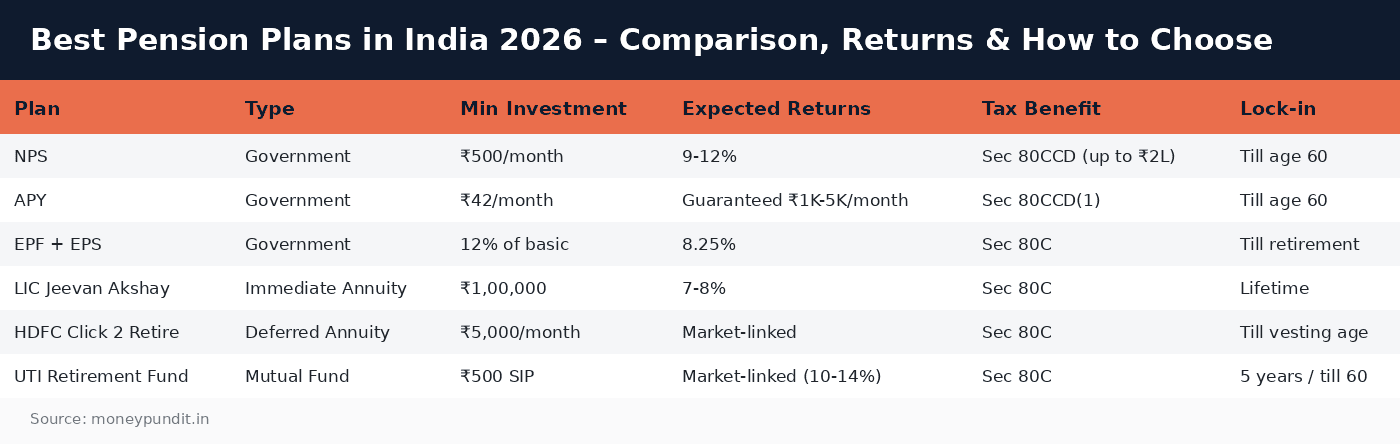
Best Pension Plans India 2026: Detailed Comparison
| Plan | Type | Min Investment | Expected Returns | Tax Benefit | Lock-in |
|---|---|---|---|---|---|
| NPS | Government | ₹500/month | 9-12% | Sec 80CCD (up to ₹2L) | Till age 60 |
| APY | Government | ₹42/month | Guaranteed ₹1K-5K/month | Sec 80CCD(1) | Till age 60 |
| EPF + EPS | Government | 12% of basic | 8.25% | Sec 80C | Till retirement |
| LIC Jeevan Akshay | Immediate Annuity | ₹1,00,000 | 7-8% | Sec 80C | Lifetime |
| HDFC Click 2 Retire | Deferred Annuity | ₹5,000/month | Market-linked | Sec 80C | Till vesting age |
| UTI Retirement Fund | Mutual Fund | ₹500 SIP | Market-linked (10-14%) | Sec 80C | 5 years / till 60 |
How to Choose the Best Pension Plans India 2026
Selecting the right pension plan depends on several factors. Start with your retirement age goal, whether you plan to retire at 58, 60, or earlier under the FIRE approach. Calculate how much monthly income you’ll need post-retirement, accounting for inflation at 6-7% annually. A general rule of thumb is you’ll need approximately 70-80% of your pre-retirement monthly expenses.
Consider the following: your risk appetite (NPS and mutual funds for higher risk-reward, EPF and LIC for safety), tax benefits available (NPS offers the highest at up to ₹2 lakh deduction), liquidity needs (EPF allows partial withdrawals, NPS is locked till 60), and whether you prefer guaranteed income (annuity plans) or market-linked growth (NPS, mutual funds).
Once you have narrowed down the best pension plans India 2026 for your needs, use a quick calculation to estimate your monthly pension.
How Much Pension Will You Get? Quick Calculation
If you start investing ₹5,000/month in NPS at age 25 with 10% average returns, by age 60 your corpus would be approximately ₹1.14 crore. With 40% annuity (mandatory), you’d purchase an annuity of ~₹45.6 lakh, giving you roughly ₹30,000-35,000/month pension. The remaining 60% (₹68.4 lakh) can be withdrawn tax-free as a lump sum.
Understanding the tax advantages is crucial when comparing the best pension plans India 2026 options.
Best Pension Plans India 2026: Tax Benefits
Most pension plans offer tax deductions under Section 80C (up to ₹1.5 lakh) and Section 80CCD(1B) for NPS (additional ₹50,000). However, pension income received after retirement is taxable as per your income tax slab. The annuity purchase amount from NPS is exempt, but the monthly pension from that annuity is taxable.
Best Pension Plans India 2026: Official Resources
Before investing in any of the best pension plans India 2026, verify details through official sources. Check NPS details on NPS Trust, APY information on NSDL CRA, EPF balance on EPFO, and pension plan regulations on IRDAI. For income tax benefits under Section 80CCD, refer to the Income Tax Department.
Related MoneyPundit Guides
Explore more retirement and investment guides: Section 80C Deductions Guide, PPF vs FD vs ELSS Comparison, Best Investment Plan for 1 Lakh, Best Mutual Funds 2026, Best FD Rates India 2026, and NSC Interest Rate Guide.
Frequently Asked Questions About Best Pension Plans India 2026
Which is the best pension plan for a 30-year-old?
For a 30-year-old, NPS combined with equity mutual fund SIPs offers the best growth potential. You get tax benefits of up to ₹2 lakh with NPS and can build a substantial corpus over 30 years with market-linked returns.
Can I have multiple pension plans?
Yes, you can invest in NPS, EPF, APY, and private pension plans simultaneously. Diversifying across plans reduces risk and maximises tax benefits. However, only one APY account is allowed per person.
Is NPS better than PPF for retirement?
NPS offers higher potential returns (9-12%) due to equity exposure compared to PPF (7.1%). NPS also provides additional tax benefits under Section 80CCD(1B). However, PPF offers guaranteed returns and full tax-free maturity, making it suitable for conservative investors.
What happens to my pension plan if I die before retirement?
In NPS, the entire accumulated corpus is paid to the nominee. For EPF, the nominee receives the full balance. Private pension plans typically offer death benefits, either return of premiums paid or the fund value, depending on the plan terms.
References: Irdai.gov.in