

Section 80C deductions under the Income Tax Act represent the most popular tax-saving provision in India, allowing you to claim deductions of up to Rs 1.5 lakh per financial year. Whether you are a salaried employee or self-employed, understanding all available Section 80C deductions options helps you save maximum tax while building wealth. Here is the complete list of all eligible Section 80C deductions available in 2026.
Since PPF, NSC, and SCSS all count toward your Section 80C limit, check our live interest rate tracker to see their current rates before deciding where to invest.
Section 80C Deduction Limit for FY 2026-27
The maximum Section 80C deductions allowed is Rs 1,50,000 per financial year. This limit is combined for all 80C investments and expenses together. This means if you invest Rs 1 lakh in PPF and Rs 50,000 in ELSS, your total 80C deduction is Rs 1.5 lakh. Note that this deduction is only available under the old tax regime.
Complete List of Section 80C Investments
1. Public Provident Fund (PPF)
PPF offers 7.1% interest (compounded annually) with complete tax exemption on maturity (EEE status). Minimum investment is Rs 500/year, maximum Rs 1.5 lakh. Lock-in is 15 years with partial withdrawals from the 7th year. Use our PPF Calculator to estimate your maturity amount.
2. Equity Linked Savings Scheme (ELSS)
ELSS mutual funds offer the shortest lock-in of just 3 years among all 80C options. Historical returns range from 12-15% annually over 10+ years. LTCG above Rs 1.25 lakh taxed at 12.5%. Check our Best ELSS Funds in 2026.
3. National Savings Certificate (NSC)
NSC offers a guaranteed 7.7% return with a 5-year lock-in. Interest earned in years 1-4 is deemed reinvested and qualifies for additional 80C deduction. Available at any post office with minimum Rs 1,000. Read our NSC Guide.
4. 5-Year Tax Saving Fixed Deposit
Tax-saving FDs have a mandatory 5-year lock-in with rates between 6.5-7.5%. No premature withdrawal allowed. Interest is fully taxable. Senior citizens get 0.25-0.50% extra. Compare rates in our Best FD Rates 2026 guide.
5. Employee Provident Fund (EPF)
Your employer deducts 12% of basic salary towards EPF, and this employee contribution qualifies for 80C. Current EPF interest rate is 8.25%. EPF offers EEE tax status if you stay invested for 5+ years.
6. Voluntary Provident Fund (VPF)
VPF allows contributions beyond the mandatory 12% EPF. It earns the same 8.25% interest and qualifies under 80C. No upper limit on contribution, though 80C benefit is capped at Rs 1.5 lakh combined. Read our VPF Guide.
7. Sukanya Samriddhi Yojana (SSY)
SSY is for the girl child (below 10 years) and offers 8.2% interest: the highest among small savings schemes. Matures when the girl turns 21. Maximum Rs 1.5 lakh/year. EEE tax status. Use our SSY Calculator.
8. National Pension System (NPS)
NPS qualifies under 80C (up to Rs 1.5 lakh) plus an additional Rs 50,000 under Section 80CCD(1B), giving Rs 2 lakh in total deductions. Read our NPS Guide and use the NPS Calculator.
9. Life Insurance Premium
Premiums for life insurance qualify under 80C, subject to premium not exceeding 10% of sum assured. Includes term insurance, endowment plans, and ULIPs. Read our Insurance Guide.
10. Home Loan Principal Repayment
The principal component of your home loan EMI qualifies for 80C. The interest portion is covered under Section 24 (up to Rs 2 lakh). Use our Home Loan EMI Calculator to see the split.
11. Stamp Duty and Registration Charges
Stamp duty and registration charges paid when buying a house qualify under 80C in the year of payment. These range from 5-8% of property value. Check our state-wise stamp duty guide.
12. Tuition Fees
Tuition fees paid for up to 2 children at any school, college, or university in India qualify under 80C. Only the tuition fee component counts, not development fees, transport, or hostel charges.
13. Senior Citizens Savings Scheme (SCSS)
SCSS is for individuals above 60 years and offers 8.2% interest paid quarterly. Maximum investment is Rs 30 lakh with a 5-year tenure. Qualifies under 80C and provides regular income.
14. Unit Linked Insurance Plan (ULIP)
ULIPs combine insurance with market-linked investments. The premium qualifies under 80C. ULIPs with annual premium above Rs 2.5 lakh are taxed like mutual funds on maturity. 5-year lock-in period.
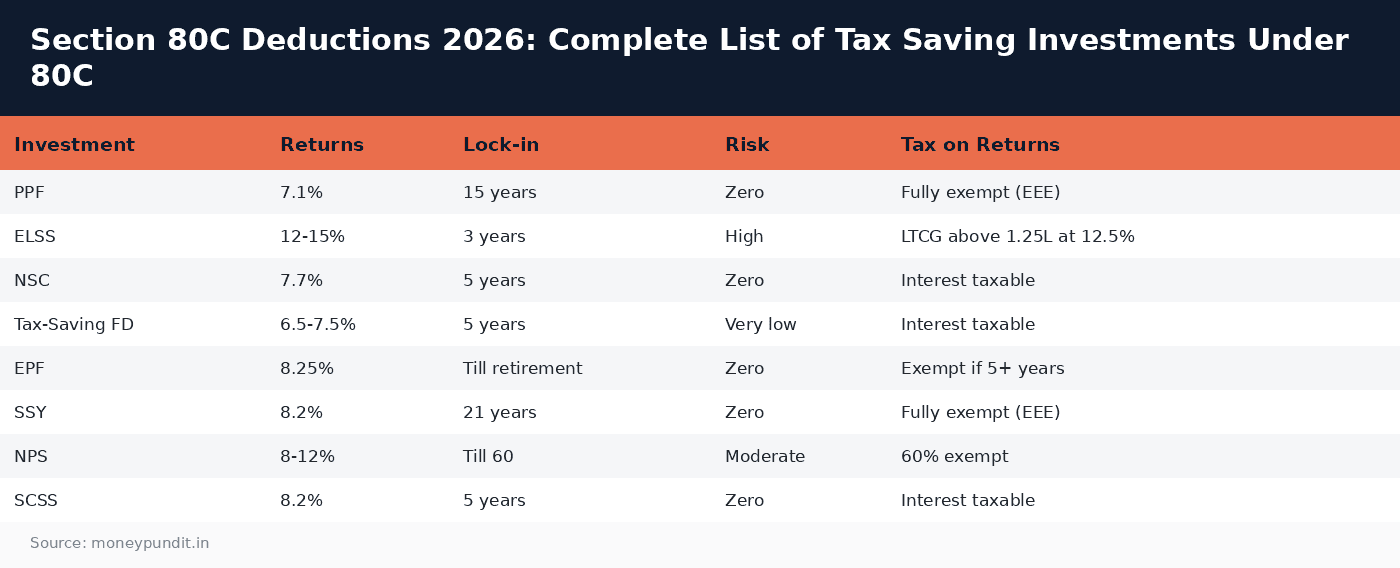
Section 80C Investments Comparison Table
| Investment | Returns | Lock-in | Risk | Tax on Returns |
|---|---|---|---|---|
| PPF | 7.1% | 15 years | Zero | Fully exempt (EEE) |
| ELSS | 12-15% | 3 years | High | LTCG above 1.25L at 12.5% |
| NSC | 7.7% | 5 years | Zero | Interest taxable |
| Tax-Saving FD | 6.5-7.5% | 5 years | Very low | Interest taxable |
| EPF | 8.25% | Till retirement | Zero | Exempt if 5+ years |
| SSY | 8.2% | 21 years | Zero | Fully exempt (EEE) |
| NPS | 8-12% | Till 60 | Moderate | 60% exempt |
| SCSS | 8.2% | 5 years | Zero | Interest taxable |
How to Maximize Your Section 80C Deductions
Step 1: Count your EPF contribution first: this is automatic and mandatory.
Step 2: Add home loan principal repayment and children’s tuition fees.
Step 3: Fill the remaining gap with high-return investments. For aggressive investors, ELSS funds offer the best returns with shortest lock-in. For conservative investors, PPF or NSC provide guaranteed returns.
Step 4: Claim the extra Rs 50,000 under Section 80CCD(1B) for NPS: this is over and above the Rs 1.5 lakh limit.
Official Resources for Section 80C Deductions
For the latest rules on Section 80C deductions, refer to the Income Tax Department portal for filing and verification. Check RBI guidelines on PPF and bank FD for tax-saving deposit rules. For ELSS mutual fund options under Section 80C deductions, visit AMFI’s equity scheme listings. You can also review SEBI circulars for updated mutual fund regulations.
Related Guides & Tools
- Complete Tax Planning Guide 2026
- Income Tax Calculator
- PPF vs ELSS: Which Is Better?
- Best ELSS Tax Saving Mutual Funds
- PPF Calculator
- PPF Interest Rate History
- NPS Calculator
- SSY Calculator
Frequently Asked Questions About Section 80C Deductions
Can I claim 80C deduction under the new tax regime?
No, Section 80C deductions are not available under the new tax regime. You need to opt for the old tax regime to claim 80C benefits.
What is the maximum deduction under Section 80C?
The maximum deduction is Rs 1,50,000 per financial year. This is a combined limit for all 80C-eligible investments and expenses.
Which 80C investment gives the highest returns?
ELSS mutual funds have historically delivered the highest returns (12-15% annually over 10+ years) with the shortest lock-in of 3 years. For guaranteed returns, SSY (8.2%) and EPF (8.25%) offer the highest rates.
Can both husband and wife claim 80C for the same investment?
No, only the person who made the investment can claim the deduction. Both spouses can independently invest up to Rs 1.5 lakh each in their own names.
Is PPF interest taxable?
No, PPF enjoys EEE (Exempt-Exempt-Exempt) status: the investment qualifies for 80C, interest is tax-free, and maturity is completely tax-exempt.