
Ppf vs fd vs elss in brief: Choosing between PPF, tax-saving FD, and ELSS for your Section 80C investments is one of the most important financial decisions you’ll make each year.
Choosing between PPF, tax-saving FD, and ELSS for your Section 80C investments is one of the most important financial decisions you’ll make each year. Each instrument has distinct advantages in terms of returns, risk, lock-in period, and tax treatment. This detailed comparison helps you understand which option, or combination of options, best suits your financial goals, risk appetite, and investment horizon in 2026.
Quick Comparison: PPF vs FD vs ELSS at a Glance
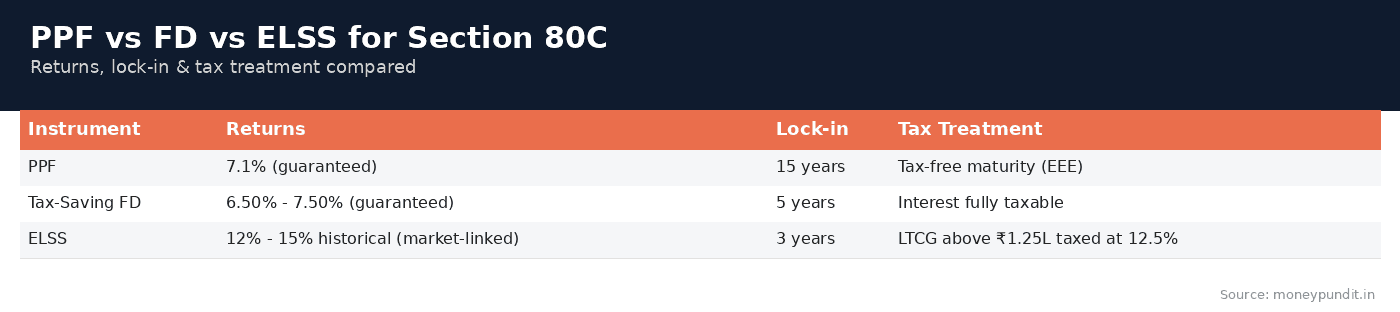
PPF (Public Provident Fund) offers 7.1% guaranteed returns with a 15-year lock-in, completely tax-free maturity (EEE status), and sovereign government backing. Tax-saving Fixed Deposits provide 6.50-7.50% guaranteed returns with a 5-year lock-in, but interest is fully taxable at your slab rate. ELSS (Equity Linked Saving Scheme) mutual funds have delivered 12-15% historical CAGR with the shortest lock-in of just 3 years, but returns are market-linked and not guaranteed. LTCG above ₹1.25 lakh is taxed at 12.5%.
The fundamental trade-off: PPF gives you safety and tax-free returns, FD gives you safety with a shorter lock-in, and ELSS gives you the highest growth potential with some risk. Your choice depends on your risk tolerance, investment timeline, and tax bracket.
Returns Comparison: The Numbers That Matter
Over the last 10 years, top ELSS funds have delivered 13-16% CAGR, PPF has provided 7.1-8.0% (rate varies quarterly), and 5-year FDs have offered 5.5-7.5%. But raw returns don’t tell the full story, post-tax returns are what actually grow your wealth. PPF’s 7.1% is entirely tax-free, making it equivalent to a 10.14% pre-tax return for someone in the 30% bracket. A 7% FD in the 30% bracket yields only 4.9% post-tax. ELSS at 14% with LTCG tax of 12.5% (above ₹1.25 lakh) still delivers approximately 12.5% effective return.
To illustrate with real numbers: ₹1.5 lakh invested annually for 15 years yields approximately ₹40.7 lakh in PPF (7.1%, tax-free), ₹31.5 lakh in FD (7% pre-tax, ~4.9% post-tax at 30% slab), and ₹75.9 lakh in ELSS (assuming 14% CAGR, before LTCG). The difference is staggering, ELSS potentially delivers nearly double the PPF corpus and 2.4x the FD corpus. Use our SIP Calculator to model ELSS returns and PPF Calculator for guaranteed projections.
Risk Assessment: What Could Go Wrong
PPF risk is essentially zero: it’s backed by the Government of India, and both principal and interest are guaranteed. The only “risk” is opportunity cost: your money earns less than equity over long periods. FD risk is also minimal. Bank FDs up to ₹5 lakh are insured by DICGC. However, FD returns may not beat inflation in high-tax brackets, resulting in negative real returns.
ELSS carries genuine market risk. In bad years, ELSS can deliver negative returns, during the 2008 crash, many ELSS funds fell 50-60%. However, every 3-year rolling period in the last 20 years has delivered positive returns, meaning if you hold beyond the 3-year lock-in, the probability of loss is very low. The critical requirement: you must have the temperament to stay invested during sharp market declines. If you’d panic-sell or lose sleep over a temporary 30% portfolio drop, ELSS isn’t for you.
Liquidity and Lock-In: Access to Your Money
ELSS has the shortest lock-in at 3 years: and each SIP instalment has its own 3-year lock-in from its purchase date. From the 4th year of SIP investing, units start becoming available for redemption monthly, creating rolling liquidity. Tax-saving FDs lock you in for exactly 5 years with no premature withdrawal allowed, not even with a penalty. PPF has the longest lock-in at 15 years, though partial withdrawals are permitted from the 7th year.
If liquidity matters: ELSS is clearly superior. You get your money back after 3 years, can sell partially anytime after that, and your investment continues growing tax-efficiently for as long as you want. PPF offers loan facilities from year 3-6 and partial withdrawal from year 7, providing some flexibility within the long lock-in. FD offers zero liquidity, it’s a strict 5-year commitment with no escape clause.
Tax Efficiency: The Complete Picture
PPF is the undisputed tax champion: investment is deductible under Section 80C (₹1.5 lakh), interest earned is tax-free, and maturity is tax-free, the coveted EEE (Exempt-Exempt-Exempt) status. No other Section 80C investment matches this triple benefit.
ELSS provides Section 80C deduction on investment. Returns are classified as equity capital gains: long-term gains (after 1 year) above ₹1.25 lakh are taxed at 12.5%, and short-term gains (within 1 year) at 20%. Since each SIP unit has its own holding period, most ELSS redemptions after the 3-year lock-in qualify for LTCG treatment. With the ₹1.25 lakh annual LTCG exemption, moderate ELSS portfolios can be redeemed with minimal or zero tax through planned annual harvesting.
Tax-saving FDs offer Section 80C deduction on investment, but interest is fully taxable at your income slab rate every year (on accrual basis, even for cumulative FDs). TDS at 10% is deducted if annual interest exceeds ₹50,000. This makes FDs the least tax-efficient of the three, particularly costly for those in the 30% bracket. Use our Tax Calculator to see the net impact on your overall tax liability.
Which Investment Suits Which Investor Profile
Choose PPF if you: are a conservative investor who prioritizes capital safety above all else, have a long-term horizon (15+ years), want completely tax-free returns, and don’t need the money before retirement age. PPF is ideal for the risk-free foundation of your retirement corpus and for parents investing for children’s future (Sukanya Samriddhi offers even higher rates for girl children).
Choose ELSS if you: have a moderate-to-high risk appetite, can stay invested through market volatility, want the highest potential returns for wealth creation, prefer the shortest 3-year lock-in, and are comfortable with equity market fluctuations. ELSS is best for young investors (20s-40s) with 7+ year horizons who want their 80C investment to also serve as equity allocation. Check our best ELSS funds for current top picks.
Choose Tax-Saving FD if you: are extremely risk-averse and cannot tolerate any principal fluctuation, need assured returns, prefer a shorter commitment than PPF, and are in a low tax bracket (where interest taxability matters less). FDs work for retirees and very conservative investors who find even PPF’s 15-year lock-in manageable but want a simpler, shorter alternative.
The Optimal Strategy: Combining All Three
Most financial advisors recommend a blended approach rather than putting all ₹1.5 lakh into one instrument. A balanced Section 80C allocation for a 30-year-old moderate investor: ₹72,000/year in ELSS (₹6,000/month SIP for high growth), ₹48,000/year in PPF (₹4,000/month for guaranteed tax-free returns), and the remaining ₹30,000 covered by EPF contributions (which also qualify under 80C). This gives you equity growth potential, guaranteed returns, and employer-matched retirement savings.
As you approach retirement (50+), shift the allocation: reduce ELSS to ₹36,000, increase PPF to ₹72,000, and add tax-saving FD for the balance if EPF doesn’t cover it. This de-risks your portfolio while maintaining tax efficiency. The key insight: your Section 80C allocation should mirror your overall asset allocation, more equity when young, more fixed-income as you approach your goal dates. Compare your options with our FD Calculator and PPF Calculator to see exact projections for your specific amounts and timeline.
Frequently Asked Questions
Can I invest in PPF, FD, and ELSS simultaneously?
Yes, the ₹1.5 lakh Section 80C limit is aggregate: you can split it across any combination of eligible investments including PPF, ELSS, tax-saving FD, EPF, NSC, life insurance premiums, and more.
Which gives better returns: PPF or ELSS?
ELSS has historically delivered 12-15% CAGR versus PPF’s 7.1%, making ELSS significantly better for long-term wealth creation. However, ELSS returns are not guaranteed and can be negative in bad years, while PPF always delivers positive, tax-free returns.
Is tax-saving FD worth it in the 30% tax bracket?
Generally no: a 7% FD yields only 4.9% post-tax at the 30% slab, which barely beats inflation. PPF (7.1% tax-free = 10.14% pre-tax equivalent) and ELSS (12-15% with favourable LTCG taxation) are both significantly more tax-efficient for higher-bracket taxpayers.
What happens to ELSS after the 3-year lock-in?
After the 3-year lock-in, ELSS units are fully redeemable: you can sell all or part anytime. However, there’s no obligation to redeem. Holding longer allows continued compounding, and you retain the flexibility to redeem strategically for tax efficiency using the ₹1.25 lakh annual LTCG exemption.
Related reading: PPF Interest Rate History | SBI FD Calculator
Ppf vs fd vs elss: Key Takeaways
Key points on ppf vs fd vs elss:
- PPF (Public Provident Fund) offers 7.1% guaranteed returns with a 15-year lock-in, completely tax-free maturity (EEE status), and sovereign government backing.
- Over the last 10 years, top ELSS funds have delivered 13-16% CAGR, PPF has provided 7.1-8.0% (rate varies quarterly), and 5-year FDs have offered 5.5-7.5%.
- PPF risk is essentially zero: it’s backed by the Government of India, and both principal and interest are guaranteed.
Verify the latest ppf vs fd vs elss figures with AMFI before you act.