

Best term insurance plans in brief: Why Every Earning Member Needs Term Insurance Top Term Insurance Plans Comparison (Rs 1 Crore Cover, 30-Year-Old Male, Non-Smoker) How Much Term Insurance Do You Need?
A ₹1 crore term insurance policy for a healthy 30-year-old can cost under ₹15,000 a year, cheap enough that the real risk isn’t affordability, it’s delaying the purchase until age or a health issue makes it more expensive. Here’s how to compare policies and current top picks.
For the complete picture: how term, health, and life insurance fit together in your financial plan, see our Insurance Guide for Indians.
Why Every Earning Member Needs Term Insurance
Term insurance is the purest and most affordable form of life insurance. It provides a large death benefit to your family at a very low premium, ensuring their financial security if something happens to you. Unlike endowment or ULIP plans, term insurance focuses purely on protection without any investment component, making it the most cost-effective way to get adequate life cover.
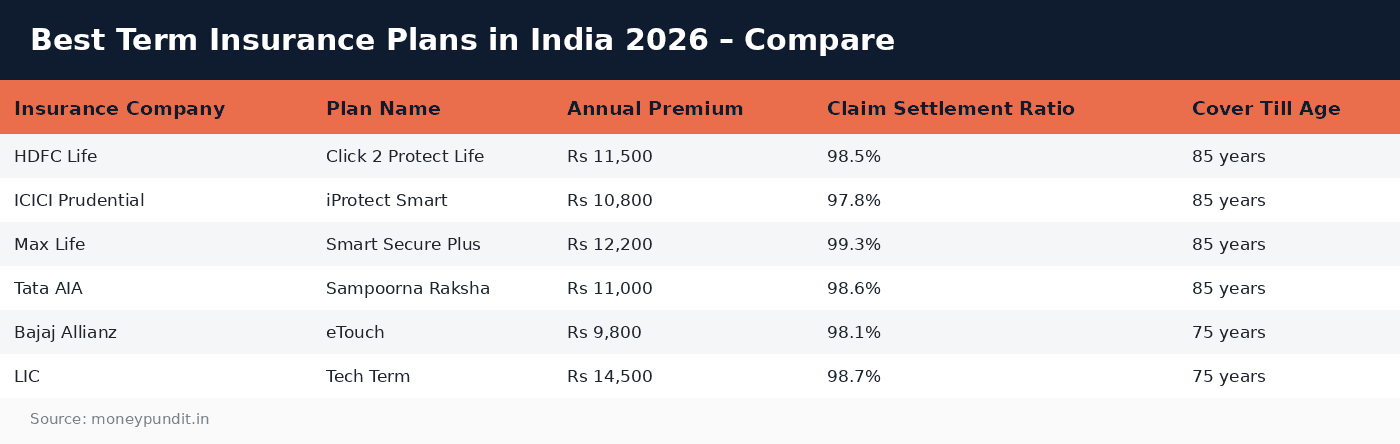
Top Term Insurance Plans Comparison (Rs 1 Crore Cover, 30-Year-Old Male, Non-Smoker)
| Insurance Company | Plan Name | Annual Premium | Claim Settlement Ratio | Cover Till Age |
|---|---|---|---|---|
| HDFC Life | Click 2 Protect Life | Rs 11,500 | 98.5% | 85 years |
| ICICI Prudential | iProtect Smart | Rs 10,800 | 97.8% | 85 years |
| Max Life | Smart Secure Plus | Rs 12,200 | 99.3% | 85 years |
| Tata AIA | Sampoorna Raksha | Rs 11,000 | 98.6% | 85 years |
| Bajaj Allianz | eTouch | Rs 9,800 | 98.1% | 75 years |
| LIC | Tech Term | Rs 14,500 | 98.7% | 75 years |
How Much Term Insurance Do You Need?
The standard thumb rule is your term insurance cover should be 10-15 times your annual income. However, a more precise calculation considers: annual household expenses multiplied by years until your youngest child becomes independent, outstanding loans (home loan, car loan, personal loan), major future goals (children’s education, marriage), and minus existing investments and savings.
For example, a 35-year-old earning Rs 15 lakh per year with a Rs 50 lakh home loan, two young children, and Rs 20 lakh in savings should ideally have term cover of Rs 2-2.5 crore. The premium for this would be approximately Rs 20,000-25,000 per year, a small price for complete peace of mind.
Key Features to Look For
Claim Settlement Ratio: Choose companies with CSR above 97%. This indicates that the company pays out at least 97 out of 100 death claims received.
Riders: Consider adding critical illness rider (pays a lump sum on diagnosis of specified illnesses) and accidental death benefit rider (pays additional sum on accidental death). These cost only Rs 2,000-5,000 extra per year.
Premium Payment Options: Limited pay options let you pay premiums for a shorter period (say 10-15 years) while the cover continues till age 85. This is useful if you want to finish premium payments before retirement.
Common Term Insurance Mistakes
Buying Through Agents: Online term plans are 30-40% cheaper than offline plans because there is no agent commission. Always buy directly from the insurer website or aggregator platforms like Policybazaar or Ditto Insurance.
Not Disclosing Medical History: Non-disclosure of pre-existing conditions is the primary reason for claim rejection. Always declare your complete medical history truthfully, the premium may be slightly higher but your claim will not be rejected.
Delaying Purchase: Term insurance premiums increase significantly with age. A 25-year-old pays almost half the premium of a 35-year-old for the same cover. Buy term insurance as soon as you have financial dependents.
Frequently Asked Questions
Does term insurance have maturity benefit?
Pure term plans have no maturity benefit: if you survive the policy term, there is no payout. Some plans offer a return of premium (TROP) variant but at 2-3x the premium, making it a poor investment.
Can I have multiple term insurance policies?
Yes, you can hold multiple term policies from different insurers. This is actually a good strategy for diversifying claim risk across insurers.
Is term insurance tax-deductible?
Yes, term insurance premiums qualify for deduction under Section 80C up to Rs 1.5 lakh. The death benefit received by the nominee is completely tax-free under Section 10(10D).
Term Insurance Buying Checklist for 2026
The right term plan isn’t just about the lowest premium, it’s about reliability when your family needs it most. Prioritize these in order: claim settlement ratio above 97% (check IRDAI annual report, not just the insurer’s claims), financial strength of the insurer (solvency ratio above 1.5x the required 1.5), plan features (return of premium not recommended. It costs 3-4x more), and then premium comparison. Leading insurers like HDFC Life, ICICI Prudential, Max Life, and Tata AIA consistently score high on all parameters.
Choose your cover amount using the income replacement method: 15-20 times your annual income, plus all outstanding liabilities (home loan, car loan, personal loans), plus specific future needs (children’s higher education, marriage funds). A 30-year-old earning ₹15 lakh/year with a ₹40 lakh home loan needs approximately ₹2.5-3.5 crore cover. Buy online directly from the insurer’s website. Online plans cost 30-40% less than offline plans because they eliminate agent commissions. Use a term insurance comparison approach to evaluate options.
Essential Riders and Nomination Best Practices
Three riders worth adding: critical illness rider (lump-sum payout on diagnosis of 30+ specified diseases, cancer, heart attack, stroke), accidental death benefit (additional sum assured for accidental death), and waiver of premium (all future premiums waived if permanently disabled). These typically add 20-35% to the base premium but provide comprehensive life-stage coverage that standalone policies would cost more to replicate.
Nomination is critical: update your nominee details whenever life circumstances change (marriage, divorce, children born). Consider assigning the policy (Section 38 of Insurance Act) to your spouse, an assigned policy’s proceeds cannot be claimed by creditors or other legal heirs, ensuring your family gets the full amount. Disclose all health conditions accurately during application, non-disclosure is the single biggest reason for claim rejection in India. Premium paid qualifies for Section 80C deduction up to ₹1.5 lakh, and maturity/death proceeds are tax-exempt under Section 10(10D).
References: Sebi.gov.in
Best term insurance plans: Key Takeaways
Key points on best term insurance plans:
- Term insurance is the purest and most affordable form of life insurance.
- The standard thumb rule is your term insurance cover should be 10-15 times your annual income.
- Riders: Consider adding critical illness rider (pays a lump sum on diagnosis of specified illnesses) and accidental death benefit rider (pays additional sum on accidental death).
Verify the latest best term insurance plans figures with IRDAI before you act.
Related reading: Compare plans alongside the insurer’s claim settlement ratio, explained here.