

Debt mutual funds in brief: Debt mutual funds lost their favorable long-term capital gains treatment in 2023, all gains are now taxed at your slab rate regardless of holding period, which changed the math on why and how to use them.
Debt mutual funds lost their favorable long-term capital gains treatment in 2023, all gains are now taxed at your slab rate regardless of holding period, which changed the math on why and how to use them. Here’s the current types, taxation rules, and which funds stand out.
Debt mutual funds invest primarily in fixed-income securities like government bonds, corporate bonds, treasury bills, and money market instruments. They offer relatively stable returns with lower risk compared to equity funds, making them ideal for conservative investors and portfolio diversification.
Types of Debt Mutual Funds
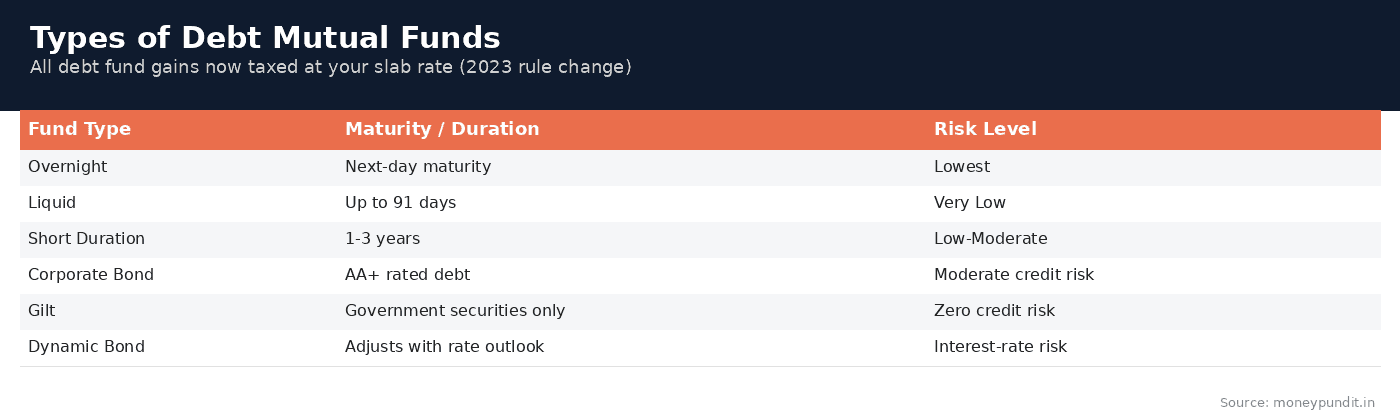
The debt fund category includes several sub-types based on duration and credit quality. Overnight funds invest in securities maturing the next day, offering the highest safety. Liquid funds hold instruments maturing within 91 days and serve as an alternative to savings accounts. Short duration funds invest in 1-3 year maturity papers, suitable for medium-term goals. Corporate bond funds focus on AA+ and above rated corporate debt. Gilt funds invest exclusively in government securities with zero credit risk. Dynamic bond funds adjust portfolio duration based on interest rate outlook.
How Debt Funds Generate Returns
Debt funds earn returns through two mechanisms: accrual income (interest earned on bonds held) and capital appreciation (when bond prices rise due to falling interest rates). The NAV of a debt fund moves inversely to interest rate changes, when rates fall, existing bond prices rise, boosting NAV. This makes duration management crucial for debt fund performance.
Taxation of Debt Funds (2026 Rules)
Following the 2023 budget changes, debt mutual funds held for any duration are now taxed at your income tax slab rate. The indexation benefit that previously made debt funds tax-efficient has been removed for funds with less than 35% equity allocation. This has leveled the playing field between debt funds and fixed deposits from a tax perspective, though debt funds still offer better liquidity and professional management.
When to Choose Debt Funds
Debt funds are ideal for parking emergency funds (liquid/overnight funds), short-term goals within 1-3 years, portfolio diversification to reduce overall volatility, retirees seeking regular income through SWP, and as a temporary holding during equity market uncertainty. For goals beyond 5 years, a combination of equity and debt through hybrid funds or manual allocation is recommended.
Risks in Debt Funds
While safer than equity, debt funds carry credit risk (possibility of bond default), interest rate risk (NAV drops when rates rise), and liquidity risk (difficulty selling bonds in stressed markets). The Franklin Templeton crisis of 2020, where six debt schemes were wound up, highlighted these risks. Always check the credit quality and portfolio concentration of a debt fund before investing.
Are debt funds better than FDs?
Debt funds offer better liquidity and professional management than FDs, but post-2023 tax changes have removed their tax advantage. Choose based on your need for flexibility versus guaranteed returns.
Which debt fund is best for emergency fund?
Liquid funds or overnight funds are best for emergency funds. They offer instant redemption up to ₹50,000 and have minimal NAV volatility.
Types of Debt Mutual Funds Explained
Debt mutual funds invest in fixed-income securities like government bonds, corporate bonds, treasury bills, and money market instruments. SEBI categorises them into 16 types based on duration and credit quality. The most relevant for individual investors: liquid funds (invest in securities maturing within 91 days, ideal for emergency funds and short-term parking), ultra-short duration funds (3-6 months), short duration funds (1-3 years), corporate bond funds (high-quality AA+ rated corporate debt), and gilt funds (100% government securities, zero credit risk).
Each type serves a different purpose. Liquid funds are your savings account alternative (6-7% returns vs 3-4% in savings accounts), short duration funds suit 1-3 year goals like a car down payment or vacation fund, and corporate bond funds work for 3-5 year horizons where you want better returns than FDs with moderate risk. Check out top short duration debt funds for curated picks.
Debt Fund Taxation After 2024 Changes
The taxation landscape for debt mutual funds changed significantly from April 2023. Debt funds (with less than 65% equity allocation) no longer enjoy long-term capital gains indexation benefit. All gains, regardless of holding period, are now taxed at your income tax slab rate. This has reduced their post-tax advantage over bank FDs for investors in lower tax brackets.
However, debt funds still offer advantages: no TDS deduction at source (unlike FDs where TDS kicks in at ₹50,000 annual interest), tax is payable only on redemption (allowing full compounding until you sell), and the flexibility to redeem partially. You can sell only what you need rather than breaking an entire FD. For investors in the 30% tax bracket, the timing flexibility and absence of TDS still make debt funds tax-efficient compared to FDs for amounts above ₹5-10 lakh.
How to Choose the Right Debt Fund
Match the fund’s average maturity with your investment horizon, investing in a long-duration fund for a 6-month goal exposes you to unnecessary interest rate risk (bond prices fall when rates rise). Stick to high credit quality: AAA-rated or sovereign (government) bonds. The extra 1-2% return from lower-rated bonds isn’t worth the credit default risk, as investors in Franklin Templeton’s debt fund crisis learned in 2020.
Key metrics to evaluate: YTM (Yield to Maturity) gives the expected return if held to maturity, modified duration indicates interest rate sensitivity (lower is safer for short-term), and expense ratio directly reduces your returns. Compare debt fund returns using our MF Returns Calculator. For a balanced portfolio, allocate your debt component based on age, a common rule of thumb is (100 minus your age)% in equity and the rest in debt. So a 30-year-old might have 70% in equity SIPs and 30% in debt funds, shifting gradually toward more debt as retirement approaches. Use our Retirement Calculator to model this asset allocation strategy.
With the tax advantage gone, debt funds now compete more directly with FDs on pure post-tax returns, the case for using them is mainly liquidity and marginal yield pickup, not the tax break that used to be their main draw.
References: Amfiindia.com
Source: amfiindia.com
Debt mutual funds: Key Takeaways
Key points on debt mutual funds:
- The debt fund category includes several sub-types based on duration and credit quality.
- Debt funds earn returns through two mechanisms: accrual income (interest earned on bonds held) and capital appreciation (when bond prices rise due to falling interest rates).
- The indexation benefit that previously made debt funds tax-efficient has been removed for funds with less than 35% equity allocation.
Verify the latest debt mutual funds figures with AMFI before you act.