
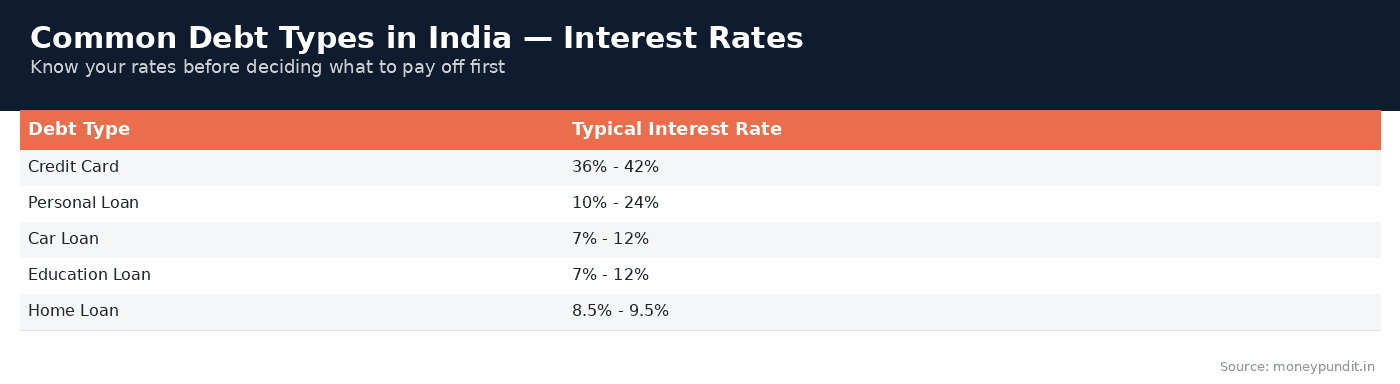
How to get out of debt in brief: Common debts in India: credit card balances (36-42% interest), personal loans (10-24%), car loans (7-12%), education loans (7-12%), home loans (8.5-9.5%), and buy-now-pay-later obligations.
Being trapped in debt is one of the most stressful financial situations, affecting your mental health, relationships, and future opportunities. Whether it is credit card balances, personal loans, or EMIs piling up, there is always a way out. The key is having a structured plan and the discipline to follow it consistently.
Assess Your Complete Debt Picture
List every debt with four details: lender name, outstanding balance, interest rate, and minimum monthly payment. Common debts in India: credit card balances (36-42% interest), personal loans (10-24%), car loans (7-12%), education loans (7-12%), home loans (8.5-9.5%), and buy-now-pay-later obligations. Calculate your total debt, total minimum payments, and the percentage of your income going to debt service. If more than 40% of income goes to debt payments, you are in a high-risk zone that needs immediate action.
The Debt Avalanche Method (Mathematically Optimal)
List all debts from highest interest rate to lowest. Pay minimum on everything. Put every extra rupee toward the highest-rate debt. Once it is paid off, roll that payment into the next highest rate. This method minimizes total interest paid. Example: if you have ₹2 lakh credit card debt at 42%, ₹3 lakh personal loan at 15%, and ₹20 lakh home loan at 9%, attack the credit card first. Paying off the credit card saves ₹84,000 annually in interest, money that accelerates the next debt payoff.
The Debt Snowball Method (Psychologically Powerful)
List debts from smallest balance to largest. Pay minimum on everything. Put every extra rupee toward the smallest balance. The quick wins from eliminating smaller debts create momentum and motivation. While you pay slightly more interest than the avalanche method, the psychological boost of seeing debts disappear keeps many people committed. For most people, the snowball method’s motivational advantage outweighs the mathematical advantage of the avalanche.
Emergency Steps for Severe Debt
Stop using credit cards immediately: switch to cash or debit card only. Call credit card companies to negotiate lower interest rates or convert to EMI at reduced rates. Explore balance transfer to lower-rate cards. Consider a debt consolidation loan at a lower rate. If debts are truly unmanageable, consult a SEBI-registered credit counselor before considering settlement or bankruptcy. Sell assets (second vehicle, gold, electronics) to reduce high-interest debt. Temporarily reduce all non-essential expenses to maximum and redirect to debt repayment.
Preventing Future Debt Traps
Build a 3-month emergency fund before investing in anything else. Use the 24-hour rule for non-essential purchases over ₹5,000. Wait a day before buying. Set credit card limits to match your ability to pay in full each month. Avoid taking loans for depreciating assets or consumable experiences. Live on last month’s income (build a one-month buffer in your bank account) to break the paycheck-to-paycheck cycle.
Should I use my savings to pay off debt?
If your debt interest rate exceeds your savings return (credit card at 42% vs savings account at 4%), mathematically you should use savings to eliminate high-interest debt. Keep a small emergency buffer (₹25,000-₹50,000) and use the rest to pay off expensive debt. Rebuild the emergency fund once high-interest debt is cleared.
Snowball vs Avalanche: Choosing the Right Debt Repayment Strategy
The snowball method arranges debts from smallest balance to largest, you pay minimums on all debts and throw every extra rupee at the smallest balance first. Once it’s cleared, that payment rolls into the next smallest. The psychological wins of eliminating debts quickly keep you motivated. The avalanche method, by contrast, targets the highest-interest debt first, saving you more in total interest payments. Mathematically, avalanche is superior; behaviourally, snowball has higher completion rates.
Use the avalanche method if you have discipline and your high-interest debts (credit cards at 36-42% APR, personal loans at 14-20%) carry significantly larger balances. Use snowball if you have many small debts creating mental clutter and need quick wins to stay committed. A hybrid approach works too: target high-interest credit card debt first (always the priority), then switch to snowball for remaining debts. Use our EMI Calculator to plan extra payment amounts and see how much faster each debt gets cleared.
Practical Steps to Break Free from Debt Permanently
Start by listing every debt with its outstanding balance, interest rate, minimum payment, and due date. Negotiate with lenders: many banks offer hardship programs, rate reductions, or restructuring for borrowers who proactively ask. Balance transfer to a lower-rate card (some offer 0% introductory periods) can save substantial interest on credit card debt, but avoid spending on the old card after transferring.
Build a bare-bones budget using the 50-30-20 rule as a starting framework, but temporarily shift to 60-20-20 (60% needs, 20% debt repayment, 20% minimum savings). Once debt-free, redirect those debt payments into an emergency fund (3-6 months of expenses) to prevent falling back into the debt trap. The golden rule: never take on new debt while repaying existing debt, and always have at least ₹10,000-20,000 in an accessible savings account to handle small emergencies without swiping a credit card.
References: Sebi.gov.in
Source: sebi.gov.in
How to get out of debt: Key Takeaways
Key points on how to get out of debt:
- List every debt with four details: lender name, outstanding balance, interest rate, and minimum monthly payment.
- Once it is paid off, roll that payment into the next highest rate.
- The quick wins from eliminating smaller debts create momentum and motivation.
Verify the latest how to get out of debt figures with RBI before you act.