
50 30 20 budgeting rule in brief: The 50-30-20 rule is one of the most popular personal finance frameworks in the world, and with a few India-specific adjustments, it works beautifully for Indian households.
Indian households often carry expenses the standard 50-30-20 framework doesn’t cleanly categorize, supporting parents, wedding savings, or a joint family budget, which is exactly where a rigid application of the rule breaks down fastest. Here’s a version adapted specifically for that reality.
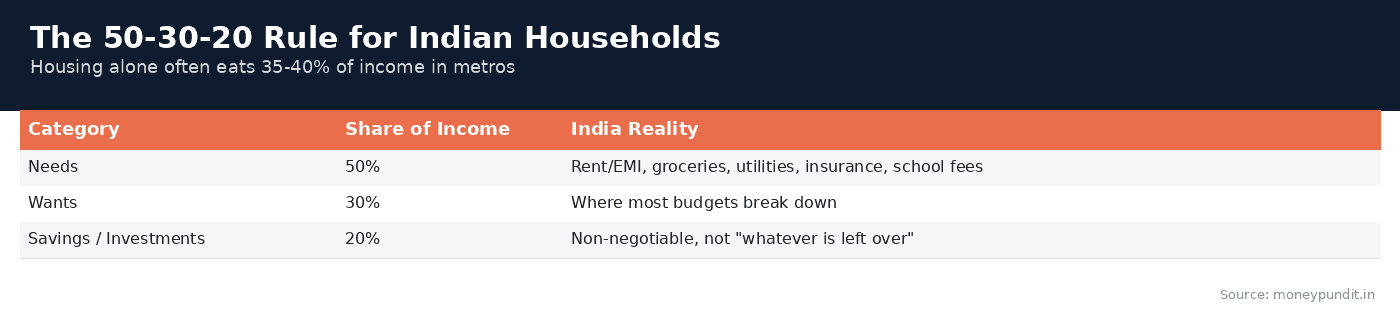
The 50-30-20 rule is one of the most popular personal finance frameworks in the world, and with a few India-specific adjustments, it works beautifully for Indian households. The concept is simple: allocate 50% of your after-tax income to needs, 30% to wants, and 20% to savings and investments. Let’s break down what this actually looks like for an Indian family in 2026.
The 50%: Needs
Needs are non-negotiable expenses: things you genuinely cannot function without. In India, this typically includes: rent or home loan EMI, groceries and cooking gas, utility bills (electricity, water, internet), transportation to work, school fees for children, insurance premiums (health, term life), and essential medicines.
If your needs exceed 50% of take-home pay, it’s a signal to either increase income or reduce fixed costs, particularly housing, which is often the biggest culprit. Many families in metros find housing alone consuming 35–40% of income.
The 30%: Wants
Wants are lifestyle expenses you choose but don’t strictly need. Dining out, streaming subscriptions, weekend trips, new clothes beyond basics, gym memberships, gadgets, entertainment. This category is where most budget busts happen, not because people are irresponsible, but because wants creep up gradually and invisibly.
The 30% allocation is generous. If you find yourself routinely exceeding it, track your wants spending for one month by category. The awareness alone typically reduces spending by 15–20%.
The 20%: Savings and Investments
This is the most important bucket. It includes emergency fund contributions (until you have 6 months of expenses saved), SIP investments in mutual funds, PPF contributions, NPS, and any debt repayment beyond minimum EMIs.
20% is the floor, not the ceiling. If you can push this to 25–30%, your wealth compounds dramatically faster. The difference between saving 20% vs 30% over 20 years is the difference between a comfortable retirement and an abundant one.
50-30-20 Budget Examples for Different Monthly Incomes
The rule works on your take-home pay, meaning the amount that reaches your bank account after tax and PF. Here is how it splits at four common income levels.
| Rs 30,000 | Rs 15,000 | Rs 9,000 | Rs 6,000 |
| Rs 60,000 | Rs 30,000 | Rs 18,000 | Rs 12,000 |
| Rs 1,00,000 | Rs 50,000 | Rs 30,000 | Rs 20,000 |
| Rs 1,50,000 | Rs 75,000 | Rs 45,000 | Rs 30,000 |
To see what the savings slice can become, an investment of Rs 20,000 a month for 10 years at an assumed 12% annual return grows to roughly Rs 46.5 lakh on Rs 24 lakh invested. That is an illustration, not a guarantee, since market returns vary. Try your own numbers in the SIP calculator.
When the 50-30-20 Rule Does Not Fit
The rule is a starting point, not a law. These are the situations where Indian households most often need to bend it.
- High rent in a metro: if rent and EMIs push needs to 60% or more, try 60-25-15 or 60-20-20 and cut wants first.
- Low income: when needs take 70% or more, protect even a small 10% for savings and an emergency fund before anything else.
- Loan EMIs: count EMIs as needs, but if total EMIs exceed 40% of income, treat paying them down as part of your 20%. You can model different tenures in the EMI calculator.
- Supporting parents or family: treat regular support as a need, so the rest of the budget stays honest.
Where to Put Your 20%
Split your 20% in this order. First, build an emergency fund of 3 to 6 months of expenses in a savings account or liquid fund. Second, make sure you have health and term insurance. Third, invest for long-term goals through SIPs, and use safer options such as FDs for goals under 3 years. Compare current deposit rates on our best FD rates page. To track whether you are sticking to the split, see our guide to the best budgeting apps in India.
Adapting the Rule for Indian Households
The 50-30-20 split works well as a starting framework, but Indian financial realities often require adjustments. In metro cities like Mumbai and Bangalore, rent alone can consume 30%-40% of take-home pay, pushing the “needs” category well above 50%. In such cases, consider a 60-20-20 or even 60-15-25 split, compressing wants to maintain savings.
For Indian families supporting elderly parents or funding children’s education, the “needs” category naturally expands. Rather than abandoning the framework, categorise these obligations honestly, parents’ medical expenses are needs, but funding a child’s overseas MBA might be a want depending on alternatives available. The key is awareness: knowing exactly where your money goes is the first step toward controlling it.
Getting Started
Track your last 3 months of bank and credit card statements. Categorize every transaction as need, want, or savings. Calculate the percentage for each bucket. This single exercise reveals where your money is actually going versus where you think it’s going. Most people are shocked by the gap.
Making the 20% Savings Work Harder
The 20% savings allocation should be further structured for maximum impact. Financial planners recommend building your savings in this priority order: first, an emergency fund covering 6 months of expenses in a liquid fund or savings account; second, adequate insurance (term life cover of 10-15x annual income and ₹10-25 lakh health cover); third, tax-saving investments under Section 80C; and finally, goal-based investments through SIPs in mutual funds.
If you can push savings beyond 20%, the compounding benefits are extraordinary. Saving 30% instead of 20% for 25 years (investing ₹30,000 vs ₹20,000 monthly in equity mutual funds at 12% CAGR) results in ₹5.9 crore vs ₹3.9 crore, a ₹2 crore difference from just ₹10,000 extra per month. Use our SIP Calculator to model different savings rates and see how the power of compounding transforms small monthly savings into serious wealth over time. Track your budget monthly for the first 3-6 months to identify spending leaks, then automate your savings through SIPs and recurring deposits.
References: Amfiindia.com
Source: amfiindia.com
Frequently Asked Questions
Is the 50-30-20 rule based on gross or take-home salary?
Use take-home pay, the amount that reaches your bank account after income tax and PF deductions.
Do EMIs count as needs or savings?
Loan EMIs for a home, car or education count as needs. Prepaying a loan beyond the EMI can count toward your 20% savings.
Can I use the 50-30-20 rule on a low salary?
Yes, but adjust it. If needs take more than 50%, reduce wants first and keep at least 10% for savings so you have an emergency fund.
What if my needs exceed 50%?
Look for the largest need, usually rent, and see whether it can be reduced. Until then, use a 60-30-10 or 60-25-15 split.
50 30 20 budgeting rule: Key Takeaways
Key points on 50 30 20 budgeting rule:
- Needs are non-negotiable expenses: things you genuinely cannot function without.
- Wants are lifestyle expenses you choose but don’t strictly need.
- If you can push this to 25–30%, your wealth compounds dramatically faster.
Verify the latest 50 30 20 budgeting rule figures with RBI before you act.