

Swp in mutual funds in brief: A structure that can be far more tax-efficient than an FD’s fully taxable interest.
A Systematic Withdrawal Plan lets you draw a fixed monthly income from a mutual fund investment while the remaining corpus keeps growing. A structure that can be far more tax-efficient than an FD’s fully taxable interest. Here’s how SWP actually works, with a worked example.
A Systematic Withdrawal Plan (SWP) is the reverse of SIP: instead of investing regularly, you withdraw a fixed amount periodically from your mutual fund investment. SWP has emerged as a superior alternative to traditional fixed deposits and pension plans for generating regular income, especially during retirement. The tax efficiency of SWP, combined with the potential for capital appreciation, makes it an attractive income strategy.
How SWP Works
You invest a lumpsum in a mutual fund (typically a balanced or equity fund) and set up a monthly withdrawal of a fixed amount. Each month, the fund house redeems units worth your withdrawal amount and credits the money to your bank account. While you are withdrawing, the remaining investment continues to earn returns. If the fund returns exceed your withdrawal rate, your corpus actually grows over time, providing inflation-adjusted income indefinitely. Since SWP in mutual funds starts with a lumpsum, use our Lumpsum Calculator to estimate how large your starting corpus needs to be for the withdrawal amount you have in mind.
SWP Example
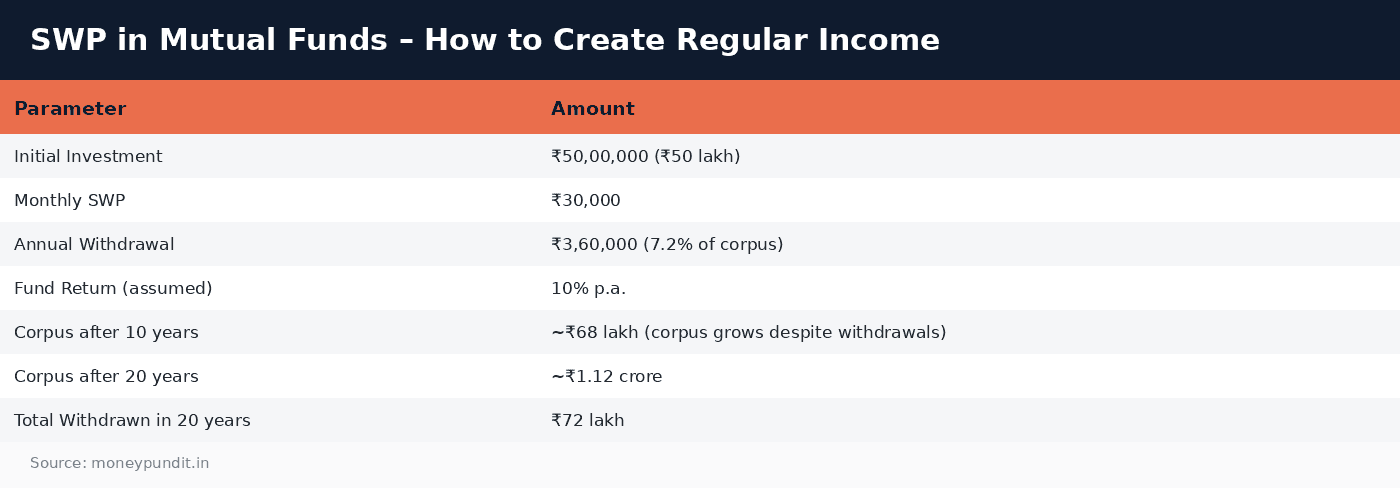
| Parameter | Amount |
|---|---|
| Initial Investment | ₹50,00,000 (₹50 lakh) |
| Monthly SWP | ₹30,000 |
| Annual Withdrawal | ₹3,60,000 (7.2% of corpus) |
| Fund Return (assumed) | 10% p.a. |
| Corpus after 10 years | ~₹68 lakh (corpus grows despite withdrawals) |
| Corpus after 20 years | ~₹1.12 crore |
| Total Withdrawn in 20 years | ₹72 lakh |
In this example, you withdraw ₹72 lakh over 20 years AND your corpus more than doubles to ₹1.12 crore, because the 10% fund return exceeds the 7.2% withdrawal rate. This is the magic of SWP with equity or balanced funds.
SWP vs FD Interest – Tax Comparison
| Feature | SWP (Equity Fund) | FD Interest |
|---|---|---|
| Monthly Income (₹50L invested) | ₹30,000 | ₹29,167 (7% FD) |
| Tax Treatment | Only gains portion taxed | Full interest taxable at slab |
| Tax Rate | 12.5% LTCG (after 1 yr hold) | Up to 30% (slab rate) |
| Tax on ₹30K/month | ~₹750-₹1,500/month | ₹7,500-₹9,000/month (30% slab) |
| Capital Growth | Remaining corpus grows | Principal stays fixed |
| Inflation Protection | Yes (equity growth) | No (fixed rate) |
The tax advantage of SWP is dramatic. In an SWP from an equity fund held for more than a year, each withdrawal consists of your original investment (capital) plus gains. Only the gains portion is taxed at 12.5%, and the first ₹1.25 lakh of annual gains is exempt. For FD interest, the entire amount is taxable at your slab rate (up to 30%). This difference can save ₹60,000-₹1,00,000 annually in taxes for a ₹50 lakh corpus.
Best Funds for SWP
For Conservative SWP
Balanced Advantage Funds (BAF) or Equity Savings Funds are ideal. BAFs dynamically adjust between equity and debt based on market valuations, reducing volatility while maintaining equity tax treatment. ICICI Prudential Balanced Advantage, HDFC Balanced Advantage, and Edelweiss Balanced Advantage are popular choices. Expected returns: 8-10% with moderate volatility.
For Moderate SWP
Aggressive Hybrid Funds (65-80% equity) or Flexi Cap Funds provide higher growth potential. These work well if your withdrawal rate is conservative (5-6% of corpus). Longer time horizons allow the equity component to recover from interim declines.
For Debt-Oriented SWP
Conservative Hybrid Funds or Short Duration Debt Funds suit investors who cannot tolerate any equity volatility. Returns are lower (7-8%) but more predictable. Best for short-term SWP needs (1-3 years) or as a complement to equity SWP.
How to Set Up an SWP
First, invest a lumpsum amount in your chosen mutual fund. Wait for at least 1 year (for equity funds) to ensure units qualify for LTCG tax treatment when redeemed through SWP. Then, set up an SWP through your mutual fund platform (Groww, Kuvera, MF Central, or AMC website) specifying: withdrawal amount, frequency (monthly/quarterly), SWP start date, and your bank account for credits. The SWP redemptions happen automatically on the specified dates.
SWP Withdrawal Rate: How Much is Safe?
The sustainable withdrawal rate depends on the underlying fund type. For equity funds (10-12% expected return), a 6-8% annual withdrawal rate is sustainable for 20+ years. For balanced funds (8-10% expected return), 5-7% is appropriate. For debt funds (6-8% expected return), 5-6% works. Withdrawing more than the fund’s expected return erodes your corpus over time. Start conservatively and increase withdrawals annually by 5-7% to match inflation.
SWP for Retirement Income
SWP is increasingly replacing traditional pension plans as the preferred retirement income strategy. A retired couple with ₹1 crore invested in a balanced advantage fund can withdraw ₹50,000-₹60,000 monthly while maintaining or growing their corpus. This is far more flexible than an annuity (which offers fixed 5-7% with no capital access) and more tax-efficient than FD interest income.
Frequently Asked Questions
Can I change my SWP amount?
Yes, you can modify, pause, or stop your SWP at any time through your mutual fund platform. Unlike annuities or pension plans, SWP offers complete flexibility. You can increase withdrawals when expenses rise, reduce them during market downturns, or temporarily stop to let your corpus recover.
What if the market crashes during my SWP?
During market downturns, your SWP redeems more units (since NAV is lower) to generate the same income amount. This accelerates corpus depletion if the downturn is prolonged. Mitigate this by maintaining a 1-2 year cash buffer in liquid funds, reducing SWP amounts during downturns by 20-30%, or using Balanced Advantage Funds that automatically reduce equity exposure during overvalued markets.
Is SWP better than dividend option in mutual funds?
Yes, SWP is significantly better than the dividend (IDCW) option. Dividends are unpredictable (fund manager decides timing and amount), fully taxable as income at your slab rate, and the fund’s NAV drops by the dividend amount. SWP gives you control over the amount and timing, and is taxed more favourably as capital gains with only the profit portion being taxable.
What is the minimum amount needed for SWP?
Most funds allow SWP with a minimum corpus of ₹25,000-₹50,000 and minimum monthly withdrawal of ₹500-₹1,000. However, for SWP to be practically useful as an income strategy, a corpus of at least ₹10-20 lakh is needed to generate meaningful monthly income of ₹5,000-₹15,000.
For anyone drawing a regular income from savings, especially retirees, an SWP from a well-chosen debt or hybrid fund is worth comparing directly against FD interest before defaulting to the FD, since the tax gap alone can be substantial over a long withdrawal period.
References: Amfiindia.com
Swp in mutual funds: Key Takeaways
Key points on swp in mutual funds:
- You invest a lumpsum in a mutual fund (typically a balanced or equity fund) and set up a monthly withdrawal of a fixed amount.
- In this example, you withdraw ₹72 lakh over 20 years AND your corpus more than doubles to ₹1.12 crore, because the 10% fund return exceeds the 7.2% withdrawal rate.
- In an SWP from an equity fund held for more than a year, each withdrawal consists of your original investment (capital) plus gains.
Verify the latest swp in mutual funds figures with AMFI before you act.
Using swp in mutual funds in Your Plan
Putting swp in mutual funds into practice starts with your own numbers. Run them through our SIP calculator and tax calculator to see how swp in mutual funds fits your goals, then compare options in our FD rates guide. Whatever you decide about swp in mutual funds, review it every year and keep records.
In short, swp in mutual funds works best when matched to your time horizon, your tax bracket and your risk comfort. Revisit swp in mutual funds whenever rules or rates change.