

Nps vs ppf retirement in brief: NPS is a government-sponsored pension scheme open to all Indian citizens aged 18-70.
NPS and PPF both build a retirement corpus with tax benefits, but they’re structured very differently, NPS ties a portion of your maturity to market-linked equity and mandates annuitizing part of the corpus, while PPF is a fixed, guaranteed 15-year lock-in. Here’s how their returns actually compare.
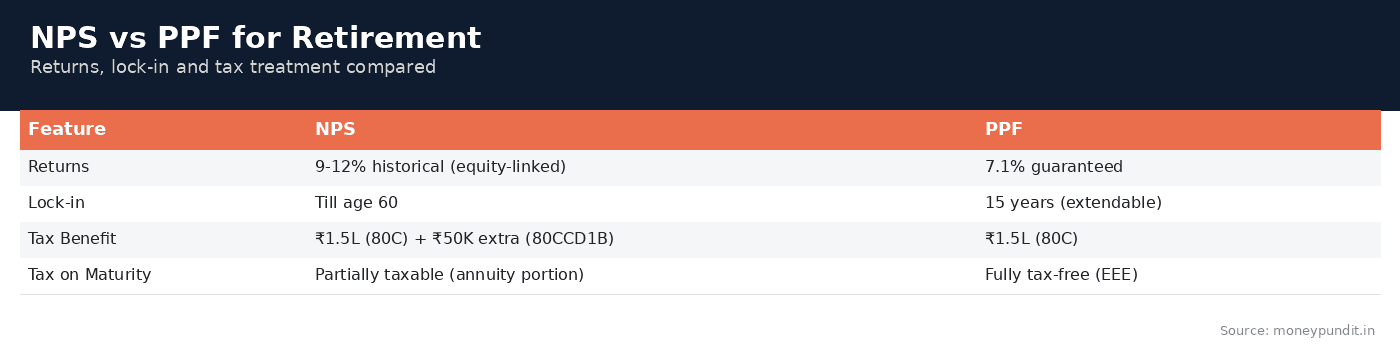
The National Pension System (NPS) and Public Provident Fund (PPF) are two of India’s most popular long-term savings instruments. Both offer tax benefits, but they differ significantly in risk-return profile, liquidity, and retirement corpus creation potential. Understanding these differences helps you make the right choice for your retirement planning.
NPS Overview
NPS is a government-sponsored pension scheme open to all Indian citizens aged 18-70. It invests your contributions in a mix of equity (up to 75%), corporate bonds, and government securities based on your chosen allocation. The equity exposure gives NPS the potential for higher returns (9-12% historically) compared to pure debt instruments. NPS offers an additional tax deduction of ₹50,000 under Section 80CCD(1B) over and above the ₹1.5 lakh under 80C, making it attractive for tax planners.
PPF Overview
PPF is a government-backed savings scheme with a 15-year lock-in period (extendable in 5-year blocks). It offers guaranteed returns currently at 7.1% per annum, revised quarterly by the government. PPF enjoys EEE (Exempt-Exempt-Exempt) tax status, contributions, interest earned, and maturity proceeds are all tax-free. The sovereign guarantee makes PPF virtually risk-free, but the returns are modest compared to equity-linked options.
Returns Comparison
Over a 25-year period with ₹1.5 lakh annual investment: PPF at 7.1% would grow to approximately ₹1.03 crore. NPS with 50% equity allocation at 10% returns would grow to approximately ₹1.48 crore. The ₹45 lakh difference illustrates the impact of equity exposure over long periods. However, NPS returns are market-linked and not guaranteed, whereas PPF offers certainty. For risk-averse investors, the guaranteed nature of PPF has its own value.
Taxation Differences
PPF enjoys complete EEE status: no tax at any stage. NPS contributions up to ₹2 lakh (₹1.5 lakh under 80C + ₹50,000 under 80CCD(1B)) are tax-deductible. At maturity, NPS allows 60% lump sum withdrawal (tax-free post-Budget 2024 changes) and mandates 40% be used to buy an annuity. The annuity income is taxed at your slab rate, which is the main disadvantage of NPS compared to PPF’s fully tax-free maturity.
Which Should You Choose
If you want guaranteed, fully tax-free returns and do not mind lower growth, PPF is your choice. If you want higher growth potential, are comfortable with market risk, and want additional tax benefits, NPS is better. The optimal strategy for most people is to invest in both: use NPS for the additional ₹50,000 tax deduction under 80CCD(1B) and invest in PPF for the guaranteed, tax-free debt component of your retirement portfolio. This combination provides tax efficiency, diversification, and a balance of safety and growth.
Can I withdraw from NPS before retirement?
Partial withdrawal is allowed after 3 years for specific reasons (medical emergency, education, marriage, home purchase) up to 25% of your contributions. Full exit before 60 requires 80% to be used for annuity purchase, with only 20% available as lump sum.
What happens to PPF after 15 years?
After the initial 15-year maturity, you can extend in blocks of 5 years (with or without contributions), withdraw the entire amount, or make partial withdrawals. Many investors continue PPF indefinitely for its tax-free returns.
NPS vs PPF: Tax Benefits Compared
Both NPS and PPF offer Section 80C deductions up to ₹1.5 lakh, but NPS provides an additional ₹50,000 deduction under Section 80CCD(1B), effectively giving you up to ₹2 lakh in total deductions. Salaried employees can claim a further deduction of up to 10% of basic salary (14% for central government employees) under Section 80CCD(2), which doesn’t count against the ₹1.5 lakh 80C ceiling. This makes NPS significantly more tax-efficient during the accumulation phase.
However, PPF’s biggest advantage is 100% tax-free maturity. Your entire PPF corpus, principal plus accumulated interest, is completely exempt from tax at withdrawal. NPS, on the other hand, taxes 60% of the corpus at withdrawal: 60% can be withdrawn as a lump sum (tax-free since Budget 2024), while the remaining 40% must be used to purchase an annuity, whose income is taxable at your slab rate. Use our PPF Calculator to project your tax-free maturity corpus.
Which One Suits Your Financial Goals Better
PPF is ideal for conservative investors seeking guaranteed, tax-free returns with sovereign safety. The 15-year lock-in (extendable in 5-year blocks) makes it perfect for long-term goals like children’s education or retirement supplementation. Current PPF interest rate is government-set and reviewed quarterly, historically ranging between 7-8%.
NPS suits investors comfortable with market-linked returns who want higher growth potential. With equity allocation up to 75% (Active Choice), NPS has historically delivered 9-12% annualized returns over the long term. The mandatory annuity purchase creates guaranteed pension income, a true retirement product. The optimal strategy for many investors: maximize NPS for the extra ₹50,000 tax deduction, and simultaneously invest in PPF for liquidity and tax-free maturity. Check our NPS Calculator to estimate your pension corpus and monthly pension amount.
Smart Strategy: Don’t choose between NPS and PPF: use both strategically. Maximize NPS for the extra ₹50,000 tax deduction under Section 80CCD(1B), and simultaneously build your PPF for guaranteed tax-free maturity. Together, they create a robust, tax-efficient retirement foundation. Compare projections using our NPS Calculator and PPF Calculator.
For most people, NPS and PPF work better together than as an either-or choice, PPF as the guaranteed core, NPS for the extra 80CCD(1B) deduction and equity exposure, sized according to your own risk appetite.
NPS vs PPF retirement: Key Takeaways
Key points on nps vs ppf retirement:
- The equity exposure gives NPS the potential for higher returns (9-12% historically) compared to pure debt instruments.
- PPF is a government-backed savings scheme with a 15-year lock-in period (extendable in 5-year blocks).
- Over a 25-year period with ₹1.5 lakh annual investment: PPF at 7.1% would grow to approximately ₹1.03 crore.
Verify the latest nps vs ppf retirement figures with NPS Trust before you act.