
Securities transaction tax in brief: Why does STT matter for my tax return even though it’s automatically deducted?
STT (Securities Transaction Tax) is a direct tax the Indian government charges on every transaction of securities on a recognized stock exchange, including the purchase and sale of equity shares, derivatives, and equity-oriented mutual fund units. Unlike income tax, which is charged only when you make a profit, STT is deducted automatically on every transaction regardless of whether you gain or lose money, making it one of the least understood but most consistently applied costs of investing in India.
What is STT (Securities Transaction Tax)?
STT was introduced under Chapter VII of the Finance Act, 2004, as a way for the government to tax securities transactions directly at the point of trade rather than relying solely on capital gains tax collected during income tax filing. It is levied on transactions carried out on recognized stock exchanges in India, and is collected automatically by your stockbroker or the exchange at the time of the transaction. You don’t need to calculate or pay it separately.
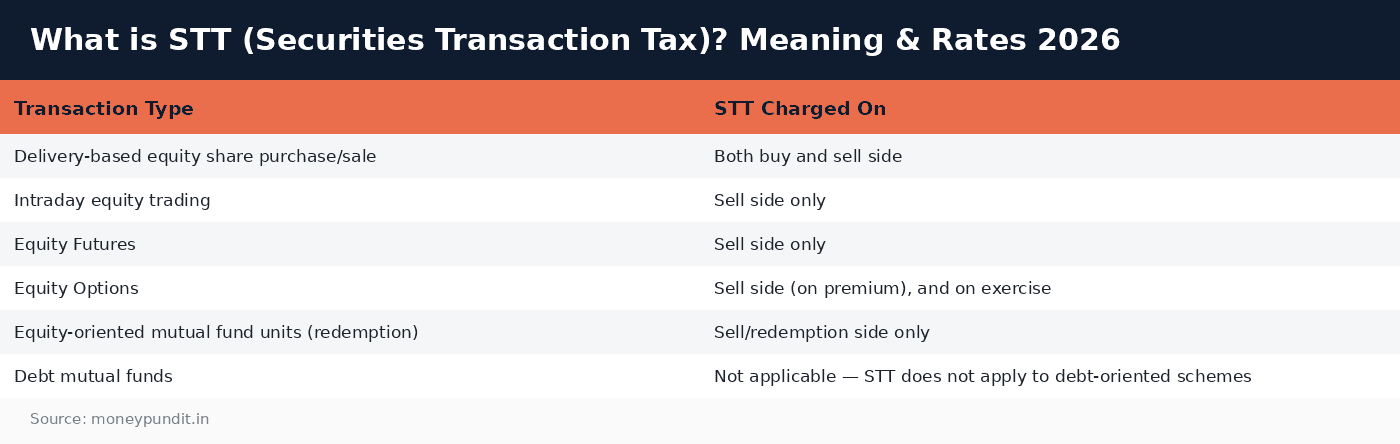
STT applies to a range of securities transactions, but the rate and the side of the transaction it’s charged on (buy, sell, or both) varies depending on the type of instrument and settlement method.
Where STT Applies
| Transaction Type | STT Charged On |
|---|---|
| Delivery-based equity share purchase/sale | Both buy and sell side |
| Intraday equity trading | Sell side only |
| Equity Futures | Sell side only |
| Equity Options | Sell side (on premium), and on exercise |
| Equity-oriented mutual fund units (redemption) | Sell/redemption side only |
| Debt mutual funds | Not applicable: STT does not apply to debt-oriented schemes |
Because STT rates are revised periodically by the government through Finance Act amendments, always check the Income Tax Department’s official STT rate schedule for the current applicable rates rather than relying on a fixed percentage, since these have changed multiple times since 2004.
How STT Affects Mutual Fund Investors
For mutual fund investors specifically, STT is charged only on the redemption of equity-oriented scheme units: it does not apply when you purchase mutual fund units, and it does not apply to debt funds, gold funds, or international funds at all. The tax is deducted automatically by the fund house at the time of redemption and reflected in your final payout, so you never need to calculate or remit it yourself.
This is a small but real drag on returns that’s separate from the fund’s expense ratio and any capital gains tax you owe: it’s charged regardless of whether your investment made a profit or a loss.
STT vs Brokerage vs Expense Ratio: Don’t Confuse the Three
Investors often lump STT together with brokerage fees and mutual fund expense ratios, but these are three separate costs with different purposes:
- STT: a government tax on the transaction itself, charged as a small percentage of the trade value on specific legs of the transaction (buy, sell, or both depending on instrument type).
- Brokerage: the fee your stockbroker or platform charges for executing the trade, which varies by broker and plan (many discount brokers now charge zero or flat-fee brokerage on equity delivery trades).
- Expense Ratio: an ongoing annual fee charged by the mutual fund’s AMC for managing the scheme, deducted daily from the fund’s NAV rather than charged per transaction.
Only STT is a government tax; brokerage and expense ratio are commercial fees charged by your broker and the fund house respectively. All three reduce your net returns, but they apply differently, STT and brokerage are transaction-based, while the expense ratio is a continuous holding cost.
STT and Capital Gains Tax: The Section 111A Connection
One important reason STT matters beyond its small direct cost: under Section 111A of the Income Tax Act, equity transactions on which STT has been paid qualify for the concessional short-term capital gains (STCG) tax rate, rather than being taxed at your regular income slab rate. This is one of the reasons equity and equity mutual funds carry a tax advantage over many other asset classes for shorter holding periods, but that advantage is conditional on STT having actually been paid on the transaction, which is automatic for all standard exchange-traded and mutual fund transactions in India.
Official Resources
For the current STT rate schedule and legal framework, refer to the Income Tax Department of India and SEBI’s official circulars on securities transaction taxation.
Related Guides & Tools
- Mutual Fund Taxation in India: Complete STCG, LTCG & Dividend Tax Guide
- Mutual Fund Expense Ratio: How It Affects Your Returns
- What is XIRR in Mutual Funds?
- How to Invest in the Stock Market: Beginner’s Guide
Frequently Asked Questions
Do I pay STT when I buy mutual fund units?
No. STT on equity-oriented mutual funds is charged only at the time of redemption (selling your units), not when you purchase them.
Does STT apply to debt mutual funds?
No, STT does not apply to debt-oriented mutual fund schemes, gold funds, or international funds, it applies only to equity and equity-oriented instruments.
Is STT the same as capital gains tax?
No. STT is a transaction tax charged on the value of the trade regardless of profit or loss, while capital gains tax is charged only on the profit you make, calculated separately at the time of income tax filing.
Who collects and pays STT to the government?
Your stockbroker or the mutual fund house collects STT automatically at the time of the transaction and deposits it with the government, you don’t need to calculate or pay it separately.
Why does STT matter for my tax return even though it’s automatically deducted?
STT paid on a transaction is what qualifies equity investments for concessional short-term capital gains tax treatment under Section 111A, so it indirectly affects how much capital gains tax you owe, even though the STT amount itself doesn’t need separate reporting.
Securities transaction tax: Key Takeaways
Key points on securities transaction tax:
- STT applies to a range of securities transactions, but the rate and the side of the transaction it’s charged on (buy, sell, or both) varies depending on the type of instrument and settlement method.
- The tax is deducted automatically by the fund house at the time of redemption and reflected in your final payout, so you never need to calculate or remit it yourself.
- Investors often lump STT together with brokerage fees and mutual fund expense ratios, but these are three separate costs with different purposes:
Verify the latest securities transaction tax figures with Income Tax Department before you act.