

How to start investing mutual funds in brief: Short-term goal like vacation (2-3 years): short-duration debt fund.
The actual mechanics of starting to invest in mutual funds, KYC, choosing a platform, setting up a SIP, take less than a day once you know the sequence, yet the process intimidates enough people that they delay starting for years. Here’s the complete step-by-step walkthrough.
Investing in mutual funds is one of the best financial decisions you can make, but getting started can feel intimidating. This step-by-step guide walks you through the entire process, from completing KYC to choosing your first fund and setting up your first SIP. By the end, you’ll be a confident mutual fund investor.
Step 1: Complete Your KYC
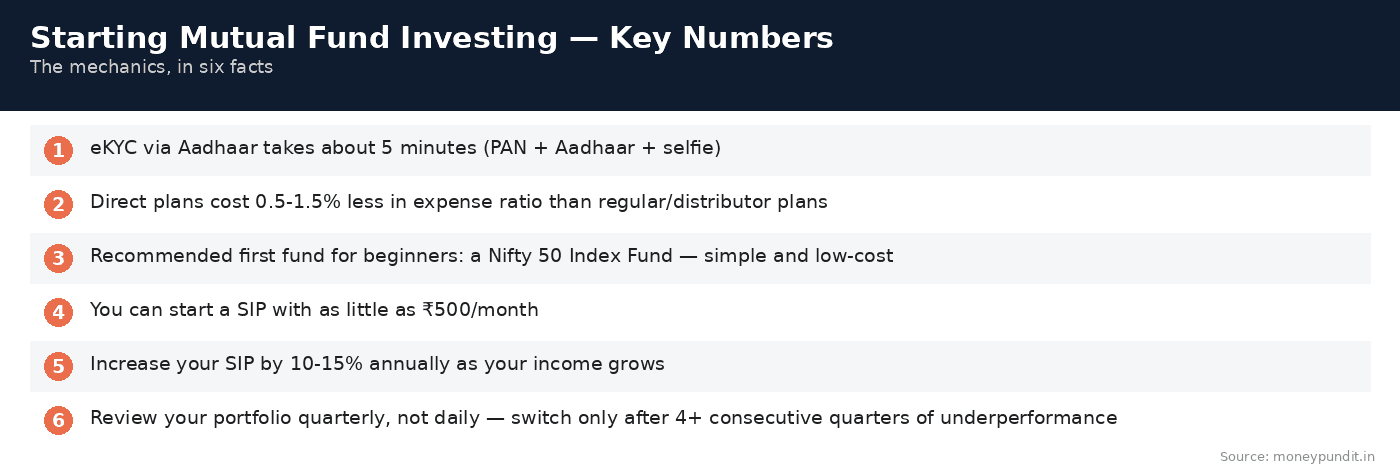
KYC (Know Your Customer) is a one-time verification process mandated by SEBI. You need it before investing in any mutual fund. The easiest way is eKYC using Aadhaar. It takes just 5 minutes through platforms like Groww, Kuvera, or KFintech. You’ll need your PAN card, Aadhaar number, and a selfie for video verification. Once done, your KYC is valid across all AMCs.
Step 2: Choose Your Investment Platform
You have three main options: direct through AMC websites (cheapest but need separate accounts for each AMC), through investment platforms like Groww, Kuvera, or Zerodha Coin (free, aggregated, convenient), or through distributors/banks (regular plans with 0.5-1.5% higher expense ratios). We recommend direct plan platforms for the best combination of convenience and cost efficiency.
Step 3: Decide Your Investment Goal and Amount
Start by answering: what am I investing for and when do I need the money? Emergency fund (1-2 years): liquid/ultra-short fund. Short-term goal like vacation (2-3 years): short-duration debt fund. Medium-term like car (3-5 years): balanced advantage fund. Long-term like retirement (7+ years): equity mutual fund via SIP.
Step 4: Select Your First Fund
For absolute beginners, start with ONE fund. Our recommendation for a first fund: Nifty 50 Index Fund (any major AMC). It gives you diversified exposure to India’s top 50 companies at the lowest possible cost. Once comfortable, add a flexi-cap or mid-cap fund. Don’t overthink fund selection, starting is more important than perfection.
Step 5: Set Up Your SIP
Choose a monthly amount you can sustain for at least 3-5 years. Even ₹500/month is a great start. Set up auto-debit from your bank account on a date after your salary credit. The best SIP date is any date. Don’t believe myths about specific dates performing better. What matters is consistency, not timing.
Step 6: Monitor and Grow
Check your portfolio quarterly, not daily. Annual review: is the fund beating its benchmark? If not for 4+ consecutive quarters, consider switching. Increase your SIP by 10-15% annually as your income grows. Don’t stop SIP during market falls, that’s when you’re buying units at a discount. Stay invested for the long term.
Common Beginner Mistakes to Avoid
Don’t invest based on past 1-year returns (look at 5-7 year consistency). Don’t buy regular plans when direct is available. Don’t invest in too many funds (3-5 is enough). Don’t stop SIP during market crashes. Don’t check NAV daily. Don’t invest without an emergency fund. Don’t mix insurance and investment (avoid ULIPs, endowment plans).
Is it safe to invest through apps like Groww and Kuvera?
Yes, completely safe. These platforms are SEBI-registered intermediaries. Your money goes directly to the AMC, not to the platform. Even if the platform shuts down, your investments remain safe with the AMC and custodian. You can always access them through the AMC directly or through CAMS/KFintech statements.
What documents do I need to start investing?
Just three things: PAN card (mandatory for investments above ₹50,000), Aadhaar (for eKYC), and a bank account with net banking or UPI. The entire setup process takes 10-15 minutes online. No need to visit any office or submit physical documents.
Common Mutual Fund Myths That Hold Beginners Back
Myth 1: “You need a lot of money to start.” Reality: SIPs start at just ₹100-500/month. Myth 2: “Mutual funds are as risky as stocks.” Reality: diversified equity funds spread risk across 40-60 stocks. Individual stock risk is dramatically lower. Debt mutual funds carry minimal market risk. Myth 3: “Higher NAV means a fund is expensive.” Reality: NAV reflects total growth since inception, a fund with ₹500 NAV isn’t more expensive than one at ₹50; what matters is the future return percentage, not the unit price.
Myth 4: “I should exit when markets fall.” This is the costliest mistake. Market corrections are when SIPs work hardest, buying more units at lower prices. Investors who continued SIPs through the 2020 crash saw 40-70% returns within 18 months. Myth 5: “I need to monitor daily.” Quarterly or semi-annual reviews are sufficient for long-term investors. Use our SIP Calculator to see how staying invested through volatility compounds your wealth over time.
Your First 90 Days of Mutual Fund Investing
Week 1: Complete KYC (online via myCAMS or KFintech: takes 10 minutes with Aadhaar and PAN). Week 2: Open accounts on a direct plan platform (Kuvera, MF Utilities, or AMC websites). Week 3: Start your first SIP, ₹5,000 in a Nifty 50 index fund (lowest cost, instant diversification across India’s top 50 companies). Month 2: Add a second SIP, ₹3,000 in a flexi-cap fund for broader market exposure including mid and small caps.
Month 3: Review your allocation and add a third fund if budget allows, either a mid-cap fund for growth or a hybrid balanced fund for stability. Set up auto-debit for all SIPs. Then, importantly: forget about them for at least a year. Resist checking NAV daily. Your first annual review: compare each fund against its benchmark, check expense ratios, and consider increasing SIP amounts. For tax-saving needs, add an ELSS fund to your portfolio. The goal is to build a simple, well-chosen portfolio of 3-5 funds: not to collect 15 funds that all hold the same stocks.
The hardest part of mutual fund investing isn’t any single step in this process, it’s actually starting. Complete your KYC today, even if you’re not ready to invest a large amount yet, and the rest becomes far easier to act on.
References: Amfiindia.com
Source: amfiindia.com
How to start investing mutual funds: Key Takeaways
Key points on how to start investing mutual funds:
- KYC (Know Your Customer) is a one-time verification process mandated by SEBI.
- Start by answering: what am I investing for and when do I need the money?
- Don’t overthink fund selection, starting is more important than perfection.
Verify the latest how to start investing mutual funds figures with AMFI before you act.