

XIRR (Extended Internal Rate of Return) is the single most accurate way to measure how your mutual fund investments have actually performed, especially if you invest through a SIP rather than a one-time lump sum. Unlike simple return percentages, XIRR accounts for the exact date and amount of every cash flow in and out of your investment, giving you a true annualized return figure you can compare across funds, asset classes, and even fixed deposits.
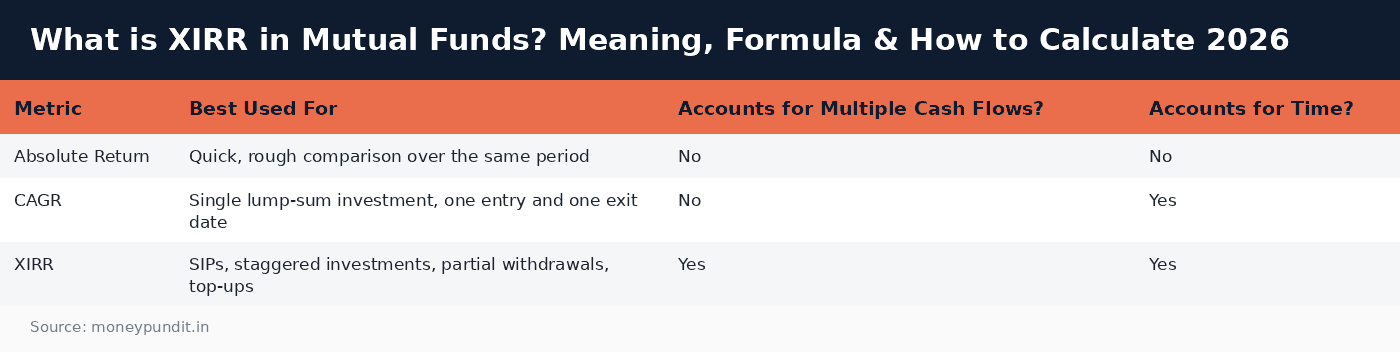
What is XIRR in Mutual Funds?
XIRR stands for Extended Internal Rate of Return. It is an annualized rate of return calculation used when money moves in or out of an investment at multiple, irregular dates. Exactly what happens with a SIP, where you invest a fixed amount every month, or with any portfolio where you’ve made top-up investments or partial withdrawals along the way.
A regular return calculation assumes a single investment made on one date and withdrawn on another. But a SIP investor puts in 12, 24, or 60 separate installments, each of which has spent a different amount of time in the market. XIRR solves this by treating every individual cash flow, each SIP installment, any lump sum top-up, and the final withdrawal, as a separate transaction on its own date, then calculates the single annualized rate that makes the present value of all these cash flows equal to zero.
Why XIRR Matters More Than Absolute Returns
Most mutual fund platforms show two very different numbers, and confusing them leads to a distorted picture of how your money has grown:
- Absolute Return: simply (Current Value − Total Invested) ÷ Total Invested, expressed as a percentage. It ignores how long your money was invested, so a 40% absolute return over 5 years looks the same as a 40% absolute return over 1 year, even though the second is a far better outcome.
- XIRR: annualizes the return while accounting for exactly when each rupee was invested, so it can be fairly compared to fixed deposit rates, other mutual funds, or any other annualized benchmark.
For a SIP specifically, XIRR is the only metric that fairly reflects performance, because your earliest installments have compounded for years while your most recent ones have barely started growing.
XIRR vs CAGR vs Absolute Return
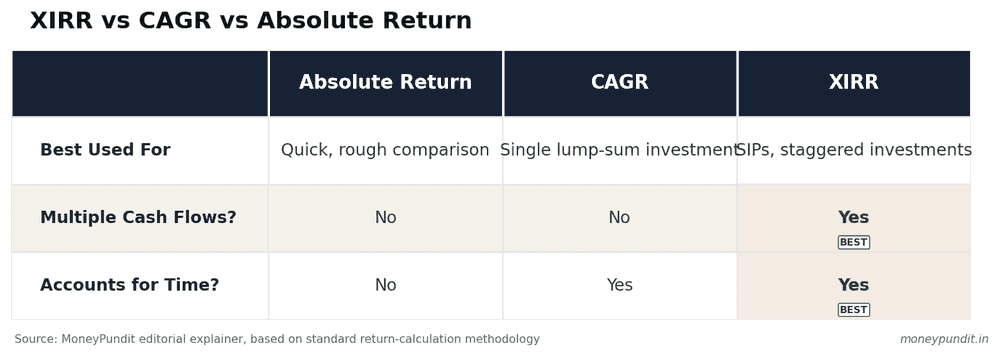
| Metric | Best Used For | Accounts for Multiple Cash Flows? | Accounts for Time? |
|---|---|---|---|
| Absolute Return | Quick, rough comparison over the same period | No | No |
| CAGR | Single lump-sum investment, one entry and one exit date | No | Yes |
| XIRR | SIPs, staggered investments, partial withdrawals, top-ups | Yes | Yes |
Use our Mutual Fund Returns Calculator for a lump-sum CAGR figure, and rely on XIRR whenever your investment involved more than one transaction date, which is true for almost every SIP investor in India.
How to Calculate XIRR
You rarely need to calculate XIRR by hand: every major platform (Groww, Zerodha Coin, Kuvera, CAMS/KFintech consolidated account statements) displays it automatically for your portfolio. But understanding the method helps you sanity-check the number:
- List every cash flow with its exact date. Each SIP installment is a negative cash flow (money going out of your pocket); the current portfolio value is a positive cash flow (money you’d receive if you redeemed today).
- Use the XIRR function in Excel or Google Sheets. The formula is
=XIRR(values, dates, [guess]): where “values” is the range of cash flows (negative for investments, positive for the final value) and “dates” is the corresponding range of transaction dates. - The spreadsheet solves iteratively. XIRR doesn’t have a simple algebraic formula: it uses an iterative method (similar to Newton-Raphson) to find the discount rate that makes the net present value of all cash flows equal zero.
- Read the result as an annualized percentage. An XIRR of 13.5% means your money grew at an effective annual rate of 13.5%, accounting for the exact timing of every installment.
What is a Good XIRR for Mutual Funds?
“Good” depends entirely on the asset category, but as a broad reference point based on long-term historical Indian market performance:
- Equity mutual funds (SIP, 7+ years): An XIRR of 12–15% is considered healthy, in line with long-term Nifty/Sensex compounding.
- Hybrid/balanced funds: 9–12% XIRR is typical, reflecting the mix of equity and debt.
- Debt funds: 6–8% XIRR is a reasonable range, closer to fixed-income instruments.
Short-term XIRR figures (under 2–3 years) can swing wildly due to market volatility and shouldn’t be used to judge whether a fund or strategy is working. Annualized return calculations need time to smooth out short-term noise.
Official Resources
For authoritative background on mutual fund return calculation standards, refer to AMFI’s official investor resources and SEBI’s mutual fund disclosure norms, which govern how asset management companies report scheme performance.
Related Guides & Tools
- SIP Calculator
- Mutual Fund Returns Calculator
- SIP vs Lumpsum Investment: Which Strategy Is Better?
- Mutual Fund Expense Ratio: How It Affects Your Returns
Frequently Asked Questions
Is XIRR the same as annual return?
XIRR is a type of annualized return, but unlike a simple annual return figure, it accounts for the exact date and amount of every individual cash flow, making it far more accurate for SIPs and any investment with multiple transaction dates.
Why is my XIRR different from the fund’s advertised CAGR?
A fund’s advertised CAGR typically reflects a lump-sum investment held for the full period. Your personal XIRR reflects your actual SIP installments, top-ups, and withdrawal dates, so it will almost always differ from the scheme’s published CAGR.
Can XIRR be negative?
Yes. If your portfolio’s current value is lower than what you invested, or if markets have fallen significantly during your investment period, XIRR will show a negative annualized return.
Do I need Excel to calculate XIRR myself?
No: Groww, Zerodha Coin, Kuvera, and CAMS/KFintech consolidated account statements all calculate and display XIRR automatically for your mutual fund portfolio. Manual calculation via Excel’s XIRR function is only useful if you want to verify the number independently.
What XIRR should I expect from an equity SIP over 10 years?
Based on long-term historical Nifty/Sensex performance, a well-diversified equity mutual fund SIP has typically delivered an XIRR in the 12–15% range over 10-year periods, though actual results depend on market conditions, fund selection, and the specific time window measured.