

Amc asset management company in brief: An AMC (Asset Management Company) is the entity legally responsible for managing a mutual fund’s investment portfolio.
An AMC (Asset Management Company) is the entity legally responsible for managing a mutual fund’s investment portfolio. Deciding which stocks, bonds, or other securities to buy and sell on behalf of investors. Every mutual fund scheme you invest in, whether it’s SBI Mutual Fund, HDFC Mutual Fund, or any other fund house, is actually managed by a registered AMC operating under strict SEBI oversight.
What is an AMC (Asset Management Company)?
An AMC is a SEBI-registered company that pools money from investors through mutual fund schemes and invests it in securities according to each scheme’s stated investment objective. The AMC employs professional fund managers, researchers, and analysts who make the actual buy/sell decisions within the scheme’s mandate, whether that’s a large-cap equity fund, a debt fund, or a hybrid fund.
When you see a mutual fund brand name like “Axis Mutual Fund” or “Kotak Mutual Fund,” that brand represents the AMC, the company actually running the show behind every scheme sold under that name.
How the Mutual Fund Structure Works: Sponsor, Trust, AMC, and Trustee
Indian mutual funds operate under a specific legal structure defined by SEBI (Mutual Funds) Regulations:
- Sponsor: the company or financial institution that establishes the mutual fund (often a bank or NBFC, like SBI or HDFC).
- Trust: the sponsor creates a Trust, which legally owns the mutual fund’s assets on behalf of investors (unit-holders).
- Trustees: appointed to oversee the Trust and ensure the AMC operates in the interest of investors, acting as an independent check.
- AMC (Asset Management Company): appointed by the Trust to manage the actual investment portfolios of each scheme, handle day-to-day fund operations, and launch new schemes (subject to SEBI approval).
This layered structure exists specifically to separate ownership (the Trust) from management (the AMC), with Trustees providing oversight, a safeguard designed to protect investor interests even though the AMC controls day-to-day investment decisions.
What Does an AMC Actually Do?
- Fund management: employs fund managers who make investment decisions for each scheme based on its stated objective and risk profile.
- Scheme launches: designs and files new mutual fund schemes with SEBI for approval before they’re offered to investors.
- Investor servicing: typically outsourced to a Registrar and Transfer Agent (RTA) like CAMS or KFintech, which handles folio records, statements, and redemptions on the AMC’s behalf.
- Compliance and disclosure: publishes daily NAV, monthly portfolio holdings, and periodic expense ratio disclosures as mandated by SEBI.
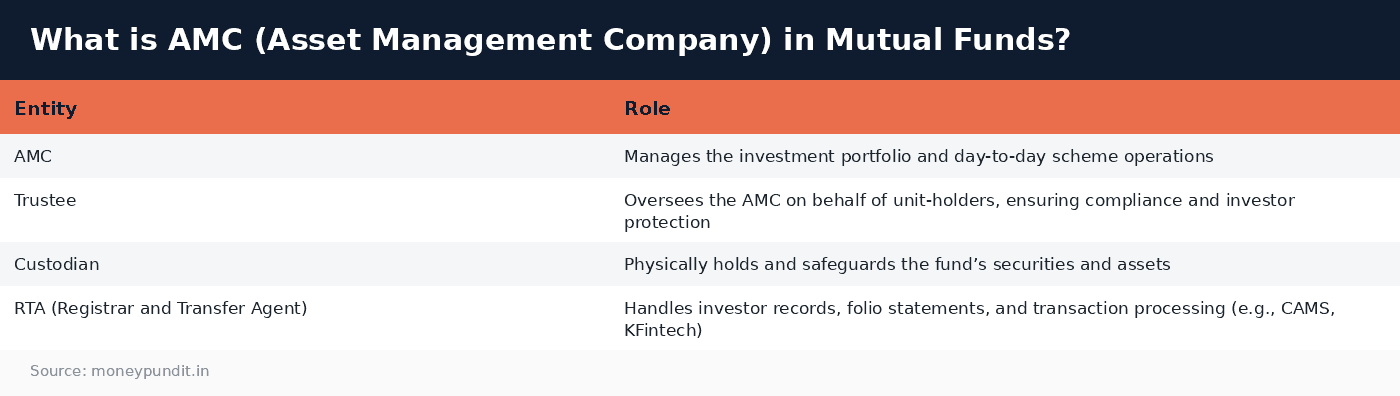
AMC vs Trustee vs Custodian vs RTA: Who Does What
| Entity | Role |
|---|---|
| AMC | Manages the investment portfolio and day-to-day scheme operations |
| Trustee | Oversees the AMC on behalf of unit-holders, ensuring compliance and investor protection |
| Custodian | Physically holds and safeguards the fund’s securities and assets |
| RTA (Registrar and Transfer Agent) | Handles investor records, folio statements, and transaction processing (e.g., CAMS, KFintech) |
Understanding this structure helps explain why mutual funds are considered relatively well-regulated: no single entity has unchecked control, and SEBI mandates independent oversight at multiple levels.
How AMCs Earn Revenue
AMCs earn revenue through the expense ratio charged to investors: a small annual percentage of the fund’s assets under management (AUM), deducted daily from the scheme’s NAV. This fee compensates the AMC for fund management, research, operations, and (for regular plans) distributor commissions. Larger AMCs with more AUM generally benefit from economies of scale, which is one reason expense ratios tend to be lower for larger, more established schemes. See our guide on mutual fund expense ratios for how this fee structure affects your actual returns.
Official Resources
For the official list of SEBI-registered AMCs and mutual fund regulations, refer to SEBI’s official website and AMFI’s (Association of Mutual Funds in India) investor resources.
Related Guides & Tools
- Mutual Fund Expense Ratio: How It Affects Your Returns
- Direct vs Regular Mutual Fund: Which Plan is Better?
- What is XIRR in Mutual Funds?
- SIP Calculator
Frequently Asked Questions
Is an AMC the same as a mutual fund?
Not exactly. The AMC is the company that manages the mutual fund’s investment portfolio, while the “mutual fund” itself is legally structured as a Trust that owns the assets on behalf of investors. In everyday use, people refer to the AMC’s brand name (like “HDFC Mutual Fund”) as if it were the fund itself.
How do I know if an AMC is legitimate and SEBI-registered?
You can verify any AMC’s registration status on SEBI’s official website or through AMFI’s list of registered asset management companies, every legitimate mutual fund AMC operating in India must be registered with SEBI.
Can an AMC lose or misuse investor money?
The multi-layered structure of Sponsor, Trust, Trustee, and Custodian is specifically designed to prevent this, the AMC cannot directly access or misuse investor assets, since the Custodian holds the securities and the Trustee provides independent oversight. However, market-related investment risk (the fund losing value due to market movements) is separate from operational misuse and cannot be eliminated by this structure.
Do different schemes from the same AMC have different fund managers?
Yes, typically. A single AMC manages multiple schemes (equity, debt, hybrid, etc.), and different fund managers or teams within the AMC are usually responsible for different schemes based on their specialization.
What happens to my investment if an AMC shuts down or merges?
If an AMC exits the business, SEBI regulations require an orderly transition, either the scheme is transferred to another AMC with unit-holder and SEBI approval, or investors are given the option to redeem their units, since the underlying assets are held by the Trust and Custodian, not directly by the AMC.
Amc asset management company: Key Takeaways
Key points on amc asset management company:
- An AMC is a SEBI-registered company that pools money from investors through mutual fund schemes and invests it in securities according to each scheme’s stated investment objective.
- Indian mutual funds operate under a specific legal structure defined by SEBI (Mutual Funds) Regulations:
- Understanding this structure helps explain why mutual funds are considered relatively well-regulated: no single entity has unchecked control, and SEBI mandates independent oversight at multiple levels.
Verify the latest amc asset management company figures with AMFI before you act.