

Epf employee provident fund in brief: The Employee Provident Fund (EPF) is a retirement savings scheme managed by the Employees’ Provident Fund Organisation (EPFO) for salaried workers in India.
Your EPF balance earns a government-declared interest rate that’s currently well above most bank FDs, tax-free on both interest and withdrawal after 5 years of continuous service, yet a surprising number of employees never check their balance or understand the withdrawal rules until they actually need the money. Here’s the complete EPF reference.
To check today’s EPF rate alongside other small savings schemes, see our live interest rate tracker: it covers PPF, KVP, NSC, SCSS, and SBI FD rates too, updated daily.
The Employee Provident Fund (EPF) is a retirement savings scheme managed by the Employees’ Provident Fund Organisation (EPFO) for salaried workers in India. With over 28 crore active and inactive accounts and a corpus exceeding ₹18 lakh crore, EPF is the largest social security programme in the country. Understanding EPF rules helps you maximise this valuable benefit and avoid common mistakes that reduce your retirement corpus.
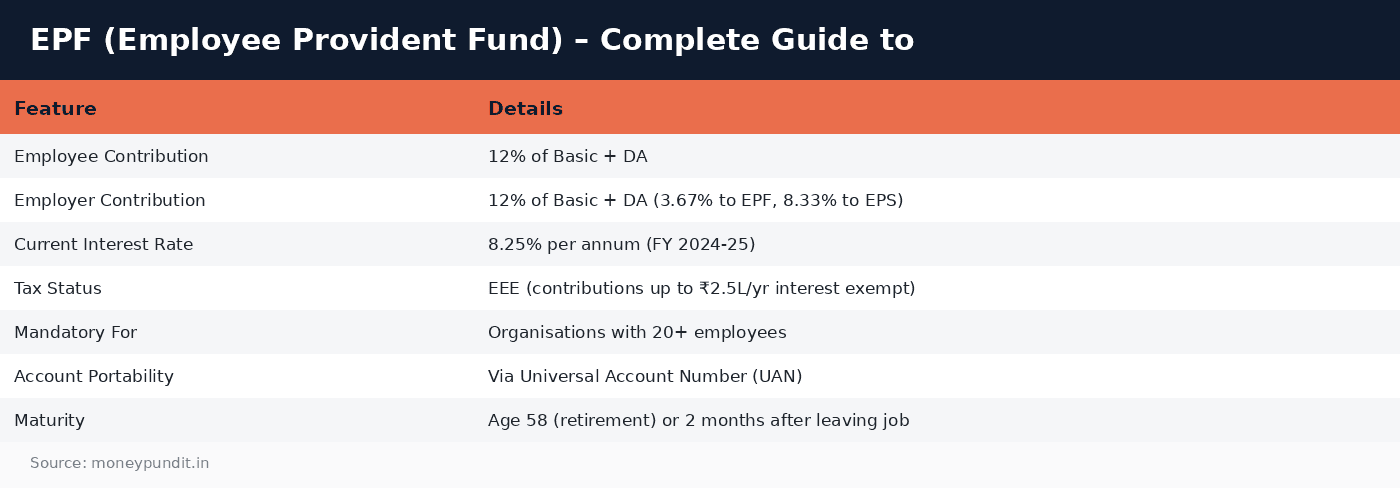
EPF Key Details
| Feature | Details |
|---|---|
| Employee Contribution | 12% of Basic + DA |
| Employer Contribution | 12% of Basic + DA (3.67% to EPF, 8.33% to EPS) |
| Current Interest Rate | 8.25% per annum (FY 2024-25) |
| Tax Status | EEE (contributions up to ₹2.5L/yr interest exempt) |
| Mandatory For | Organisations with 20+ employees |
| Account Portability | Via Universal Account Number (UAN) |
| Maturity | Age 58 (retirement) or 2 months after leaving job |
How EPF Contribution Works
Your employer deducts 12% of your basic salary plus dearness allowance (DA) as your EPF contribution. The employer also contributes 12%, but this is split: 3.67% goes to your EPF account, and 8.33% goes to the Employee Pension Scheme (EPS). On a basic salary of ₹30,000, your monthly EPF contribution is ₹3,600 and your employer adds ₹3,600, but only ₹1,101 goes to EPF and ₹2,499 goes to EPS. Your total monthly EPF accumulation is ₹3,600 + ₹1,101 = ₹4,701.
The 8.25% interest is calculated monthly on the running balance but credited at the end of the financial year. This means the interest itself does not compound monthly, only the contributions add monthly. However, over long periods, the annual compounding at 8.25% produces excellent results compared to other guaranteed-return instruments.
EPF Tax Rules
Contribution Phase
Your EPF contribution (12% of basic) qualifies for Section 80C deduction up to the ₹1.5 lakh limit. The employer’s contribution up to 12% of basic is exempt from tax in your hands (not counted as income). Since EPF is just one piece of your ₹1.5 lakh Section 80C limit, our Section 80C Deductions guide covers the other eligible investments worth combining with it.
Interest Phase
Interest earned on EPF contributions up to ₹2.5 lakh per year is completely tax-free. If your annual EPF contribution exceeds ₹2.5 lakh (basic salary above ₹2.08 lakh per month), the interest on the excess amount is taxable at your slab rate. This rule was introduced from FY 2021-22 to limit tax benefits for high-salary employees.
Withdrawal Phase
EPF withdrawal after 5 years of continuous service is completely tax-free. If withdrawn before 5 years (except in cases of illness, company closure, or transfer to NPS), the withdrawal is taxable. Your employer’s contribution and interest are added to your income for that year, and TDS of 10% is deducted if the amount exceeds ₹50,000.
EPF Withdrawal Rules
Full Withdrawal
You can withdraw the entire EPF balance in these scenarios: upon retirement at age 58, if unemployed for 2 consecutive months after leaving a job, or for women on permanent resignation for marriage (subject to conditions). Full withdrawal requires submitting Form 19 (EPF withdrawal) and Form 10C (EPS withdrawal) through your employer or online via the EPFO portal.
Partial Withdrawal (Advance)
| Purpose | Amount Allowed | Service Requirement |
|---|---|---|
| Medical emergency | 6 months basic or total employee share (lower) | No minimum |
| Marriage (self/children/siblings) | 50% of employee share | 7 years |
| Education (children’s higher ed) | 50% of employee share | 7 years |
| Home purchase/construction | Up to 36 months’ basic + DA | 5 years |
| Home loan repayment | 36 months’ basic + DA | 10 years |
| Home renovation | 12 months’ basic salary | 5 years |
| 1 year before retirement | 90% of total balance | 54 years of age |
How to Check EPF Balance
There are multiple ways to check your EPF balance. The EPFO Member Portal (member.epfindia.gov.in) shows your complete passbook with monthly contributions and interest. The UMANG app provides mobile access with the same details. You can also send an SMS “EPFOHO UAN” to 7738299899 from your registered mobile, or give a missed call to 011-22901406. For detailed year-wise breakdowns, the online passbook is the most comprehensive option.
EPF Transfer When Changing Jobs
When you change jobs, your EPF account should be transferred to your new employer’s EPF account using your UAN (Universal Account Number). This can be done online through the EPFO portal or UMANG app by submitting Form 13. The transfer typically takes 10-20 days for online claims. Never withdraw your EPF when changing jobs, the tax-free compounding at 8.25% is too valuable to interrupt. A ₹5 lakh EPF balance at age 30 left untouched would grow to approximately ₹48 lakh by age 58 just from interest alone.
Employee Pension Scheme (EPS)
EPS is a pension scheme funded by 8.33% of your employer’s contribution. The maximum pensionable salary for EPS calculation is capped at ₹25,000 per month (raised from ₹15,000 effective 17 September 2026). At retirement (age 58), you receive a monthly pension calculated as: (Pensionable Salary × Years of Service) / 70. For someone with 30 years of service and ₹25,000 pensionable salary, the monthly pension is approximately ₹10,714. You need a minimum of 10 years of service to qualify for pension.
VPF – Voluntary Provident Fund
If you want to contribute more than the mandatory 12%, you can opt for VPF (Voluntary Provident Fund) up to 100% of your basic salary. VPF earns the same 8.25% interest as EPF and enjoys the same EEE tax treatment (subject to the ₹2.5 lakh annual contribution limit for tax-free interest). VPF is an excellent option for conservative investors who want guaranteed, tax-efficient returns above the EPF limit.
Frequently Asked Questions
Can I opt out of EPF?
Employees earning a basic salary above ₹15,000 per month can opt out of EPF at the time of joining a new organisation. However, once enrolled, you cannot opt out during your employment with that organisation. Given the 8.25% guaranteed return with EEE tax status, opting out is generally not advisable unless you have a very high salary and prefer full control over your retirement investments.
What happens to my EPF if my company shuts down?
Your EPF balance is safe regardless of your company’s status. EPF is managed by EPFO (a government body), not your employer. Your employer only acts as a collection agent. Even if the company closes, your EPF balance continues to earn interest and can be withdrawn or transferred using your UAN. The only risk is if your employer was not depositing your contributions. You can verify this through your EPF passbook.
Should I withdraw EPF to invest in mutual funds?
Generally, no. EPF offers 8.25% guaranteed returns with zero risk and full tax exemption. A combination no mutual fund can match. While equity funds may offer higher returns, they come with market risk. The guaranteed nature of EPF makes it an ideal debt component of your retirement portfolio. Instead of withdrawing EPF, invest additional savings in equity mutual funds for the growth component.
How is EPF interest rate decided?
The EPFO Central Board of Trustees recommends the interest rate annually, which is then approved by the Ministry of Finance. The rate is influenced by EPFO’s investment returns (primarily from government securities and bonds), fiscal considerations, and economic conditions. Over the past decade, the EPF rate has ranged from 8.10% to 8.65%, providing relatively stable returns compared to market-linked instruments.
References: Amfiindia.com
EPF employee provident fund: Key Takeaways
Key points on epf employee provident fund:
- Your employer deducts 12% of your basic salary plus dearness allowance (DA) as your EPF contribution.
- Your EPF contribution (12% of basic) qualifies for Section 80C deduction up to the ₹1.5 lakh limit.
- Full withdrawal requires submitting Form 19 (EPF withdrawal) and Form 10C (EPS withdrawal) through your employer or online via the EPFO portal.
Verify the latest epf employee provident fund figures with AMFI before you act.