

How to open demat account in brief: With over 15 crore Demat accounts in India as of 2026 and the entire process now fully digital, opening one takes less than 15 minutes.
A demat account and a trading account sound interchangeable but do two different jobs, one holds your securities, the other executes your buy and sell orders, and every broker bundles both together during onboarding. Here’s the complete beginner walkthrough for opening one in India.
A Demat (dematerialised) account is essential for investing in stocks, ETFs, bonds, and mutual funds in India. Just as a bank account holds your money, a Demat account holds your securities in electronic form. With over 15 crore Demat accounts in India as of 2026 and the entire process now fully digital, opening one takes less than 15 minutes. This guide walks you through everything, from choosing a broker to placing your first trade.
What is a Demat Account?
Before 1996, shares in India were held as physical paper certificates, prone to theft, forgery, and damage. SEBI mandated dematerialisation, and today all securities are held electronically through two depositories: NSDL (National Securities Depository Limited) and CDSL (Central Depository Services Limited). Your Demat account is accessed through a Depository Participant (DP), which is typically your stockbroker.
Demat + Trading Account: What’s the Difference?
| Feature | Demat Account | Trading Account |
|---|---|---|
| Purpose | Holds securities (like a locker) | Enables buying/selling (like a transaction tool) |
| Analogy | Savings account (stores money) | Cheque book (enables transactions) |
| Mandatory For | Holding any securities | Trading on stock exchanges |
| Annual Charges | ₹0–₹750 | Usually included with Demat |
| Can Exist Independently | Yes | No (needs a linked Demat) |
Most brokers open both accounts together as a “2-in-1” account. Some also offer a “3-in-1” account that links your bank savings account for seamless fund transfers.
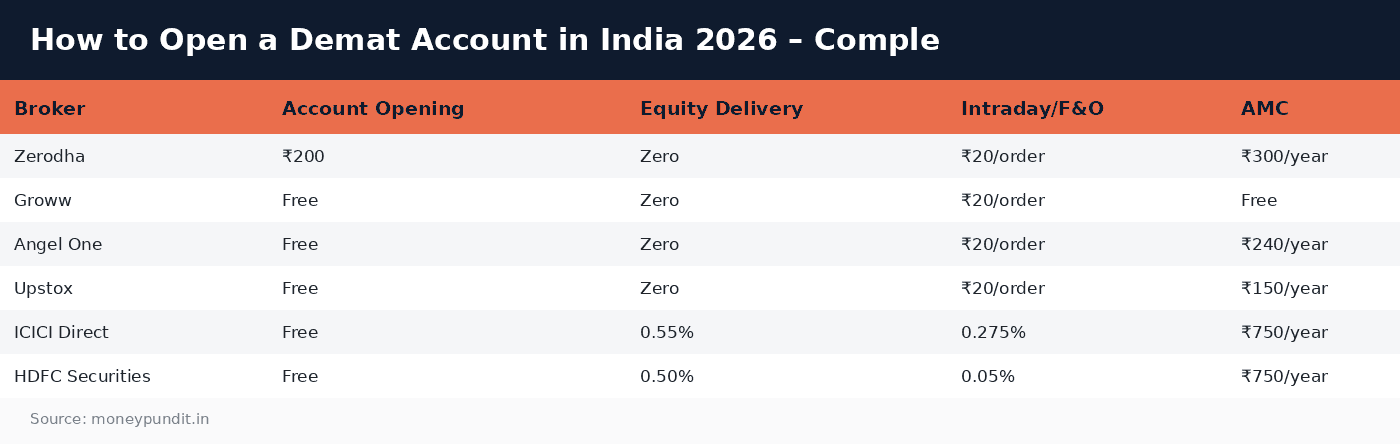
Top Discount Brokers in India 2026
| Broker | Account Opening | Equity Delivery | Intraday/F&O | AMC |
|---|---|---|---|---|
| Zerodha | ₹200 | Zero | ₹20/order | ₹300/year |
| Groww | Free | Zero | ₹20/order | Free |
| Angel One | Free | Zero | ₹20/order | ₹240/year |
| Upstox | Free | Zero | ₹20/order | ₹150/year |
| ICICI Direct | Free | 0.55% | 0.275% | ₹750/year |
| HDFC Securities | Free | 0.50% | 0.05% | ₹750/year |
Discount brokers (Zerodha, Groww, Angel One, Upstox) charge flat fees per trade, making them significantly cheaper for active traders. Full-service brokers (ICICI Direct, HDFC Securities) charge percentage-based fees but offer research, advisory, and branch support.
How to Open a Demat Account Online
Step 1: Choose a Broker
Select based on your investing style. Long-term investors who buy and hold can choose any discount broker with zero delivery charges. Active traders should compare intraday brokerage, platform features, and order execution speed. Beginners may prefer platforms with intuitive interfaces like Groww or Zerodha’s Kite.
Step 2: Complete KYC Online
You need: PAN card, Aadhaar card (linked to mobile for e-verification), bank account details (cancelled cheque or bank statement), and a selfie/photo. The entire process is completed through Aadhaar-based e-KYC with OTP verification, no physical documents need to be submitted. Most brokers complete account activation within 24-48 hours.
Step 3: Fund Your Account and Start Investing
Link your bank account through UPI or net banking. Transfer funds to your trading account, and you are ready to buy stocks, ETFs, or other securities. Most platforms also offer direct mutual fund investing through the same account.
Charges and Fees Explained
Brokerage
This is the fee charged per trade. Discount brokers charge ₹20 per executed order (regardless of size) or zero for delivery trades. Full-service brokers charge a percentage of the trade value (0.3-0.5% for delivery, 0.03-0.05% for intraday).
STT (Securities Transaction Tax)
A government tax on stock exchange transactions. For equity delivery, STT is 0.1% on both buy and sell sides. For intraday, it is 0.025% on the sell side only. STT is unavoidable regardless of which broker you use.
Other Charges
Exchange transaction charges (NSE: 0.00345%, BSE: 0.00375%), GST (18% on brokerage + exchange charges), SEBI turnover fees (0.0001%), stamp duty (varies by state), and DP charges (₹15-₹20 per sell transaction for transferring securities from your Demat account). While individually small, these charges add up for frequent traders.
Demat Account for Mutual Funds
While a Demat account is not mandatory for buying mutual funds (you can invest directly through AMC websites or platforms like MF Central), holding mutual fund units in Demat form offers some advantages. It provides a single consolidated view of all investments, makes switching between funds easier, and simplifies the nomination and transmission process. However, some direct plan mutual funds may not be available through all Demat-linked platforms.
Safety and Security
Your Demat account is protected by SEBI regulations. Securities held in your Demat account belong to you, not the broker. Even if your broker defaults or shuts down, your holdings are safe and can be transferred to another broker. CDSL and NSDL provide investor grievance mechanisms, and the Investor Protection Fund covers losses up to ₹25 lakh in case of broker default.
Frequently Asked Questions
Can I have multiple Demat accounts?
Yes, you can open Demat accounts with multiple brokers. There is no restriction on the number of accounts. However, maintaining multiple accounts means multiple AMCs, and some brokers charge annual maintenance fees. For most investors, one or two Demat accounts are sufficient.
What is the difference between NSDL and CDSL?
Both are SEBI-registered depositories that hold your securities. NSDL Demat accounts start with “IN” followed by 14 digits, while CDSL accounts are 16-digit numbers. Functionally, there is no difference for the investor. Your securities are equally safe with either depository. Your broker determines which depository is used.
Is there any risk in opening a Demat account?
Opening a Demat account itself carries no financial risk: it is simply a storage facility for securities. The risk lies in the investment decisions you make through the trading account. Ensure you invest only what you can afford to lose in stocks, especially if you are new to the market. Start with long-term investing in quality stocks or index funds before attempting short-term trading.
Can NRIs open a Demat account in India?
Yes, NRIs can open a Demat account in India. They need an NRE (Non-Resident External) or NRO (Non-Resident Ordinary) bank account linked to the Demat account. NRIs can invest in Indian stocks, mutual funds, and bonds through the Portfolio Investment Scheme (PIS) route. Some brokers specialise in NRI accounts and offer dedicated support for overseas Indians.
References: Amfiindia.com
How to open demat account: Key Takeaways
Key points on how to open demat account:
- Before 1996, shares in India were held as physical paper certificates, prone to theft, forgery, and damage.
- Most brokers open both accounts together as a “2-in-1” account.
- Discount brokers (Zerodha, Groww, Angel One, Upstox) charge flat fees per trade, making them significantly cheaper for active traders.
Verify the latest how to open demat account figures with SEBI before you act.