

Family floater vs individual health insurance in brief: If you buy a ₹10 lakh floater for a family of four, any one member (or combination of members) can make claims totaling up to ₹10 lakh in a policy year.
A family floater plan splits one sum insured across everyone on the policy, which is cheaper until one member has a major hospitalization and eats into the cover left for everyone else. Here’s how floater plans actually work, and when buying individual policies instead makes more sense.
Health insurance is the most important financial protection you can buy, arguably more important than life insurance for most working-age Indians. But when it comes to covering your family, a fundamental question arises: should you buy one family floater plan, or individual plans for each member? The wrong choice could leave you dangerously underinsured at the worst possible time.
How Family Floater Plans Work
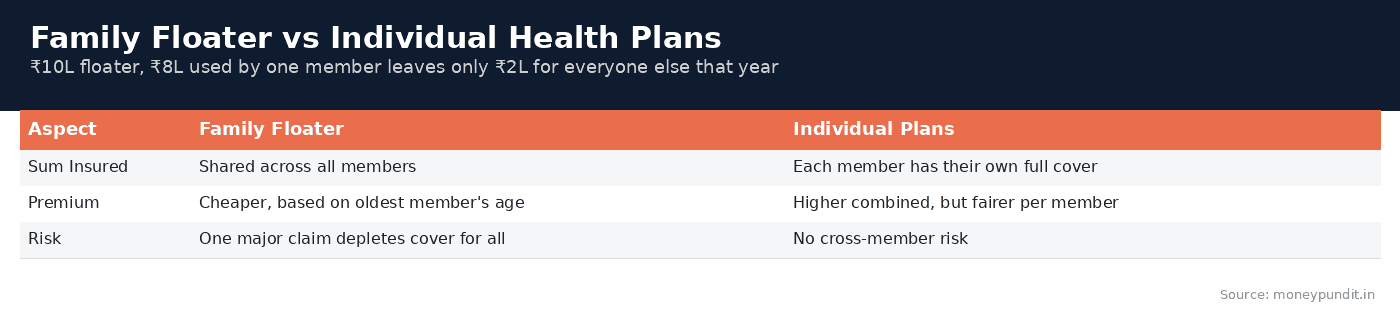
A family floater plan provides a single sum insured that all covered members share. If you buy a ₹10 lakh floater for a family of four, any one member (or combination of members) can make claims totaling up to ₹10 lakh in a policy year. Premiums are based on the age of the oldest member and are significantly cheaper than buying individual plans for everyone.
The Risk in Floater Plans
The catch: the sum insured is shared. If your parents are on your floater and your mother has a major surgery costing ₹8 lakh, only ₹2 lakh remains for the rest of the family for the year. In a bad year with multiple hospitalizations, you can exhaust the shared pool.
Floater plans also become very expensive once you include elderly parents, premium is calculated on the oldest member’s age, so adding a 60-year-old parent dramatically increases the annual premium.
Individual Plans: Higher Cost, Better Protection
Individual plans give each family member their own dedicated sum insured. A hospitalization by one member doesn’t reduce protection for others. For families where members have different health conditions or risk profiles, individual plans provide cleaner, more reliable coverage.
The Recommended Approach
For young nuclear families (spouses + young children): A family floater with a ₹10–20 lakh sum insured works well. Children’s claims are typically low, and you’re unlikely to exhaust the shared pool. More cost-effective than individual plans.
For families with senior parents: Keep parents on a separate senior citizen health plan: don’t add them to your family floater. Their presence inflates the premium for everyone. Buy them a dedicated senior citizen plan with adequate sum insured.
For the future: Always choose a plan with no room rent sub-limits, no co-payment clause, and a wide network of hospitals. Restore benefit (which restores the sum insured after a claim) is worth paying extra for. Consider a super top-up plan to increase your effective coverage without high base premiums.
Family Floater Vs Individual Health Insurance: How Family Floater Plans Work
A family floater health insurance policy covers the entire family, typically self, spouse, and up to 2-4 children, under a single shared sum insured. If you buy a ₹10 lakh family floater, any family member can use any portion of the ₹10 lakh for hospitalisation. The premium is calculated based on the oldest member’s age, making it significantly cheaper than buying separate individual policies for each family member. For a family of 4 with the eldest member aged 35, a ₹10 lakh floater costs approximately ₹15,000-20,000/year versus ₹40,000-50,000 for four individual ₹10 lakh policies.
The Hidden Risk of Family Floaters
The biggest drawback is the shared sum insured problem. If one family member has a major hospitalisation costing ₹7 lakh from your ₹10 lakh floater, only ₹3 lakh remains for the rest of the family for that policy year. In a worst-case scenario (two family members hospitalised in the same year), the floater may not cover the second claim adequately. Individual policies eliminate this risk, each person has their own dedicated sum insured regardless of others’ claims.
Another concern: if you add parents (especially those over 60) to a family floater, the premium increases dramatically because it’s based on the oldest member’s age. A ₹10 lakh floater covering self (35), spouse (32), and parents (62, 58) could cost ₹45,000-55,000/year, almost as much as separate policies but with the shared sum insured risk.
When to Choose a Family Floater
Family floaters are ideal when: all covered members are young (under 45) and relatively healthy, your family is small (2-4 members), you want to optimise premium costs, and you have a super top-up policy to cover any shortfall. For a young couple with 1-2 children, a ₹15-20 lakh family floater with a ₹50 lakh super top-up (costs just ₹3,000-5,000/year extra) provides excellent coverage at a fraction of individual policy costs.
When Individual Policies Make More Sense
Switch to individual policies when: any member has chronic conditions that could lead to frequent claims, you’re covering parents over 55-60 (their age inflates the entire floater premium), you want each member to have guaranteed coverage regardless of others’ claims, or your family has grown beyond 4-5 members. Many families use a hybrid approach: a floater for the couple + children, and separate individual policies for parents. This optimises both cost and coverage.
Tax Benefits of Health Insurance
Health insurance premiums qualify for deduction under Section 80D: up to ₹25,000 for self, spouse, and children (or ₹50,000 if you’re a senior citizen), plus up to ₹25,000 for parents (₹50,000 if parents are senior citizens). This means a family covering self + spouse + children + senior citizen parents can claim up to ₹1 lakh in 80D deductions. Whether you choose floater or individual, the combined premiums qualify. Use our income tax calculator to see how health insurance premiums reduce your overall tax liability alongside Section 80C investments.
How Much Health Insurance Cover Do You Need?
Medical inflation in India runs at 12-15% annually. A hospitalisation costing ₹5 lakh today will cost ₹20 lakh in 10 years and ₹80 lakh in 20 years. For a family in a metro city, a minimum base cover of ₹15-25 lakh with a ₹50 lakh-1 crore super top-up is recommended. The super top-up activates only after the base policy’s sum insured is exhausted, making it extremely cost-effective for catastrophic coverage.
References: Sebi.gov.in
Source: sebi.gov.in
Frequently Asked Questions
Is a family floater better than individual policies?
A floater is usually cheaper for young, healthy families because one sum insured is shared. Individual policies give each member a dedicated cover and suit families with older or high-risk members.
How much sum insured should a family floater have?
Common advice is at least ₹10 to 20 lakh in metros, adjusted for your city, family size and existing employer cover.
What is the downside of a family floater?
The sum insured can be exhausted by one member’s large claim, leaving less for others in the same year.
Family floater vs individual health insurance: Key Takeaways
Key points on family floater vs individual health insurance:
- A family floater plan provides a single sum insured that all covered members share.
- If your parents are on your floater and your mother has a major surgery costing ₹8 lakh, only ₹2 lakh remains for the rest of the family for the year.
- Individual plans give each family member their own dedicated sum insured.
Related tools for family floater vs individual health insurance: SIP calculator, tax calculator and FD calculator.
Verify the latest family floater vs individual health insurance figures with IRDAI before you act.