
Car insurance in brief: A single accident can cost ₹50,000 to ₹5 lakh or more in repairs.
A comprehensive car insurance policy and a third-party-only policy can cost nearly the same in premium during the first year, but only one of them pays out if your own car is damaged in an accident you caused. Here’s how car insurance types differ, how premiums are calculated, and how claims actually work.
Car insurance is mandatory for every vehicle on Indian roads. Beyond legal compliance, a comprehensive car insurance policy protects you from massive financial liability in case of accidents, theft, natural disasters, or third-party claims. With the right policy, you can avoid paying lakhs from your pocket for damages, hospitalisation costs, or legal settlements. This guide explains how car insurance works in India and how to choose the best policy.
Types of Car Insurance
| Type | Coverage | Premium (approx) | Mandatory? |
|---|---|---|---|
| Third-Party Only | Covers damage/injury to others | ₹2,000-₹3,500/yr | Yes (legal requirement) |
| Comprehensive | Own damage + Third-party | ₹8,000-₹25,000/yr | No (but highly recommended) |
| Standalone OD | Own damage only | ₹5,000-₹20,000/yr | No |
What Comprehensive Insurance Covers
Own Damage
Covers repair or replacement costs for damage to your car from: accidents (collision with another vehicle or object), fire and explosion, natural calamities (floods, earthquakes, storms, hailstorms), theft or attempted theft, riots and strikes, terrorist activities, and transit damage (while being transported by road, rail, or air). This is the most valuable part of car insurance. A single accident can cost ₹50,000 to ₹5 lakh or more in repairs.
Third-Party Liability
Covers your legal liability for: death or bodily injury to any person, and damage to property belonging to a third party. Third-party claims in India can run into lakhs or even crores. The Motor Accident Claims Tribunal (MACT) has awarded compensation exceeding ₹1 crore in several cases. Without third-party cover, you would have to pay these amounts from your own funds.
Personal Accident Cover
A mandatory ₹15 lakh personal accident cover for the owner-driver is included in all motor insurance policies. This provides compensation in case of death or permanent disability of the insured driver due to a vehicle accident.
How Car Insurance Premium is Calculated
IDV (Insured Declared Value)
IDV represents the current market value of your car and determines the maximum claim amount. It is calculated as the manufacturer’s listed selling price minus depreciation based on the car’s age. A brand new car’s IDV is close to the showroom price, but a 5-year-old car’s IDV may be only 50-60% of the original price. You can negotiate IDV within a range, higher IDV means higher premium but better claim payout.
Factors Affecting Premium
Car’s make, model, and variant (luxury cars cost more to insure), manufacturing year (older cars have lower IDV), city of registration (metro cities have higher premiums due to higher accident rates), engine capacity (higher CC means higher third-party premium), fuel type (CNG/LPG vehicles have a surcharge), add-on covers selected, and previous claims history (No Claim Bonus discount).
No Claim Bonus (NCB)
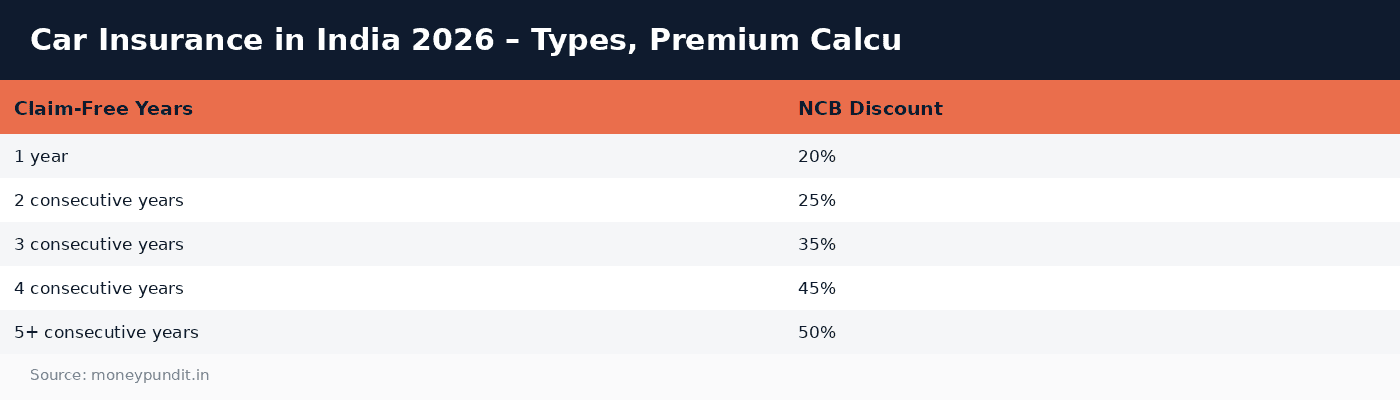
| Claim-Free Years | NCB Discount |
|---|---|
| 1 year | 20% |
| 2 consecutive years | 25% |
| 3 consecutive years | 35% |
| 4 consecutive years | 45% |
| 5+ consecutive years | 50% |
NCB is a powerful discount that rewards claim-free driving. After 5 claim-free years, your own-damage premium is effectively halved. NCB belongs to the insured person, not the vehicle, you can transfer your NCB to a new car or even a new insurer. Making small claims can reset your NCB, costing you more in future premiums than the claim amount. Consider paying minor repairs (under ₹10,000-₹15,000) yourself to preserve your NCB.
Important Add-On Covers
Zero Depreciation / Nil Depreciation
In standard claims, the insurer deducts depreciation on replaced parts, rubber (50%), plastic (30-50%), glass (Nil), metal (Nil for first claim). With zero depreciation add-on, you get the full cost of parts without depreciation deduction. This is highly recommended for cars under 5 years old, as it can save ₹15,000-₹50,000 per claim on part replacement costs.
Return to Invoice (RTI)
In case of total loss or theft, standard insurance pays only the IDV (depreciated value). RTI cover pays the full invoice/showroom price, covering the gap between IDV and what you actually paid. Essential for new cars in the first 2-3 years when the IDV drops significantly while the loan outstanding may still be high.
Engine Protection
Standard policies do not cover engine damage from water ingression (hydrostatic lock) or oil leakage. If you live in flood-prone areas or drive through waterlogged roads during monsoons, engine protection add-on covers repair or replacement costs that can run ₹50,000-₹3 lakh depending on the car.
Roadside Assistance
Covers towing charges, on-spot repairs, flat tyre assistance, battery jump-start, and emergency fuel delivery. Useful if you drive long distances or live in areas with limited mechanic access. The annual cost is typically ₹500-₹1,500, much less than a single towing bill.
How to File a Car Insurance Claim
Step 1: Inform Your Insurer Immediately
Report the incident to your insurer within 24-48 hours. Most insurers have 24/7 helplines and mobile app-based claim registration. Provide details of the incident, location, and extent of damage. For theft or accidents involving injury, also file an FIR with the police.
Step 2: Document the Damage
Take detailed photographs and videos of the damage from multiple angles before moving the vehicle. Collect the other party’s details in case of a collision. Preserve all evidence, dashcam footage is increasingly valuable for claim settlement.
Step 3: Choose Cashless or Reimbursement
At a network garage (insurer’s empanelled workshop), you get cashless repairs, the insurer pays the garage directly. At a non-network garage, you pay upfront and claim reimbursement later. Cashless claims are more convenient but limited to network garages. Reimbursement claims give you freedom to choose any workshop but involve paperwork and waiting for settlement.
Frequently Asked Questions
Can I buy car insurance from any company even if my loan is with a specific bank?
Yes, you are free to buy insurance from any IRDA-registered insurer regardless of your car loan provider. Banks often push their partner insurers, but you have no obligation to comply. Compare quotes from multiple insurers to get the best deal. Just ensure the hypothecation clause (bank’s name as financier) is mentioned in the policy.
What is not covered by car insurance?
Common exclusions include: damage due to drunk driving, using the car for racing or illegal activities, normal wear and tear, mechanical or electrical breakdown, consequential losses, damage outside India, and damage to tyres and tubes (unless the car is also damaged). Using the vehicle for a purpose not mentioned in the policy (like commercial use on a private vehicle policy) also voids coverage.
Should I buy insurance online or through an agent?
Online car insurance is typically 5-15% cheaper than agent-sold policies because it eliminates agent commission. The coverage is identical. Online comparison platforms like PolicyBazaar, Coverfox, and InsuranceDekho allow you to compare quotes from 10+ insurers in minutes. The only advantage of an agent is personal assistance during claim processing, which most insurers now offer through their apps and helplines anyway.
Can I transfer my car insurance to the new owner when I sell my car?
Yes, car insurance can be transferred to the new owner within 14 days of the sale by submitting a transfer request to the insurer along with the sale deed, new owner’s documents, and RC transfer proof. The NCB belongs to you and does not transfer. You can carry it to your next car’s policy.
References: Amfiindia.com
Car insurance: Key Takeaways
Key points on car insurance:
- Covers your legal liability for: death or bodily injury to any person, and damage to property belonging to a third party.
- IDV represents the current market value of your car and determines the maximum claim amount.
- After 5 claim-free years, your own-damage premium is effectively halved.
Verify the latest car insurance figures with IRDAI before you act.