
Credit card billing cycle in brief: Your credit card billing cycle is a period of approximately 30 days during which all transactions are recorded.
The gap between your billing cycle ending and your due date is actually an interest-free window on new purchases, but only if you pay your previous statement in full, since carrying even a small balance forward cancels that grace period entirely. Here’s how billing cycles and interest charges actually work.
Many credit card users do not fully understand how billing cycles, due dates, and interest calculations work. This lack of understanding often leads to unnecessary interest charges and financial stress. Mastering these concepts helps you use credit cards to your advantage without paying a single rupee in interest.
The Billing Cycle Explained
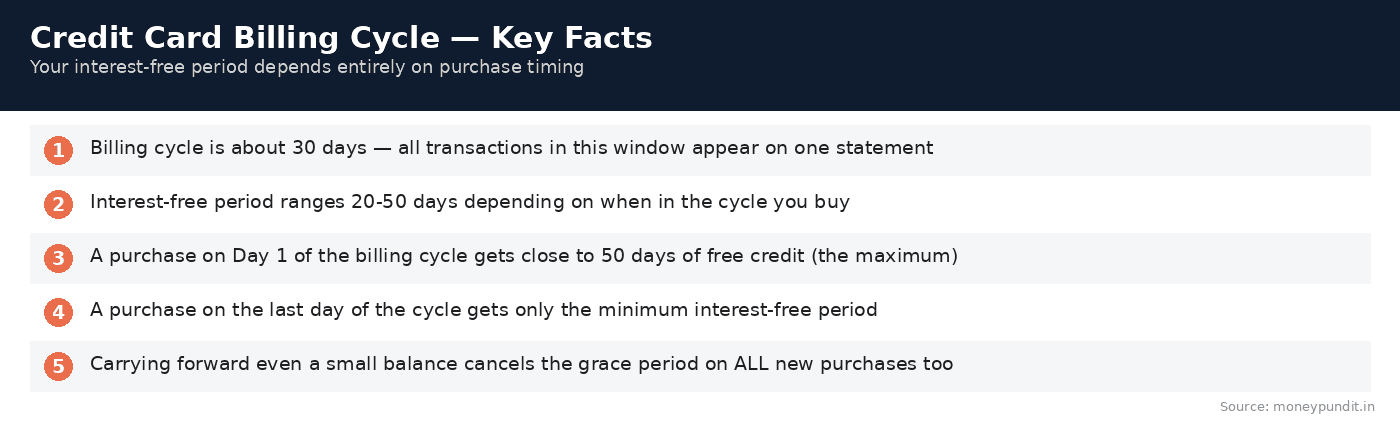
Your credit card billing cycle is a period of approximately 30 days during which all transactions are recorded. At the end of this cycle (the statement date), the bank generates your monthly statement showing all transactions, the total amount due, and the minimum amount due. For example, if your billing cycle runs from the 5th to the 4th of each month, all purchases made during this period appear on one statement.
Interest-Free Period: Your Greatest Advantage
The interest-free period is the time between your purchase date and the payment due date. It ranges from 20-50 days depending on when in the billing cycle you make the purchase. A transaction on the first day of your billing cycle gets the maximum interest-free period (about 50 days: 30 days of billing cycle + 20 days to pay). A transaction on the last day gets only the minimum (about 20 days). Smart spenders time large purchases for just after the statement date to maximize this free credit period.
How Interest is Calculated
Credit card interest in India is typically 3-3.5% per month (36-42% annually), calculated on a daily basis from the date of each transaction. The critical rule: if you do not pay the full statement amount by the due date, you lose the interest-free period on ALL transactions, including new ones. Even paying 99% of the bill triggers interest on the entire amount from the original transaction dates. This is why partial payment is a trap.
Minimum Amount Due: The Debt Trap
The minimum due is typically 5% of the outstanding amount or ₹200, whichever is higher. Paying only this minimum avoids late payment fees and protects your credit score from a missed payment mark. However, interest accrues on the remaining 95% at 3.5% per month. A ₹1,00,000 balance paid at minimum due would take over 10 years to clear and cost over ₹2,50,000 in interest alone. Always pay in full.
Late Payment Consequences
Missing the due date entirely results in a late payment fee (₹100-₹1,300 depending on the amount), a negative mark on your CIBIL report lasting 2-3 years, loss of interest-free period for current and next billing cycles, and potential reduction in credit limit. Set up auto-debit for at least the minimum amount as a safety net, but aim for full payment every month.
What if I cannot pay the full bill this month?
Pay as much as you can above the minimum due. Consider converting the balance to EMI at 12-18% annual interest, much lower than the 36-42% revolving credit rate. Contact your bank for hardship options if this becomes a recurring issue.
How the Billing Cycle Works
Your credit card billing cycle is typically 30 days, during which all transactions are accumulated into a single statement. The statement generation date (also called billing date) is when the bank tallies all charges and creates your monthly statement. The payment due date is usually 15-20 days after the statement date. Transactions made between two statement dates form one billing period, understanding this timing helps you maximise your interest-free period.
For example, if your statement date is the 5th of each month and due date is the 25th: a purchase on June 6th (just after the statement) won’t appear on your bill until July 5th, with payment due July 25th, giving you nearly 50 days of interest-free credit. The same purchase on July 4th (just before the statement) appears on the July 5th bill due July 25th, only 21 days interest-free. Strategic timing of large purchases just after your statement date maximises free credit.
Interest Charges: The Minimum Due Trap
If you pay the full statement balance by the due date, you pay zero interest, the entire interest-free period applies. If you pay even ₹1 less than the full amount, interest is charged on the ENTIRE outstanding balance from the transaction date (not the due date) at 36-42% annual rate. This is the most expensive consumer debt in India.
The minimum due (typically 5% of outstanding or ₹200, whichever is higher) is a trap designed to keep you in debt while avoiding late payment fees. On a ₹50,000 balance paying only minimum due: you’d take over 8 years to clear the debt and pay approximately ₹75,000 in interest, 150% of the original spending. Always pay the full balance. If you’re unable to, consider a balance transfer to a lower-rate card or a personal loan (10-14% APR) to replace 36-42% credit card debt.
Managing Multiple Credit Cards
With multiple cards, track each card’s billing date and due date separately, a missed payment on any card hurts your CIBIL score. Set up auto-pay for the full amount on each card to eliminate the risk of missed payments. If auto-pay for the full amount feels risky (worried about insufficient bank balance), set auto-pay for minimum due as a safety net while manually paying the full amount before the due date.
Monitor your total credit utilisation across all cards: keep it below 30% combined. If your total credit limit across cards is ₹5 lakh, keep total outstanding below ₹1.5 lakh at any point. Review each card’s statement for unauthorised charges within 3 days of statement generation, early detection of fraud ensures zero liability under RBI’s customer protection guidelines. For a comprehensive understanding of credit card usage, read our guide on credit card EMI charges and how to use credit cards as a financial tool rather than a debt trap.
References: Rbi.org.in
Source: rbi.org.in
Compare: credit card charges India 2026: interest rates and late fees by bank for bank-wise late fee and interest comparisons.
Credit card billing cycle: Key Takeaways
Key points on credit card billing cycle:
- At the end of this cycle (the statement date), the bank generates your monthly statement showing all transactions, the total amount due, and the minimum amount due.
- The interest-free period is the time between your purchase date and the payment due date.
- Credit card interest in India is typically 3-3.5% per month (36-42% annually), calculated on a daily basis from the date of each transaction.
Verify the latest credit card billing cycle figures with RBI before you act.